Why "30 Days From Today" and "1 Month From Today" Are Not the Same Date

You set a reminder for "30 days from today." Your friend sets one for "1 month from today." You both expected the same date — but the phones show different days. That small gap is the difference between 30 days and 1 month, and it trips up renters, freelancers, payroll teams, and even attorneys every year.
The confusion is not your fault. English treats "month" as if it always equals 30 days, but the Gregorian calendar disagrees. Before you trust a date in your head, it helps to know exactly when the two values match — and when they drift apart by one, two, or even three days.
Is 30 days the same as a month?
No. Thirty days is a fixed count, but a calendar month is 28, 29, 30, or 31 days depending on the month and year. The difference between 30 days and 1 month is usually one to three days. Only April, June, September, and November contain exactly 30 days, so the two values match in just four months out of twelve.
The core difference: calendar months vs. fixed day counts
A "day" is a constant unit — 24 hours, 1,440 minutes. A "month" is a variable unit set by the Gregorian calendar, which the United States and most of the world have used since 1752.
When you say "30 days from today," you are counting exactly 30 sunrises. When you say "1 month from today," you are jumping to the same date number in the next named month. Those are two completely different operations.
The four month lengths used today are 28, 29, 30, and 31 days. As of 2026, the U.S. Naval Observatory still maintains the official civil time standard that anchors these counts. Because most months have 31 days (seven of them), "one month" is usually longer than 30 days, not shorter.
60-second video explainer
Watching is faster than reading. This short visual walks through the two date operations side by side, highlights the leap-year twist, and ends with the one rule that fixes 90% of confusion.
60-second explainer · Silent visual · Produced by MulcliCalculator
The simple date-math formula (and where it breaks)
Here is the conceptual rule most date software uses behind the scenes:
NewDate = (SameDayNumber) in (Month + N) // "months" mode
If SameDayNumber > LastDayOfNewMonth → use LastDayOfNewMonth
- StartDate — the date you are counting from.
- N — the number of days or months you are adding.
- SameDayNumber — the day-of-month digit, like the "31" in January 31.
- LastDayOfNewMonth — 28, 29, 30, or 31 in the target month.
The formula works perfectly when your start date is the 1st through the 28th of any month. It breaks for the 29th, 30th, and 31st whenever the next month is shorter, because the "same date" simply does not exist.
Real-world example: January 31 + 1 month = ?
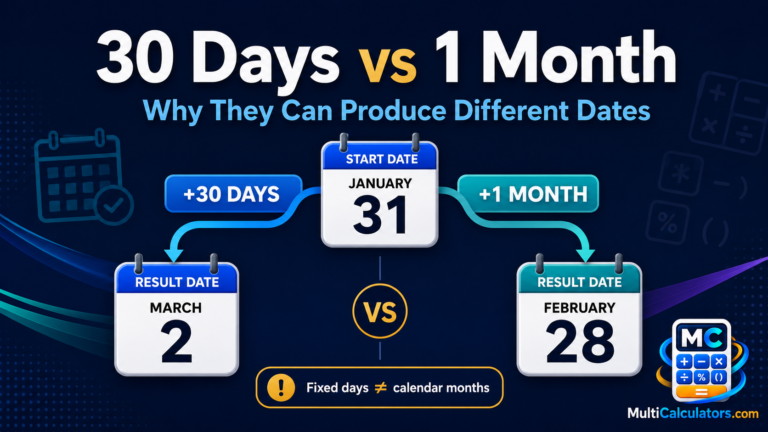
Take January 31, 2026. Add 30 days and you land on March 2, 2026, because February 2026 has 28 days. Add "1 month" instead and most systems return February 28, 2026, since February has no 31st.
That is a two-day gap from one phrase change. If January 31 is a payment-due date, you could miss a deadline or pay early without realizing it. The same logic applies to medication refills, free-trial expirations, and 1099 filing windows.
Step-by-step: count both values without a calculator
Use this short routine whenever you need to verify a deadline by hand. It works for any start date in the Gregorian calendar.
- Write down your start date. Note the day, month, and year clearly — for example, January 31, 2026.
- For "+30 days": subtract the start day from the days remaining in the current month, then carry the leftover into the next month or two until you reach 30.
- For "+1 month": keep the day number the same and move to the next month's name. If that day does not exist (like Feb 31), roll back to the last valid day of that month.
- Check for February or a leap year. If your count crosses February, confirm whether the year is divisible by 4 (and not a non-400 century year).
- Compare both end dates. The gap should be 0–3 days. If it is larger, you miscounted somewhere — usually by including or excluding the start date.
Why your results differ across tools
Two date calculators can show different answers for the same question. The reason is rarely a bug — it is a difference in assumptions.
Manual calculation
When you count on your fingers, you usually skip whether the start date itself counts as "day 0" or "day 1." That single decision flips your result by one day. Most legal counts treat the start date as day 0, but most everyday speech treats it as day 1.
Calculator logic
A good date calculator applies an explicit rule for the end-of-month case: roll back to the last valid day, roll forward to the 1st of the next month, or throw an error. Different tools choose different rules, which is why the same input can return different outputs.
AI-generated estimates
Large language models often default to "1 month = 30 days." They get the simple cases right but miss leap years and end-of-month rollovers. As of 2026, AI tools still struggle with February edge cases unless you explicitly ask them to apply Gregorian calendar rules.
Infographic: the 30-day vs. 1-month mismatch map
The chart below pulls the key data into one shareable visual. Save it, pin it, or send it to anyone who insists a month is always 30 days.

Edge cases & failure scenarios
- Your start date is the 29th, 30th, or 31st. The "same date" may not exist next month, forcing a rollback to the last valid day.
- You are crossing February in a non-leap year. The 28-day month adds two to three extra days of drift compared with 30-day counts.
- You are counting business days, not calendar days. Weekends and federal holidays (per the Office of Personnel Management calendar) will shift your real deadline.
- The contract uses "month" but state law reads it as "30 days." Some jurisdictions override the plain reading.
- You cross a daylight-saving boundary near midnight. Rare, but it can flip a deadline timestamped to the second.
When contracts say "30 days" vs. "one month"
In US contract law, "30 days" is a fixed-count term and "one month" is generally read as a calendar month. According to the Cornell Legal Information Institute, courts default to the calendar-month reading unless the contract clearly defines the term differently.
Consider Maria, a freelance designer. Her client agreement says payment is due "within 30 days of invoice." She invoices on January 31, 2026. Her client must pay by March 2, 2026 — not February 28. Maria assumed the deadline was the end of February and almost missed late-fee eligibility.
Now consider David, a tenant whose lease says rent is due "on the same day of each month." His lease started January 31. February has no 31st, so rent is due February 28. He assumed he had until March 2 and was charged a late fee.
| Start date | + 30 days | + 1 month | Gap |
|---|---|---|---|
| January 15, 2026 | February 14, 2026 | February 15, 2026 | 1 day |
| January 31, 2026 | March 2, 2026 | February 28, 2026 | 2 days |
| March 31, 2026 | April 30, 2026 | April 30, 2026 | 0 days |
| July 15, 2026 | August 14, 2026 | August 15, 2026 | 1 day |
| December 31, 2026 | January 30, 2027 | January 31, 2027 | 1 day |
Lease agreements and the 30-day myth
Most US residential leases use "30 days written notice" instead of "one month." The reason is precision. The U.S. Department of Housing and Urban Development (HUD) recommends fixed-day notice periods in its model lease guidance because they remove calendar ambiguity.
A "30-day notice" gives both landlord and tenant a single, countable deadline. A "one-month notice" can shift by three days depending on when in the year you send it. For a tenant moving out, those three days can mean an extra prorated rent charge.
If your lease says "one month notice," count from the date you deliver written notice to the same calendar date in the next month. If it says "30 days," count exactly 30 sunrises forward, start date excluded.
The February problem: why month math breaks in winter
February is the shortest month, so it warps every monthly count that crosses it. In a common year (28 days), adding 30 days to any late-January date pushes you two days into March. In a leap year (29 days), the drift shrinks to one day.
Leap years follow a rule set in the Gregorian calendar reform of 1582: every year divisible by 4 is a leap year, except century years that are not divisible by 400. So 2000 was a leap year, 2100 will not be, and 2024 was the most recent one. The next leap year after 2026 is 2028.
This is why financial firms often standardize on "30/360" day-count conventions for interest math — to neutralize February entirely. The Securities and Exchange Commission (SEC) accepts both 30/360 and actual-day conventions in bond disclosures, but only if the chosen method is clearly stated.
Common mistakes and myths
- Myth: A month is always 30 days. Reality: Only four months (April, June, September, November) have exactly 30 days. Seven have 31. February has 28 or 29.
- Myth: "30 days from January 31" lands in February. Reality: It lands on March 2 in a common year and March 1 in a leap year.
- Myth: "One month" in a contract always means 30 days. Reality: US courts usually read it as a calendar month unless the contract redefines it.
- Myth: Leap years happen every four years, no exceptions. Reality: Century years are skipped unless divisible by 400 — so 1900 was not a leap year, but 2000 was.
- Myth: Date calculators always agree. Reality: They differ based on whether the start date counts as day 0 or day 1 and how they handle missing dates.
What date professionals actually check
When you enter a start date and get an end date, here is what is actually happening behind the scenes — and what experienced paralegals, payroll clerks, and contract managers verify before they trust the result.
First, they confirm the day-count convention. Is the tool using "actual/actual" (real calendar days), "30/360" (financial standard), or "actual/365" (common in bonds)? Each produces a different answer for the same input. The International Swaps and Derivatives Association (ISDA) publishes the formal definitions used across global finance.
Second, they check the end-of-month rule. Does the system roll January 31 + 1 month to February 28, or does it advance to March 3? Modern spreadsheet functions like Excel's EDATE and EOMONTH use the rollback rule, but custom scripts may not.
Third, they confirm whether the start date is inclusive or exclusive. In US federal civil procedure (Rule 6(a)), the day of the event is excluded and the last day is included. Plain English usage often does the opposite.
When to use a date calculator instead of mental math
Counting days in your head works for short, simple spans. It breaks down fast when you cross February, deal with end-of-month dates, or need a deadline that lines up with a legal definition.
If you need an exact date and not a guess, run the question through the date calculator on MulcliCalculator. It applies the Gregorian rules, handles leap years, and lets you switch between "add days" and "add months" so you can see the gap for yourself. That visual comparison is the fastest way to settle any "30 days or one month?" argument.
Frequently asked questions
Is 30 days the same as a month?
No. Thirty days is a fixed count, but a calendar month can be 28, 29, 30, or 31 days. Only April, June, September, and November have exactly 30 days. So "30 days from today" and "1 month from today" usually land on different dates by one to three days.
Does a month always mean 30 days in a contract?
Not automatically. Most US courts read "one month" as a calendar month unless the contract specifically says "30 days." If the contract uses "30 days," you count thirty actual days. If it uses "one month," you jump to the same date number in the next month.
What happens if the next month does not have my date?
If you add one month to January 31, the next month (February) has no 31st. Most legal and software rules then roll the date to the last day of February, which is the 28th or 29th. This is called the "end-of-month rule" and it is the standard in Excel and most date libraries.
Why do landlords give 30 days notice instead of one month?
Many state laws require "30 days written notice" as a fixed, countable period. This avoids confusion when the lease starts mid-month. A 30-day count gives both parties an exact deadline, while "one month" can shift depending on which month you are in.
How many days are in February for date math?
February has 28 days in a common year and 29 days in a leap year. Leap years happen every four years, except century years not divisible by 400. So 2024 had 29 days, 2025 has 28, and 2026 has 28. This is why winter month math often surprises people.
Which is longer: 30 days or 1 month?
It depends on the month. One month is longer than 30 days in January, March, May, July, August, October, and December (31 days each). One month is shorter than 30 days in February (28 or 29 days). The two match only in April, June, September, and November.
How do I count 30 days from today correctly?
Start with tomorrow as day 1, then count thirty calendar days forward, including weekends and holidays. The day you start does not count. For exact results without finger-counting, use a dedicated tool that handles leap years and end-of-month rules automatically.
Author

Shakeel Muzaffar is the Founder and Editor-in-Chief of MultiCalculators.com, bringing over 15 years of experience in digital publishing, product strategy, and online tool development. He leads the platform's editorial vision, ensuring every calculator meets strict standards for accuracy, usability, and real-world value. Shakeel personally oversees content quality, formula verification workflows, and the platform's commitment to publishing tools that are genuinely useful for students, professionals, and everyday users worldwide.