Did you know that the differences in decades, such as when they start, often confound people? This is partly due to how our calendars handle the transition from one period to the next. The question, “when does a decade start: 2020 or 2021?” reflects a larger debate hinging on named decades versus strict calendar counting. Understanding these differences can clarify why both years have their claim to starting a decade. This article dives into the topic, providing insights and historical context for a clearer understanding.
Key Takeaways
- Named decades like the 2020s start in years ending in 0.
- Strict calendar decades begin in years ending in 1.
- The no year zero issue originates from how the Anno Domini (AD) calendar was constructed.
- Astronomers use a year zero for precise calculations.
- Expect the same debate in upcoming years like 2030 vs. 2031.
When Does a Decade Start: 2020 or 2021?
Named Decade vs. Counted Decade
The decade debate stems from two ways of counting years. Named decades, such as “the 2020s,” begin with years ending in zero, aligning with cultural references and common usage. Meanwhile, counted decades, starting with a one, follow a strict calendar method based on how the Gregorian calendar was structured.
The Impact of No Year Zero
The Gregorian calendar and its predecessor, the Julian calendar, lack a year zero. This means the Common Era (CE) begins from year AD 1, not AD 0. This absence has led to the current off-by-one counting issue we face today.
| Decade Type | Start Year | End Year |
|---|---|---|
| Named Decade (e.g., 2020s) | 2020 | 2029 |
| Counted Decade | 2021 | 2030 |
Popular Understanding: The 2020s and Cultural Influence
Why Most People Say 2020
For most, a new decade is associated with the change in the tens digit. This makes 2020 easy to label as the start of the 2020s. The shift in a decade is a cultural milestone marked by events and trends, creating a collective recognition of time periods.
Decades in Pop Culture
The influence of pop culture has reinforced beginning decades with the number ending in zero. When people talk about the swinging ’60s or the tech-booming ’90s, they think of ten-year stretches starting with decades like 1960–1969 or 1990–1999. Such influences shape how we refer to time spans in day-to-day dialogue.
The Mathematical Perspective: Counting from Year 1
Starting from AD 1
According to strict calendar counting, decades start in years ending with a one. This method reflects our CE calendar system, where the first year was AD 1. As a result, such decades run from 1 to 0, not 0 to 9.
Examples of Strict Counting
Using a strict counting approach, the first decade included AD 1 through AD 10. By extension, the 202nd decade spanned 2011 to 2020, and currently, we’re in the 203rd decade, running from 2021 to 2030. This calculation honors the original structure handed down by early calendrical systems.
The Year 0 Problem and BCE/CE Systems

How Calendars Handle Year Zero
When constructing their system, early calendar makers did not include a year zero—moving straight from 1 BC to AD 1. This discontinuity complicates historical counting but is addressed in certain fields for convenience.
1 BC to AD 1 Transition
This transition involves a direct move from 1 BC to AD 1 without a year zero in between. As a result, scholars and historians generally follow this system, though it presents challenges for accurate historical reconstructions.
Differences in Astronomical Year Numbering
Astronomers and Year 0
Astronomical year numbering introduces a year zero, which proves useful when performing computer calculations. This zero streamlines math across negative and positive termini, simplifying the process of converting between different eras.
Practical Applications
Having a year zero is critical in fields requiring precise date and time calculations, such as in determining celestial events. This approach aligns with astronomical calculations rather than traditional historical timelines.
Similar Historical Debates: The Millennial Transition
2000 vs. 2001 Debate
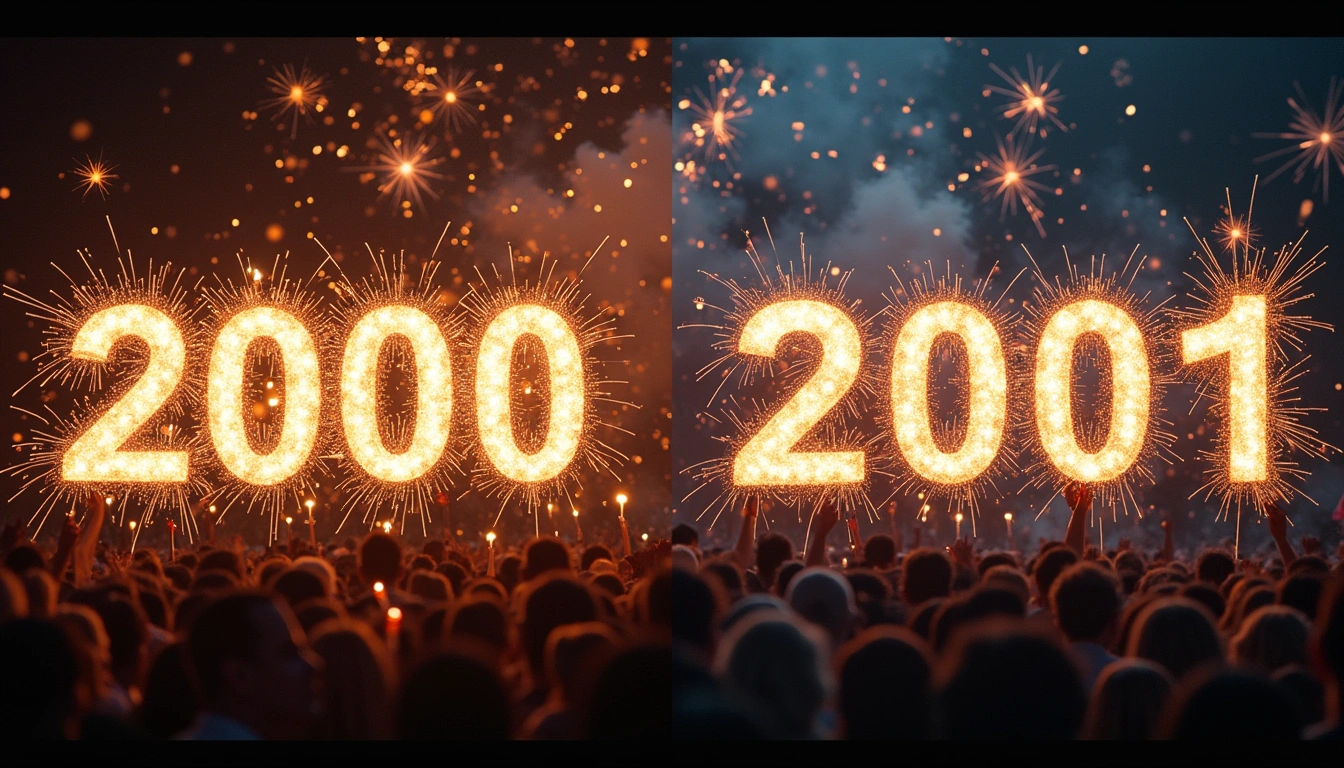
The turn of the millennium sparked a similar debate, pitting those who celebrated in 2000 against those pointing to 2001. While culturally motivated folks prefer 2000, technically, the 21st century began in 2001.
What This Means for Future Decades
This debate anticipates renewal when we discuss future shifts, such as from 2029 to 2030. Understanding these conventions will help clarify any confusion similar to past debates in the years to come.
FAQ
Does a decade start at 0 or 1?
A decade starts at 0 for named decades like the 2020s, but it starts at 1 when following strict century counting from AD 1.
When did the 2020s start?
The 2020s started on January 1, 2020, based on cultural convention rather than strict calendar counting.
Was there a year 0?
No, the Gregorian calendar, used by historians, does not have a year 0. It transitions directly from 1 BC to AD 1.
How do astronomers use year 0?
Astronomers use a year 0 to ease mathematical calculations and align their systems more comfortably across eras.
When does the 21st century start?
The 21st century technically started on January 1, 2001, following the sequence from AD 1 to AD 100 for previous centuries.
Do the 2030s begin in 2030 or 2031?
The 2030s begin in 2030 when using named decades, but under strict counting, it starts in 2031.
Why do some people say the decade started in 2021?
People believe it started in 2021 because this method follows historical counting, beginning with AD 1.
Is 2020 part of the 2010s or the 2020s?
In cultural terms, 2020 is part of the 2020s. In strict counting, it is the final year of the 2010s decade.
Final Thoughts on Decade Starts
Whether a decade starts in 2020 or 2021 depends on cultural versus technical approaches. The math behind date calculators might differ, but both interpretations have relevance. Preparing for future decades with this understanding will help clarify any confusion as we move forward.
Source Links
- Anno Domini
- Time and Date Calendars
- NIST Calendar Overview
- Britannica Calendar Concepts
- US Naval Observatory
Author

Urooj Mukhtar is the Editorial and UX Content Manager at MultiCalculators.com, where she bridges content quality with user experience. She manages editorial review workflows, content clarity standards, and on-page usability — making sure every calculator is intuitive, well-explained, and accessible to users of all backgrounds. Urooj's work ensures that complex formulas and concepts are translated into clear, friendly, and trustworthy content that helps users get accurate results with confidence.
Areas of Expertise: Editorial Review, UX Writing, Content Accessibility, Information Architecture, Usability Standards