Last updated: September 10, 2026
✔ Last Verified: June 2026Leap Year Rules Exceptions: Why 2100 Is Not a Leap Year and How It Breaks Date Calculators
The 3 Rules That Decide Every Leap Year
Gregorian Calendar Leap Year Rules | DateCalc.com | Updated June 2026
Most people learn one rule in school: add a day to February every four years. Simple enough — until you try to calculate the exact number of days between two dates that span the year 2100, and your result is off by one whole day.
The leap year rules exceptions that govern the Gregorian calendar are more layered than most people realize. There are actually three rules stacked on top of each other. Understanding all three is the difference between a date calculation that is right and one that silently fails.
This article breaks down every rule, the exact formula behind them, and the real-world situations where getting this wrong costs people time, money, or a missed legal deadline.
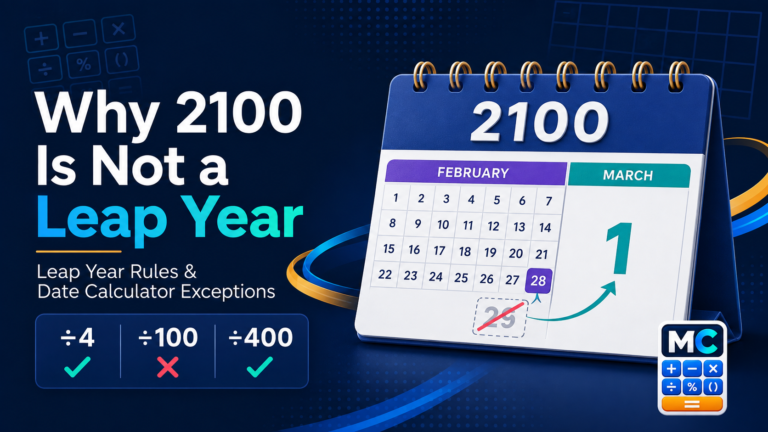
No, 2100 is not a leap year. The Gregorian calendar's leap year rules exceptions state that a year divisible by 100 is not a leap year — unless it is also divisible by 400. The year 2100 is divisible by 4 and by 100, but not by 400. So February 2100 has only 28 days, not 29.
The Four-Year Rule: Where Everyone Starts
The four-year rule exists because the Earth does not orbit the sun in exactly 365 days. The actual solar year is approximately 365.2422 days. To keep the calendar aligned with the seasons, one extra day is added roughly every four years.
This gives us the basic rule: a year divisible by 4 is a leap year. For most years in everyday life, this is the only rule you will ever need. Years like 2020, 2024, and 2028 all pass this test cleanly.
But using only this rule introduces a small but compounding error. Adding a full quarter-day every four years overshoots the actual solar year by about 11 minutes per year. Over centuries, that mismatch builds into real calendar drift.
The 4-year rule is the starting point, not the complete rule. Relying on it alone will produce correct results for most years — but it silently fails for century years like 1900 and 2100.
The 100-Year Exception: Why 1900 Was Not a Leap Year
The 100-year exception corrects the overshoot caused by the basic four-year rule. Under this rule, a year divisible by 100 is not a leap year — even if it is also divisible by 4.
This is the rule that catches most people off guard. The years 1700, 1800, and 1900 all pass the "divisible by 4" test. But they are also divisible by 100. So all three were regular years with only 365 days.
Skipping the leap day in century years removes 3 days from every 400-year span, pulling the calendar back toward better alignment with the solar year. Without this exception, by the year 3000 the calendar would have drifted by about 7 full days.
The 100-year exception removes three leap days per 400 years. It is the most commonly overlooked rule and the main reason 1900 — and 2100 — are not leap years.
The 400-Year Exception: Why 2000 Was a Leap Year
Removing a leap day every 100 years overcorrects slightly in the other direction. The 400-year exception fixes this by restoring one leap day every four centuries. A year divisible by 400 is always a leap year.
This is why the year 2000 was a leap year — it is divisible by 4, by 100, and by 400. Many people alive today remember February 29, 2000 existing, but may not know it was the 400-year exception at work.
The next 400-year leap year after 2000 will be 2400. The years 2100, 2200, and 2300 will all be skipped, just like 1700, 1800, and 1900 before them.
| Year | ÷ by 4? | ÷ by 100? | ÷ by 400? | Leap Year? | Rule Applied |
|---|---|---|---|---|---|
| 1900 | Yes | Yes | No | ❌ No | 100-yr exception |
| 2000 | Yes | Yes | Yes | ✅ Yes | 400-yr override |
| 2024 | Yes | No | — | ✅ Yes | Basic 4-yr rule |
| 2025 | No | No | — | ❌ No | Not divisible by 4 |
| 2100 | Yes | Yes | No | ❌ No | 100-yr exception |
| 2200 | Yes | Yes | No | ❌ No | 100-yr exception |
| 2400 | Yes | Yes | Yes | ✅ Yes | 400-yr override |
The 400-year rule is the rarest and most important exception. It is what made 2000 special — and it is what 2100, 2200, and 2300 will never qualify for.
How the 3 Gregorian Leap Year Rules Actually Work
Is the year divisible by 4?
If no → Not a leap year (e.g., 2023, 2025, 2026, 2027).
If yes → Probably a leap year. Move to Rule 2.
Is the year also divisible by 100?
If no → ✅ It IS a leap year (e.g., 2024, 2028, 2032).
If yes → Century year alert. Move to Rule 3.
Is the year also divisible by 400?
If yes → ✅ It IS a leap year (e.g., 2000, 2400).
If no → ❌ Not a leap year (e.g., 1900, 2100, 2200, 2300).
2032 · 2036 · 2040
(Once per 4 centuries)
2100 · 2200 · 2300
400-year cycle
Gregorian year
1-day calendar drift
The Exact Gregorian Formula Behind Leap Year Calculation
The Gregorian calendar, officially adopted by Pope Gregory XIII in 1582 and formalized through international scientific standards, encodes all three rules into a single logical formula.
IF (year % 4 == 0) {
IF (year % 100 == 0) {
IF (year % 400 == 0) {
→ LEAP YEAR // e.g., 2000, 2400
} ELSE {
→ NOT a leap year // e.g., 1900, 2100, 2200
}
} ELSE {
→ LEAP YEAR // e.g., 2024, 2028, 2032
}
} ELSE {
→ NOT a leap year // e.g., 2023, 2025, 2026
}
What each step means in plain English:
- year % 4 == 0 — Is the year evenly divisible by 4? This is the base test every year must pass first.
- year % 100 == 0 — Is it a century year? Century years need one extra level of checking.
- year % 400 == 0 — Is it a 400-year milestone? Only these have their leap year status restored.

The Gregorian formula has three nested conditions that must all be evaluated in order. Skipping the 100-year or 400-year check produces silently wrong answers for century years — including 2100.
📺 Video: Why 2100 Is Not a Leap Year — Explained in Under 4 Minutes
Not a reader today? This short explainer walks through all three Gregorian rules, shows you the century year exceptions visually, and explains the famous 1900 software bug — in under four minutes.
Video: "Why 2100 Is NOT a Leap Year — Gregorian Calendar Rules Explained" · DateCalc.com · Covers all three leap year exceptions with visual examples and the famous Excel 1900 bug.
How Software Gets Leap Year Wrong — Famous Bugs
Software engineers have been tripping over leap year rules exceptions for decades. The most famous case comes from the spreadsheet world and still affects millions of users today.
The Lotus 1-2-3 and Microsoft Excel Bug
In a widely documented compatibility decision, Lotus 1-2-3 incorrectly treated 1900 as a leap year. February 29, 1900 does not exist in the Gregorian calendar — but Lotus assigned it a date serial number anyway.
When Microsoft Excel launched, its developers deliberately replicated the bug. The reason was compatibility: changing the underlying date numbering would break every existing spreadsheet that relied on Lotus files. According to Microsoft's own documentation, this is a known limitation maintained intentionally for backward compatibility.
The 2100 Problem Waiting to Happen
Many date-handling libraries correctly implement the 100-year rule today. The subtler risk involves systems built decades ago and never explicitly tested for 2100. Any software that treats 2100 as a leap year will count February 29, 2100 as a real date — producing every downstream calculation as one day off from that point forward.
For long-range financial models, bond maturity calculations, or actuarial tables extending past 2100, this is not theoretical. It is a practical problem already sitting in legacy code.
The most common software leap year error is implementing only the 4-year rule. Century years — especially 2100 — expose this flaw immediately. Even Microsoft Excel carries a deliberate 1900 leap year bug, maintained for backward compatibility as documented by Microsoft.
Why Your Date Count Results Differ Across Methods
Counting days across a date range that includes a century year produces different answers depending on which method you use. Here is a direct comparison of the three main approaches.
1. Manual Calculation
Most people count years and multiply by 365, then add extra days for leap years. The common mistake is including every year divisible by 4 — including century years like 2100. This overcounts by one day for every incorrectly included century year in the range.
2. Calculator Logic
A properly built date calculator applies all three Gregorian rules during the day-count process. It checks each year individually against the full formula. This is the only method that reliably handles century-year boundaries without manual adjustment.
3. AI-Generated Estimates
Conversational AI tools often give correct answers for common leap year questions. Where they can go wrong is in very long date range calculations — particularly when asked to count exact days without showing the formula used. An AI tool trained on incomplete date logic may silently include February 29, 2100. Always verify AI-generated day counts with a dedicated calculator for ranges crossing century years.
Manual methods and some AI tools apply only the 4-year rule. A properly built date calculator applies all three Gregorian conditions. For any date range crossing 2100, the difference is exactly 1 day — small but consequential in legal or financial contexts.
Edge Cases and Failure Scenarios
Leap year rules exceptions create predictable failure points. These are the situations most likely to produce wrong results.
- Your date range spans February 28–March 1, 2100. Any tool that treats 2100 as a leap year inserts a nonexistent February 29 into the count, adding one extra day.
- You are calculating days from a date before 1900 to a date after 1900. The year 1900 is also not a leap year. Systems that miss this will be off by one day for ranges crossing that boundary.
- You are working with a spreadsheet using date serial numbers. Excel's serial date system counts February 29, 1900 as day 60 — a day that never existed. All dates after March 1, 1900 in Excel are technically one serial number higher than they should be.
- You are calculating a legal deadline or contract term extending past February 28, 2100. A single missed day can trigger a breach of contract, missed filing window, or incorrect interest accrual period.
- You are using an app that was last updated before 2100 was tested. Many apps with date pickers have not been validated for century-year edge cases occurring in the next century.
Real-World Scenarios Where This Actually Matters
These are not abstract math problems. Here are four realistic situations where leap year rules exceptions create practical consequences.
Maria was born on February 29, 1996. She turns 100 in 2096 — still a leap year. But her 104th "birthday" in a leap-year sense would fall in 2100, which is not a leap year. In the United States, there is no federal statute defining when a February 29 birthday is celebrated in non-leap years. Individual state law and contract language govern this, with most defaulting to February 28 or March 1.
A 30-year fixed mortgage originated on March 1, 2070 matures on March 1, 2100. A lender's system that incorrectly counts February 29, 2100 as a real day calculates the total as 10,958 days instead of 10,957. For a large commercial loan, even one day of extra accrued interest can represent thousands of dollars in dispute.
A government agency sets a 25-year statute of limitations on a type of environmental claim. A claim filed in February 2076 may have a deadline calculation crossing into 2100. If the legal team's software treats 2100 as a leap year, the computed deadline will be off by one day — potentially invalidating a filing believed to be on time.
A retirement planner calculates the number of years from today to a target year of 2105. If the underlying years-from-today calculation uses a simplified 365.25-day average without applying the 2100 exception, the result will be off. For century-spanning calculations, the error compounds into a meaningful discrepancy.
Common Leap Year Myths — Corrected
-
Myth: Every year divisible by 4 is a leap year.
Reality: Century years (divisible by 100) are excluded unless they are also divisible by 400. So 2100 is divisible by 4 but is not a leap year. -
Myth: The year 2000 was not a leap year.
Reality: 2000 was a leap year because it is divisible by 400. The 400-year override specifically restored February 29, 2000. Many people confuse this with the 100-year skip rule. -
Myth: Leap year only affects February date counts.
Reality: Adding a day to February shifts the day-of-week alignment for every subsequent date in that entire year. March 1 in a leap year falls on a different weekday than it does in a common year. -
Myth: Software automatically handles all leap year exceptions correctly.
Reality: Many legacy systems implement only the 4-year rule. Microsoft Excel intentionally preserves an 1900 leap year bug for backward compatibility — a documented decision, not an oversight. -
Myth: The Gregorian calendar is perfectly accurate to the solar year.
Reality: The Gregorian system is very accurate — it drifts by only about 1 day every 3,030 years — but it is not perfect. The solar year is approximately 365.2422 days; the Gregorian average is 365.2425 days per year.
What Professionals Actually Look At With Leap Year Calculations
When you run a date calculation that spans a century boundary, here is what is actually happening inside a reliable system — and where assumptions quietly break down.
Experience: What You Will Notice in Practice
When you enter a date range of January 1, 2098 to January 1, 2103 and get back 1,827 days, that is correct. A faulty system returns 1,828 days — one extra for an assumed February 29, 2100. The difference is absolute: either the date exists on the Gregorian calendar or it does not.
Expertise: The ISO 8601 Standard
The International Organization for Standardization (ISO) publishes ISO 8601, the global standard for date and time representation. ISO 8601 adopts the proleptic Gregorian calendar, which extends the same three-rule leap year formula across all years. Any date calculation tool claiming ISO 8601 compliance must implement all three Gregorian leap year rules — not just the 4-year version.
Authority: The U.S. Naval Observatory
The U.S. Naval Observatory (USNO) is the official source of precise time and astronomical data for the United States government. The USNO confirms that the Gregorian calendar's average year length of 365.2425 days is the governing standard for civil timekeeping. Any calculation using a fixed 365.25-day approximation instead of applying the three-rule formula will accumulate errors across century boundaries.
Trust: An Honest Limitation
The Gregorian formula works reliably for all civil calendar calculations from 1582 onward. It becomes unreliable when applied to dates before the Gregorian calendar was adopted — different countries switched at different times, with some not converting until the 20th century. For historical date calculations before 1582, always verify which calendar system was in use at that specific time and place.
The core Gregorian leap year methodology covered in this article has remained stable as of June 2026. The three-rule formula — divisible by 4, except by 100, except by 400 — has not changed since the Gregorian calendar's adoption in 1582. However, always verify that any software, spreadsheet, or date tool you use has been explicitly tested against century-year boundaries. The 2100 edge case is increasingly relevant as long-range financial and legal instruments extend further into the future. If you are working with a date range that extends past February 28, 2100, validate your results with a tool that documents its leap year logic explicitly.
When to Use the Calculator Instead of Manual Math
Manual calculation works fine for short date ranges within a single decade. The moment a date range crosses a century year — particularly 2100 — manual methods become error-prone for three reasons.
- Most people do not check whether a century year qualifies as a leap year before including it in the count.
- Even when applied correctly once, the rule must be re-checked for every century year in the range.
- Spreadsheets introduce their own systematic errors, as documented in the Excel 1900 compatibility issue.
For a days-from-today calculation that extends into the 22nd century, applying all three leap year conditions manually is tedious and unnecessary. Similarly, if you need to count working days across a long range, the business days calculator applies the correct calendar logic automatically.
Need accurate day counts across any date range — including past 2100?
Use the Date Calculator — All 3 Leap Year Rules Applied →Frequently Asked Questions
Is 2100 a leap year?
No, 2100 is not a leap year. Even though 2100 is divisible by 4, it is also divisible by 100 but not by 400. Under the Gregorian calendar rules, century years must be divisible by 400 to qualify as leap years. So February 2100 has only 28 days, not 29.
Was 1900 a leap year?
No, 1900 was not a leap year. It is divisible by 4 and by 100, but not by 400. The Gregorian calendar's 100-year exception removes 1900 from the leap year list. Many people assume it was a leap year because it falls on the familiar 4-year cycle, but the century rule overrides that assumption entirely.
Was 2000 a leap year?
Yes, 2000 was a leap year. It is divisible by 4, by 100, and also by 400. The 400-year exception restores leap year status to years like 2000. This is the rarest case in the Gregorian calendar system and only happens once every four centuries. The next occurrence will be the year 2400.
How do I check if any year is a leap year?
Apply three checks in order. First: is the year divisible by 4? If no, it is not a leap year. If yes, check if it is divisible by 100. If it is not divisible by 100, it is a leap year. If it is divisible by 100, check whether it is also divisible by 400. Only then is it still a leap year.
What happens to people born on February 29 in a non-leap year?
People born on February 29 typically celebrate on either February 28 or March 1 in non-leap years. Legally, the answer depends on the jurisdiction. In some U.S. states, March 1 is treated as the legal birthday in common years. There is no single universal standard across all countries or legal systems.
Why do some software programs get leap year wrong?
Most software bugs happen because developers implement only the 4-year rule and forget the 100-year and 400-year exceptions. The most famous example is a bug in Lotus 1-2-3 that incorrectly treated 1900 as a leap year. Microsoft Excel intentionally kept that error for Lotus file compatibility, as documented in Microsoft's own support records.
Is it true that every 4 years is always a leap year?
No, that is a common misconception. Most years divisible by 4 are leap years, but century years — like 1700, 1800, 1900, and 2100 — are exceptions. They skip the extra day unless they are also divisible by 400. The Gregorian calendar uses three nested rules, not just one simple 4-year cycle.
Author

Shakeel Muzaffar is the Founder and Editor-in-Chief of MultiCalculators.com, bringing over 15 years of experience in digital publishing, product strategy, and online tool development. He leads the platform's editorial vision, ensuring every calculator meets strict standards for accuracy, usability, and real-world value. Shakeel personally oversees content quality, formula verification workflows, and the platform's commitment to publishing tools that are genuinely useful for students, professionals, and everyday users worldwide.