Ever wonder why one vegetable garden bursts with healthy plants while a neighbor’s turns into a tangled, disease-prone mess? The answer often comes down to one simple factor: plant spacing. Crowd your vegetables and they compete for light, water, and nutrients, and poor airflow lets disease spread fast. Get plant spacing right for your vegetable garden, and even a small bed can turn into a steady harvest.
Space plants by their mature size: leafy greens need little room, root vegetables need medium room, and sprawling plants like tomatoes need much more. To find how many plants fit, divide your bed’s area in square feet by the space one mature plant needs. A 4 ft by 8 ft bed (32 sq ft) fits about 32 compact plants at 1 sq ft each, or about 8 sprawling plants at 4 sq ft each. These are general numbers, so always check the seed packet for your exact variety.
Why Plant Spacing Matters in a Vegetable Garden
Plant spacing is not just about tidiness. It shapes plant health, harvest size, and how much time you spend fighting disease and weeds.
- Airflow and disease prevention. Crowded leaves trap moisture, and damp leaves invite fungal disease. Space plants so air moves freely and leaves dry fast after rain.
- Room for mature size. A seedling looks small on planting day, but many vegetables grow much wider. Spacing plans for the full-grown plant, not the seedling.
- Sunlight access. Plants packed too close shade each other. Less sun usually means slower growth and smaller harvests.
- Root competition. Roots spread out to find water and nutrients. Crowded roots fight over the same limited soil.
General Spacing Ranges for Common Vegetables
Exact spacing depends on the variety, so the seed packet or plant tag always has the final word. That said, most vegetables fall into three general groups.
- Leafy greens (lettuce, spinach, arugula): generally close together, often around 4 to 6 in apart in each direction.
- Root vegetables (carrots, beets, radishes): generally medium spacing, often around 2 to 4 in apart.
- Sprawling plants (tomatoes, squash, pumpkins): generally wide spacing, often 24 to 36 in or more apart.
These ranges are general guides, not fixed rules. Soil, climate, and the specific variety can shift the ideal spacing, so always check the seed packet first.
The Math Behind Plant Spacing
Once you know roughly how much room a plant needs, one simple formula estimates how many plants fit your bed.
Number of Plants = Bed Area (sq ft) / Space Needed Per Plant (sq ft)
Bed area is just length times width. Space needed per plant is the square footprint one mature plant needs, similar to the square-foot gardening method. Always round the result down to a whole plant, since you cannot plant a fraction of one.
If you would rather skip the manual math, the Grow a Garden Calculator can run these numbers for you and adjust instantly as you change bed size or spacing.
Worked Example: A 4 ft by 8 ft Raised Bed
Let’s put the formula to work with a common raised bed size, a 4 ft by 8 ft frame.
First, find the bed area: 4 ft times 8 ft equals 32 sq ft. That single number is what you divide for any crop you plan to grow.
For a compact crop grown at an illustrative 1 sq ft per plant, square-foot gardening style, the math is 32 sq ft divided by 1 sq ft, which fits about 32 plants. For a sprawling crop like squash grown at 4 sq ft per plant, the math is 32 sq ft divided by 4 sq ft, which fits about 8 plants.
These are general examples. Real spacing varies by variety, so treat the numbers as a planning starting point, then confirm with your seed packet.
| Space Per Plant | Formula | Estimated Plants |
|---|---|---|
| 1 sq ft (compact, e.g. lettuce) | 32 / 1 | About 32 plants |
| 2 sq ft (medium, e.g. bush beans) | 32 / 2 | About 16 plants |
| 4 sq ft (sprawling, e.g. squash) | 32 / 4 | About 8 plants |
Using the Square-Foot Gardening Approach
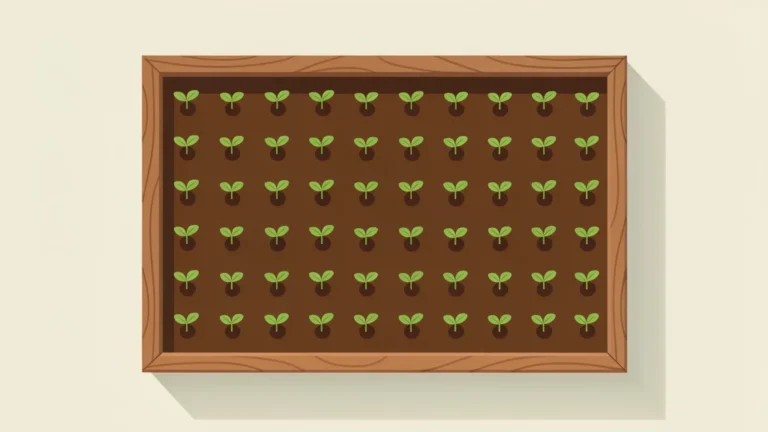
Square-foot gardening is a popular way to estimate plant spacing without measuring every inch. You divide a bed into 1 ft by 1 ft squares, then fill each square with a set number of plants based on that plant’s general size.
- 1 plant per square: sprawling crops like tomatoes, squash, and cabbage.
- 4 plants per square: medium plants like lettuce, Swiss chard, and bush beans.
- 9 plants per square: smaller plants like spinach and beets.
- 16 plants per square: tiny plants like radishes and carrots.
This is a general framework, not an exact rule. It works well as a fast way to plan a bed before you check specific spacing on the seed packet.
Adjusting for Mature Size and Reading the Seed Packet
A common mistake is spacing plants based on how big they look on planting day. Seedlings and small starts always look like they need less room than they actually will.
Instead, plan around the plant’s full-grown width. A tomato seedling is tiny, but the mature plant can spread wide and tall, so it needs the full spacing from day one.
The seed packet or plant tag is the most reliable source for exact spacing, since it reflects that specific variety. It usually lists both in-row spacing (between plants in a row) and row spacing (between rows), and both matter for airflow and access.
Growing vertically on a trellis or cage can also let some sprawling plants, like cucumbers or pole beans, use less ground space than the general guides suggest.
What This Guide Does Not Cover
This guide focuses only on plant spacing math and the reasons behind it. A few related garden topics live elsewhere on this site.
- Fertilizer needs for lawns and gardens are covered in How Much Fertilizer Does Your Lawn Need?
- Soil volume for raised beds is covered in How Much Soil for Raised Beds. Bed size affects both how much soil you need and how many plants fit, so the two guides pair well together.
Tips for Getting Plant Spacing Right
- Measure your bed’s length and width before you buy seeds or starts.
- Thin crowded seedlings early if you planted more than the spacing allows.
- Leave narrow pathways so you can reach every plant without stepping in the bed.
- Use string or small stakes as spacing markers when you plant rows.
- Recheck spacing each season, since new varieties can have different mature sizes.
Ready to plan your beds? Use our Grow a Garden Calculator to turn your bed size and spacing choices into an exact plant count.
Frequently Asked Questions About Vegetable Garden Plant Spacing
What Is the Formula for Plant Spacing in a Vegetable Garden?
The formula is Number of Plants = Bed Area (sq ft) / Space Needed Per Plant (sq ft). Find bed area by multiplying length times width, then divide by the square footprint one mature plant needs. Round the result down, since a bed cannot hold a fraction of a plant.
How Do I Calculate How Many Plants Fit In My Raised Bed?
Multiply the bed’s length by its width to get the area in square feet. Then divide that area by the space one plant needs when fully grown. A 4 ft by 8 ft bed is 32 sq ft, which fits about 32 compact plants at 1 sq ft each.
How Far Apart Should I Plant Vegetables?
It depends on the vegetable. Leafy greens generally need about 4 to 6 in, root vegetables about 2 to 4 in, and sprawling plants like tomatoes about 24 to 36 in or more. These are general ranges, so always confirm with the seed packet for your variety.
Why Does Plant Spacing Affect Disease?
Crowded plants trap moisture between their leaves, and damp leaves are a common starting point for fungal disease. Good spacing lets air move through the bed, so leaves dry faster after rain or watering, which lowers the chance of disease spreading.
What Happens If I Plant Vegetables Too Close Together?
Plants packed too close compete for sunlight, water, and nutrients, which often leads to smaller harvests. Crowding also raises the risk of disease because airflow drops. Mature plants may also struggle to grow to their full size if there is not enough room.
Can I Use Closer Spacing Than the Seed Packet Suggests?
Spacing tighter than recommended usually trades some plant health for a higher plant count, and it can lower yield per plant. Square-foot gardening does use closer spacing than traditional rows for many crops, but sprawling plants still need generous room to reach full size.
Does Plant Spacing Differ for Square Beds vs Rows?
The spacing a plant needs stays about the same, but the layout changes how you use it. Square-foot gardening spaces plants evenly in a grid within a bed, while traditional rows use in-row spacing plus wider row spacing for access and airflow.
Sources
Authoritative Sources Used in This Article
This article is for general education only, not professional landscaping or pool-service advice. Soil, climate, product concentrations, and local conditions vary, so always check product labels and consider a local expert for your specific situation. Reviewed for accuracy by Prof. Dr. Khalil Mudassar, PhD. Last updated September 13, 2026.
Author

Shakeel Muzaffar is the Founder and Editor-in-Chief of MultiCalculators.com, bringing over 15 years of experience in digital publishing, product strategy, and online tool development. He leads the platform's editorial vision, ensuring every calculator meets strict standards for accuracy, usability, and real-world value. Shakeel personally oversees content quality, formula verification workflows, and the platform's commitment to publishing tools that are genuinely useful for students, professionals, and everyday users worldwide.