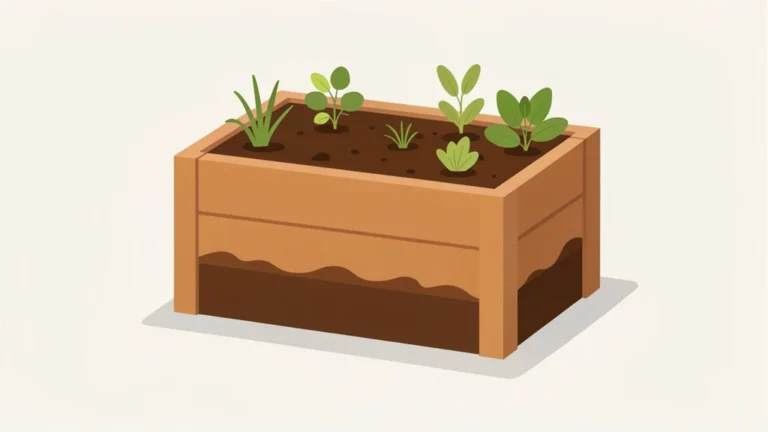
Ever fill a truck with garden soil, dump it in, and still come up short? It happens because raised bed soil is not a guess, it is a volume problem. If you want to know how much soil for raised beds your project needs, multiply the bed’s length, width, and height in feet to get cubic feet, then divide by 27 to get cubic yards. This guide walks through that formula, a full worked example, and the bag-versus-bulk math so you order the right amount the first time.
Multiply your raised bed’s length x width x height, all in feet, to get cubic feet of soil. Divide that number by 27 to convert to cubic yards, the unit bulk soil is usually sold in. A 4 ft x 8 ft bed that is 1.5 ft deep needs 48 cubic feet, or about 1.78 cubic yards. Bagged soil is measured in cubic feet, so check the bag label before you buy.
How Much Soil for Raised Beds: The Simple Formula
The math behind raised bed soil is basic geometry, not a mystery. A raised bed is shaped like a box, so you find its volume the same way you would for any box.
The formula is: Length x Width x Height = Cubic Feet of soil. Measure all three sides in feet, then multiply them together. The result tells you how many cubic feet of soil will fill the bed level to the top edge.
Bulk soil is commonly sold by the cubic yard, not the cubic foot. Take your cubic-foot total and divide by 27, since one cubic yard equals 27 cubic feet (3 ft x 3 ft x 3 ft = 27).
- Cubic Feet = Length (ft) x Width (ft) x Height (ft)
- Cubic Yards = Cubic Feet / 27
Step-by-Step: How to Measure Your Raised Bed
Good soil numbers start with good measurements. Grab a tape measure and measure the inside of the bed, not the outside edge of the lumber.
- Measure the inside length of the bed in feet.
- Measure the inside width of the bed in feet.
- Measure the inside depth, from the base to the top edge, in feet.
- Multiply length x width x height to get cubic feet.
- Divide cubic feet by 27 to get cubic yards.
If your bed has an odd shape, split it into simple rectangles. Find the volume of each piece, then add the totals together. Convert inches to feet by dividing by 12 before you multiply.
Worked Example: Filling a 4 Ft by 8 Ft Raised Bed
Say your raised bed measures 4 ft wide, 8 ft long, and 1.5 ft deep. That is a common size for a backyard vegetable bed.
Cubic feet: 4 x 8 x 1.5 = 48 cubic feet of soil.
Cubic yards: 48 / 27 = 1.78 cubic yards, rounded to two decimal places.
Most soil yards sell bulk soil in half-yard steps, so you would likely round up and order 2 cubic yards. The extra half yard covers soil that settles after the first deep watering.
Prefer bagged soil instead of bulk delivery? Check the bag label for its cubic feet. A common bag size holds 1.5 cubic feet. Divide your total by the bag size: 48 / 1.5 = 32 bags. Always confirm the exact size printed on the bag, since it varies by brand. You can also skip the manual math with our Topsoil Calculator, which multiplies and converts for you instantly.
Cubic Feet vs Cubic Yards: Why the Units Matter
Soil is sold in two different units, and mixing them up is the easiest way to order the wrong amount.
Bagged soil almost always lists its volume in cubic feet, since a bag is a small, portable amount. Bulk soil delivered by truck is priced and measured in cubic yards, a more practical size for large volumes.
Remember the conversion: 1 cubic yard equals 27 cubic feet. Multiply a cubic-yard total by 27 to see how many cubic feet that covers, or divide a cubic-foot total by 27 to see how many yards to order.
A simple way to picture it: a cubic yard of soil is roughly the size of a washing machine box, while one bag is closer to a large gym bag.
Shallow Beds vs Deep Beds: How Depth Changes the Soil You Need
Two beds with the same footprint can need very different amounts of soil, and depth is the reason why.
A shallow bed, 4 ft x 8 ft x 0.5 ft deep, needs only 16 cubic feet of soil (4 x 8 x 0.5 = 16). A deep bed with the same 4 ft x 8 ft footprint but 2 ft of depth needs 64 cubic feet (4 x 8 x 2 = 64), four times as much soil.
- Deeper beds suit root crops like carrots and potatoes, which need room to grow down.
- Shallow beds work fine for lettuce and herbs, and they cost less to fill.
Pick a depth that matches what you plan to grow before you build, since depth affects your soil budget more than length or width usually do.
What Goes into a Raised Bed Soil Mix
The volume formula tells you how much soil to buy, but raised beds usually hold a blend, not pure topsoil.
A common general mix blends topsoil with compost and an amendment such as aged manure or a peat-free potting mix. Compost adds nutrients and helps soil hold water without turning soggy.
Exact ratios vary with what you grow, your local climate, and the products sold near you. Treat any ratio you read online as a general starting point, then adjust based on how your plants respond.
The length x width x height formula still applies no matter what blend you choose. You are filling the same box, so the total volume needed does not change.
Related Garden Math You May Need Next
Bed depth affects more than soil. It also affects how much room your plants have to spread out, which is a spacing question, not a volume question.
Once your bed is filled, our Plant Spacing Guide for a Vegetable Garden helps you decide how many seedlings to fit inside it.
The same length x width x height approach applies to other backyard projects too. If a water feature is next on your list, our guide on how to size a pond liner uses a similar volume idea, adapted for water and liner material instead of soil.
Ready to get exact numbers for your own bed? Plug in your measurements with our Topsoil Calculator and see cubic feet and cubic yards instantly, so you order the right amount the first time.
Frequently Asked Questions About Raised Bed Soil
How Much Soil Do I Need for a 4×8 Raised Bed?
It depends on depth. At 1.5 ft deep, a 4 ft x 8 ft bed needs 48 cubic feet, or about 1.78 cubic yards (4 x 8 x 1.5 = 48, then 48 / 27 = 1.78). Adjust the height in the formula to match your own bed.
How Do I Convert Cubic Feet to Cubic Yards for Soil?
Divide your cubic feet total by 27, since one cubic yard equals 27 cubic feet. For example, 48 cubic feet divided by 27 equals 1.78 cubic yards. Round up slightly if your supplier only sells in half-yard or full-yard amounts.
How Many Bags of Soil Fill a Raised Bed?
Divide your total cubic feet by the cubic feet listed on the bag. A bed needing 48 cubic feet filled with 1.5 cubic foot bags needs 32 bags (48 / 1.5 = 32). Check your bag label, since sizes vary by brand.
Does Bed Depth Change How Much Soil I Need?
Yes, depth changes the total more than length or width alone. A 4 ft x 8 ft bed that is 2 ft deep needs 64 cubic feet, four times the 16 cubic feet a 0.5 ft deep bed with the same footprint needs.
What Is a Good Soil Mix for a Raised Bed?
Many gardeners use a general blend of topsoil, compost, and an amendment like aged manure. Exact ratios vary by climate and what you grow, so treat any recipe as a flexible starting point rather than a fixed rule.
Should I Buy Extra Soil for a Raised Bed?
A small buffer helps, since soil settles after the first watering and can compact over the first season. Rounding up to the next half or full cubic yard, or adding one or two extra bags, is a reasonable margin.
Do I Measure the Inside or Outside of the Bed?
Always measure the inside dimensions, since that is the space soil actually fills. Measuring the outer edge of the lumber overstates the volume and can lead you to order more soil than the bed can hold.
Sources
Authoritative Sources Used in This Article
This article is for general education only, not professional landscaping or pool-service advice. Soil, climate, product concentrations, and local conditions vary, so always check product labels and consider a local expert for your specific situation. Reviewed for accuracy by Prof. Dr. Khalil Mudassar, PhD. Last updated September 13, 2026.
Author

Shakeel Muzaffar is the Founder and Editor-in-Chief of MultiCalculators.com, bringing over 15 years of experience in digital publishing, product strategy, and online tool development. He leads the platform's editorial vision, ensuring every calculator meets strict standards for accuracy, usability, and real-world value. Shakeel personally oversees content quality, formula verification workflows, and the platform's commitment to publishing tools that are genuinely useful for students, professionals, and everyday users worldwide.