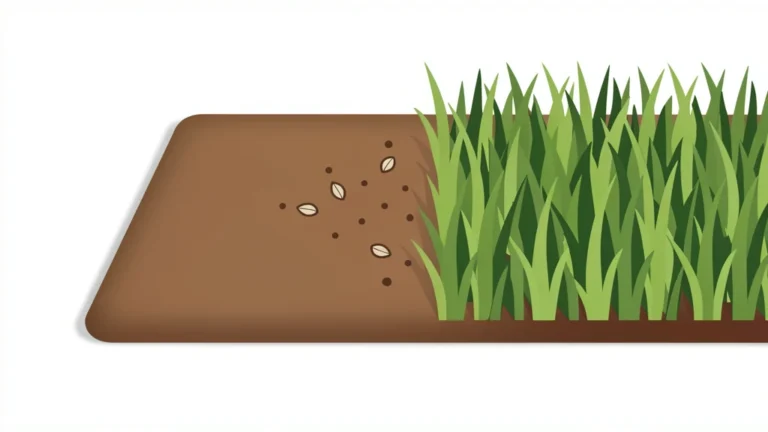
Ever wonder why one bag of grass seed says to spread 2 lb over your lawn while another bag says 8 lb for the same size yard? The right amount of grass seed per square foot is not one fixed number. It depends on whether you are starting a brand-new lawn from bare soil or simply overseeding a lawn that already has grass, plus which type of grass seed you pick. This guide walks through general seeding rate ranges, a simple formula for sizing your project, and a worked example you can copy for your own yard.
For a new lawn, plan on about 4 to 9 lb of grass seed per 1,000 sq ft, since cool-season grasses need more seed than warm-season types. Overseeding an existing lawn usually needs much less, often 2 to 3 lb per 1,000 sq ft, because you are only filling thin spots. To find your amount: divide your lawn area by 1,000, then multiply by the seeding rate on your product label. These are general ranges, so always check the exact rate printed on your seed bag.
What “Per Square Foot” Really Means for Grass Seed
Seed bags rarely list a rate for one single square foot, because the number would be too tiny to measure by hand. Instead, labels use “per 1,000 sq ft” as a practical unit, then you scale that rate up or down to match your own lawn’s exact size.
For example, a rate of 6 lb per 1,000 sq ft works out to just 0.006 lb per square foot, roughly the weight of a small pinch of seed. That is why the area divided by 1,000, times rate formula matters more than trying to measure grass seed one square foot at a time.
Why New Lawns and Overseeding Need Different Amounts
A brand-new lawn starts as bare soil with no grass plants in it at all. Every seed needs good contact with soil and with nearby seeds so young grass can form a thick, even stand. That is why new lawns use a higher seeding rate.
Overseeding is different. You are adding seed to a lawn that already has living grass covering most of the ground. The goal is to thicken thin patches and fill small gaps, not cover bare dirt from scratch, so the seeding rate drops sharply.
General Seeding Rates by Grass Type (Illustrative)
Seeding rates vary widely by grass type, so treat these ranges as general starting points, not fixed rules. Cool-season grasses, like tall fescue and ryegrass, usually need more seed than warm-season grasses, like bermuda, because of differences in seed size and germination.
- Cool-season, new lawn: about 4 to 9 lb per 1,000 sq ft
- Cool-season, overseeding: about 2 to 3 lb per 1,000 sq ft
- Warm-season, new lawn: about 1 to 2 lb per 1,000 sq ft
- Warm-season, overseeding: about 0.5 to 1 lb per 1,000 sq ft
Always follow the seeding rate printed on your product label first. Labels reflect the exact seed blend, purity, and germination rate for that bag, which a general range cannot capture.
How to Calculate Grass Seed for Your Lawn
Once you know your seeding rate, the math is simple. Use this formula: Seed Needed = (Lawn Area / 1,000) x Seeding Rate.
First, measure your lawn area in square feet. Next, divide that number by 1,000. Then multiply the result by the seeding rate per 1,000 sq ft from your seed bag or the ranges above.
Worked Example: Seeding a 2,000 Sq Ft Lawn
Say you have a 2,000 sq ft yard that needs a brand-new lawn. Using an illustrative new-lawn rate of 6 lb per 1,000 sq ft: 2,000 / 1,000 = 2, then 2 x 6 = 12 lb of seed.
Now say that same 2,000 sq ft lawn already has grass and just needs overseeding. Using an illustrative overseeding rate of 2 lb per 1,000 sq ft: 2 x 2 = 4 lb of seed, a third of the new-lawn amount.
These rates are examples only. Your actual bag may call for more or less seed, so confirm the label before you buy.
New Lawn vs Overseeding: A Side-by-Side Look
The example above shows a pattern that holds true across grass types: overseeding almost always uses far less seed than starting from bare soil.
| Factor | New Lawn | Overseeding |
|---|---|---|
| Starting Ground | Bare soil, no grass present | Existing lawn with thin spots |
| Typical Seed Amount | Higher, full coverage needed | Lower, only gaps need filling |
| Main Goal | Establish a full new stand | Thicken and fill in patches |
| Soil Prep Needs | Often needs loosened soil or topsoil | Usually just light raking |
Factors That Change Your Seeding Rate
The right rate for your yard depends on more than just grass type. A few other factors can shift the number up or down.
- Grass type: cool-season and warm-season seeds differ greatly in size and rate.
- Soil condition: compacted or rocky soil may need extra seed to make up for poor seed-to-soil contact.
- Time of year: seeding outside the ideal window can lower germination, so some labels call for a higher rate.
- Seed quality: higher-purity, higher-germination seed can often need less than a cheaper blend.
Buying a Little Extra Seed and Timing It Right
Many people buy a bit more seed than the formula calls for. Spreaders rarely drop seed perfectly evenly, some seed blows away in wind or gets eaten by birds, and a few spots may simply germinate poorly. Buying about 5 to 10 percent extra beyond your calculated amount is a common general practice, though your product label may suggest its own cushion.
Seeding also tends to work best during certain general windows tied to grass type. Cool-season grasses often establish well in early fall or spring, while warm-season grasses often prefer late spring into early summer. Exact timing still depends on your local climate, so check regional guidance for your area.
How well your calculated amount actually turns into a full lawn also depends on watering right after you seed. Keeping the top layer of soil consistently moist, without letting water pool, helps more of the seed you spread actually germinate. Skipping this step can waste even a carefully measured amount of seed.
Prepping Soil Before You Seed a New Lawn
Grass seed germinates best in loose, healthy topsoil, not compacted dirt or leftover construction fill. If your new lawn area is missing topsoil or needs a fresh layer, our Topsoil Calculator can help you figure out how much to bring in before you spread seed.
Getting the soil right first gives your seed the seed-to-soil contact it needs to germinate evenly, no matter which seeding rate you use. Skipping soil prep is one of the most common reasons a correctly measured seeding rate still ends up patchy.
Beyond Seed: Feeding Your Lawn
Seed alone will not keep a lawn thick over time. New grass also needs the right nutrients to build strong roots, and that is a separate topic from seeding rate. For that side of lawn care, see our guide on how much fertilizer does your lawn need.
If you are also planning garden beds nearby, our guide on how much soil for raised beds covers that separate project.
Ready to prep the ground before you seed? Use our Topsoil Calculator to estimate how much topsoil to add first, so your new lawn gets an even, healthy start.
Frequently Asked Questions About Grass Seed Per Square Foot
How Much Grass Seed Do I Need Per Square Foot?
Most seeding rates are given per 1,000 sq ft, not per single square foot, since the amounts get too small to measure otherwise. A new lawn often needs 4 to 9 lb per 1,000 sq ft, while overseeding usually needs only 2 to 3 lb. Always check your product label for the exact rate.
How Do I Calculate Grass Seed for My Lawn Size?
Divide your total lawn area in square feet by 1,000. Then multiply that number by the seeding rate per 1,000 sq ft listed on your seed bag. For example, a 2,000 sq ft lawn at 6 lb per 1,000 sq ft needs 12 lb of seed.
Why Does Overseeding Use Less Seed Than a New Lawn?
Overseeding adds seed to a lawn that already has living grass covering most of the ground. You only need to fill thin spots and small gaps, not cover bare soil everywhere. That is why overseeding rates run much lower than new-lawn rates.
Does the Seeding Rate Change by Grass Type?
Yes, seeding rates vary a lot by grass type. Cool-season grasses like tall fescue typically need more seed per 1,000 sq ft than warm-season grasses like bermuda. Always follow the rate printed on your specific seed product’s label.
What Happens If I Use Too Much Grass Seed?
Seeding too heavily can crowd young grass plants, forcing them to compete for light, water, and nutrients. This can lead to thin, weak growth instead of a thicker lawn. Sticking close to the labeled rate usually works better than overdoing it.
What Happens If I Use Too Little Grass Seed?
Seeding too lightly leaves gaps where weeds can move in before grass fills the space. A new lawn seeded too thin may look patchy even after it grows in. Following the label’s minimum rate helps you avoid this problem.
Do I Need Topsoil Before Seeding a New Lawn?
Many new lawn areas benefit from a layer of healthy topsoil, especially over compacted soil or construction fill. Good topsoil gives seed the loose, even surface it needs for strong seed-to-soil contact. Our Topsoil Calculator can help estimate how much you may need.
Sources
Authoritative Sources Used in This Article
This article is for general education only, not professional landscaping or pool-service advice. Soil, climate, product concentrations, and local conditions vary, so always check product labels and consider a local expert for your specific situation. Reviewed for accuracy by Prof. Dr. Khalil Mudassar, PhD. Last updated September 13, 2026.
Author

Shakeel Muzaffar is the Founder and Editor-in-Chief of MultiCalculators.com, bringing over 15 years of experience in digital publishing, product strategy, and online tool development. He leads the platform's editorial vision, ensuring every calculator meets strict standards for accuracy, usability, and real-world value. Shakeel personally oversees content quality, formula verification workflows, and the platform's commitment to publishing tools that are genuinely useful for students, professionals, and everyday users worldwide.



