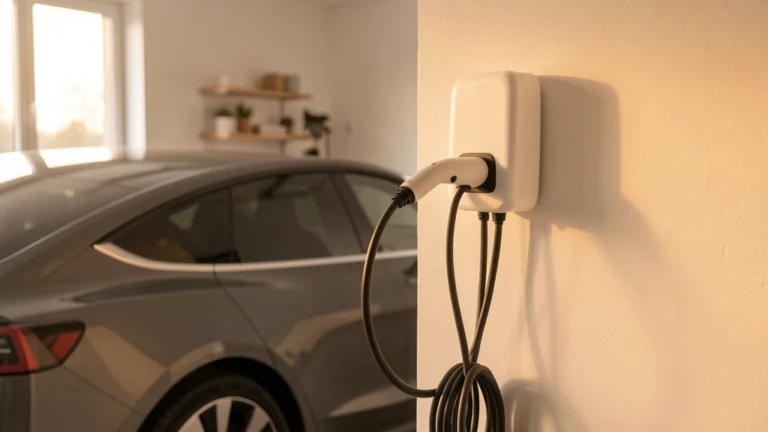
What does it really cost to drive 1,000 miles a month on electricity from your own garage? At 17 cents per kWh, the answer is about $57, or under 6 cents a mile. You reach that number with three inputs: your car’s energy use, your charging losses, and your electric rate. This guide shows each step, so you can read your own bill with confidence.
- Monthly cost equals miles times kWh per mile, divided by charging efficiency, times your price per kWh.
- At 1,000 miles, 30 kWh per 100 miles, 90 percent efficiency, and $0.17, you pay $56.67 a month.
- The EPA window sticker figure already includes charging losses, so do not divide it again.
- Moving the same charging to a $0.10 off-peak rate drops the bill to $33.33 a month.
- Adding 45 kWh to a 75 kWh battery, from 20 to 80 percent, costs about $8.50 at $0.17.
What Does It Cost to Charge an EV at Home?
Most drivers pay roughly $30 to $60 a month for 1,000 miles, depending on their electric rate. The exact figure comes from one short formula that works for any car and any utility.
Here is the formula in plain words. Take your monthly miles and multiply by the energy your car uses per mile. Divide by your charging efficiency, then multiply by your price per kWh.
Now run the numbers for a typical driver. Take 1,000 miles at 30 kWh per 100 miles, and the car uses 300 kWh. At 90 percent efficiency, the grid supplies 333.3 kWh. At $0.17 per kWh, the monthly bill is $56.67, which works out to 5.67 cents per mile.
That same driver pays about $680 over a full year. Your own rate matters a lot here. The EIA reported an average U.S. residential price of 18.31 cents per kWh in July 2026. At that price, the same 333.3 kWh costs $61.03 a month.
How Do You Find Your kWh per 100 Miles?
You find it on the EPA window sticker or in your car’s trip display. Each source measures energy at a different point, so they need slightly different math.
The Window Sticker Number
The EPA measures EV efficiency at the wall outlet, not at the battery. Its test counts losses in the charging cable and the on-board charger during Level 2 charging. That means the sticker value already includes charging losses.
So use the sticker number directly, with no efficiency step. A car rated at 30 kWh per 100 miles needs 300 kWh from the wall for 1,000 miles. At $0.17, that costs $51.00 a month.
The Dashboard Number
Your car’s trip display usually counts energy leaving the battery. That figure leaves out the energy lost while charging, so divide it by your efficiency. Cold weather and highway speed also raise real use above the sticker.
Our guide on how to calculate real EV range explains why real consumption drifts from the rated number. Use your own driving average whenever you have one.
How Much Energy Is Lost While Charging?
Some energy turns into heat before it reaches the battery, so the meter always records more than the car stores. The example in this guide uses 90 percent efficiency.
The EPA notes that a small amount of energy is lost through conversion and heat. The loss happens in the charging equipment and in the car’s on-board charger, which turns AC power into DC.
Your utility bills you for the grid side, not the battery side. With 90 percent efficiency, every 100 kWh in the battery takes 111.1 kWh from the wall. That extra 11.1 kWh is real money on the bill.
How Much Does One Home Charging Session Cost?
One session costs the kWh you add, divided by efficiency, times your rate. Topping a 75 kWh battery from 20 to 80 percent costs about $8.50 at $0.17.
Here is the math. Sixty percent of 75 kWh is 45 kWh added to the battery. Divide by 0.90, and the grid supplies 50 kWh. At $0.17, that is $8.50, and at a $0.10 off-peak rate it is $5.00.
Level 1 Versus Level 2 Speed
The charging level changes the time, not the price per kWh. The AFDC lists Level 1 at 120 volts and about 1.9 kW, adding roughly 5 miles of range per hour. Level 2 at home runs on 240 volts, commonly 7.2 kW, adding roughly 25 miles per hour.
For the 50 kWh session above, Level 2 takes about 6.9 hours. Level 1 takes about 26.3 hours. A driver covering 1,000 miles a month averages 33 miles a day, which is about 6.7 hours on Level 1.
How Do Time-of-Use Rates Change the Monthly Bill?
Time-of-use plans charge less at night and more at peak hours. Charging overnight on a cheaper rate can cut the same month’s bill by a third or more.
The AFDC notes that some utilities offer residential time-of-use rates or other incentives for charging. Your utility’s website lists the exact hours and prices for each plan.
Use the same 333.3 grid kWh from the first example. All of it at $0.17 costs $56.67. All of it at a $0.10 off-peak price costs $33.33, a saving of $23.34 a month.
Most drivers do not hit 100 percent off-peak. Say 80 percent charges at $0.10 and 20 percent at a $0.30 peak. The blended rate is $0.14, and the bill is $46.67. The EV charging cost calculator lets you enter your own peak and off-peak split.
Is Home Charging Cheaper Than Public Fast Charging?
Home charging is usually the cheaper option, because you pay your household rate. Public DC fast chargers trade a posted price for much faster speed.
The AFDC lists DC fast chargers at up to 500 kW, adding about 100 to 200 or more miles in 30 minutes. Each network sets its own price, so read the posted rate at the station. Then run it through the same formula to compare it with your home rate.
Setup cost differs too. The AFDC notes that many owners meet daily needs with overnight Level 1 charging, requiring no additional cost or installation. Level 2 needs a 240-volt circuit, so get a quote from a licensed electrician.
To weigh these costs against a gasoline car, see our breakdown of electric vs gas car cost. This guide stays focused on the electric bill itself.
The EV Charging Cost Calculator turns your miles, kWh per 100 miles, efficiency, and rate plan into a monthly cost. It also shows the cost and time of one session.
FAQs About EV Home Charging Cost
How Much Does It Cost to Charge an EV at Home per Month?
For 1,000 miles at 30 kWh per 100 miles and 90 percent efficiency, you draw 333.3 kWh from the grid. At $0.17 per kWh, that is $56.67 a month, or 5.67 cents per mile.
Does the EPA kWh per 100 Miles Figure Include Charging Losses?
Yes. The EPA measures EV efficiency at the wall outlet and counts losses in the charging cable and on-board charger. Use the sticker number directly, without dividing by charging efficiency again.
How Much Does One Full Charging Session Cost at Home?
Take the kWh you add, divide by efficiency, and multiply by your rate. Charging a 75 kWh battery from 20 to 80 percent adds 45 kWh, draws 50 kWh, and costs $8.50 at $0.17.
Is Level 2 Charging More Expensive Than Level 1?
No. Both use your household rate, so the price per kWh is the same. Level 2 adds about 25 miles of range per hour, while Level 1 adds about 5 miles per hour.
How Much Can a Time-of-Use Plan Save on EV Charging?
For 333.3 grid kWh a month, moving from $0.17 to a $0.10 off-peak rate saves $23.34. An 80-20 off-peak and peak split at $0.10 and $0.30 costs $46.67 instead.
What Electricity Price Should I Use for My Estimate?
Use the per-kWh price on your own utility bill, including delivery charges. The EIA reported a U.S. residential average of 18.31 cents per kWh in July 2026, but local rates vary widely.
Why Is My Charging Bill Higher Than My Dashboard Suggests?
Your dashboard usually counts energy leaving the battery, while your meter counts energy from the grid. Charging losses fill the gap. At 90 percent efficiency, 100 battery kWh needs 111.1 grid kWh.
Sources
References Used in This Article
- U.S. EPA, Fuel Economy and EV Range Testing (efficiency measured at the wall, charging losses)
- U.S. DOE Alternative Fuels Data Center, Electric Vehicle Charging Stations (Level 1, Level 2, DC fast)
- U.S. DOE Alternative Fuels Data Center, Charging Plug-In Electric Vehicles at Home
- U.S. EIA, Electric Power Monthly Table 5.6.A, Average Price of Electricity by Sector
This article is general household energy-cost education, and all prices are examples. Check your own utility rate plan before you decide how to charge. Reviewed for accuracy by Prof. Dr. Khalil Mudassar, PhD. Last updated September 27, 2026.
Author

Shakeel Muzaffar is the Founder and Editor-in-Chief of MultiCalculators.com, bringing over 15 years of experience in digital publishing, product strategy, and online tool development. He leads the platform's editorial vision, ensuring every calculator meets strict standards for accuracy, usability, and real-world value. Shakeel personally oversees content quality, formula verification workflows, and the platform's commitment to publishing tools that are genuinely useful for students, professionals, and everyday users worldwide.