The average U.S. home bought 10,791 kWh of electricity in 2022, according to the EIA. Is your home above or below that line? You can find out with two meter readings, a year of bills, and some simple division. This guide shows you how to turn those numbers into one clear total for your whole house.
- Subtract two meter readings and divide by the days between them to get kWh per day.
- Add 12 months of usage to build an annual baseline that covers every season.
- Compare your lowest months with your peaks to estimate your heating and cooling share.
- Convert gas, propane, and oil to kWh or MMBtu so every fuel shares one unit.
- Check your total against the EIA average of 10,791 kWh a year before sizing solar or a heat pump.
How Do You Read Your Own Electric Meter?
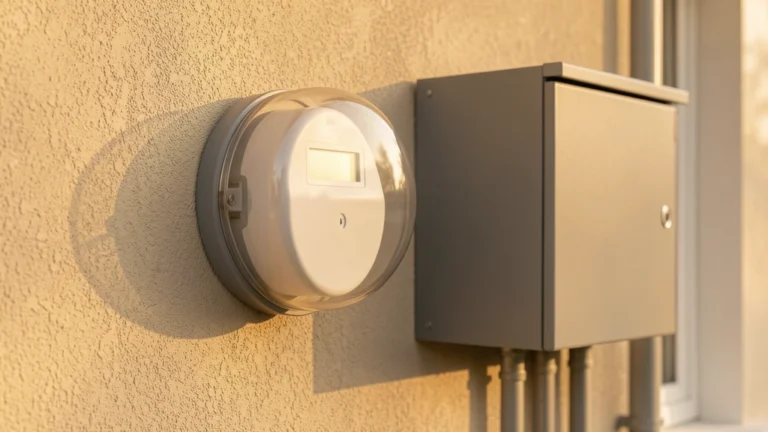
Write down the kWh number on your meter, wait a set number of days, and read it again. The difference is the energy your home used between the two readings.
Here is a real-world example. Your meter shows 45,210 on the first reading and 46,110 thirty days later. Your home used 900 kWh, which works out to 30.0 kWh per day.
Multiply the daily rate by 365 to project a full year. At 30.0 kWh per day, that comes to about 10,950 kWh a year. Read the meter at the same time of day each time, since evening use can add several kWh.
Why Do Billing Days Distort Your Monthly Totals?
Utility billing periods are not all the same length. One bill can cover 28 days and the next 33 days. A home using exactly 30 kWh per day would show 840 kWh on the short bill and 990 kWh on the long one.
That 150 kWh gap looks like an 18 percent jump, yet nothing changed in the house. Always divide each bill by its days of service before you compare months. Daily use is the honest number.
How Do You Build a 12-Month Energy Baseline?
Add up the kWh from your last 12 bills to get your annual baseline. A full year captures winter heating, summer cooling, and the mild months in between, so no single season skews the result.
Most utilities show a 12 or 13 month usage history on the bill or in your online account. Copy each month into a simple list with its kWh and days of service. Check that the days add up to about 365.
The sample home below used 11,050 kWh over one year, or about 921 kWh per month. Notice how much the months differ. July used 1,200 kWh, while May used only 680 kWh.
What Does Your Seasonal Swing Reveal?
Your seasonal swing shows how much energy goes to heating and cooling. The quiet spring and fall months reveal your base load, and the extra use in peak months is mostly climate control.
Take the three lowest months in the sample year: May at 680, October at 690, and April at 700 kWh. They average 690 kWh per month. Multiply by 12 and the base load comes to 8,280 kWh a year.
Subtract that from the 11,050 kWh total. The remaining 2,770 kWh, about 25 percent of the year, is seasonal load. This home swings from 680 to 1,200 kWh, a peak nearly 1.8 times its low month.
This split matters because heating and cooling dominate most homes. EIA survey data shows that 52 percent of household energy in 2020 went to space heating and air conditioning. A home with a gas furnace hides most of its heating load on the gas bill, which is why the next step matters.
How Do You Combine Electricity, Gas, Propane, and Oil?
Convert every fuel to British thermal units (Btu), then add them up. One kWh equals 3,412 Btu, so any fuel can also be restated as kWh for a single whole-home total.
The EIA publishes the conversion factors. Use them as a simple lookup.
| Fuel | Unit | Btu per unit | kWh equivalent |
|---|---|---|---|
| Electricity | 1 kWh | 3,412 | 1.00 |
| Natural gas | 1 therm | 100,000 | 29.31 |
| Propane | 1 gallon | 91,452 | 26.80 |
| Heating oil | 1 gallon | 138,500 | 40.59 |
Now combine the sample home with a gas furnace that burned 700 therms in a year. That gas holds 70 MMBtu, or 70 million Btu, equal to about 20,516 kWh. The 11,050 kWh of electricity adds 37.7 MMBtu.
Together the home used about 107.7 MMBtu, or 31,566 kWh equivalent. Gas supplied roughly two thirds of the total. The home energy usage calculator runs these conversions for every fuel at once.
How Does Your Home Compare With the Average?
Compare your annual electricity with the EIA national average of 10,791 kWh, or about 899 kWh a month. The sample home at 11,050 kWh sits about 2.4 percent above that figure.
The national number hides wide regional gaps. The EIA reports that Louisiana homes averaged 14,774 kWh in 2022, while Hawaii homes averaged only 6,178 kWh. Climate, fuel choice, and home size drive most of that spread.
Divide by floor area for a fairer comparison. A 2,000 square foot home using 11,050 kWh runs about 5.5 kWh per square foot. Track that ratio each year, since it stays steady when your family or house size changes.
Remember that this benchmark covers electricity only. The EIA notes that 58 percent of homes used natural gas in 2020. A gas-heated house belongs next to other gas-heated houses, not all-electric ones.
How Do You Use Your Total for Solar or Heat Pump Decisions?
Your 12-month total sets the target for any solar array or heat pump. Size equipment to the energy your home actually uses, not to a single month or a sales estimate.
For solar, the annual kWh number is the starting point. A system meant to offset 11,050 kWh must produce that much over a year at your location. Our guide on how many solar panels you need turns that total into a panel count.
For a heat pump, look at the heating fuel. Say the 700 therm furnace runs at 80 percent efficiency. It delivers 56 MMBtu of heat into the house each year.
Assume a heat pump with a seasonal efficiency ratio, called COP, of 3. Supplying that same 56 MMBtu would take about 5,471 kWh of electricity. Add that to your electric baseline to preview your post-switch bill in kWh.
Once you know your baseline, the next step is finding where the kWh go and how to cut them. Our guide to reading your electricity bill and cutting kWh covers the line items and the savings steps.
The Home Energy Usage Calculator turns meter readings or 12 months of bills into kWh per day, an annual total, your seasonal swing, an all-fuel MMBtu figure, and a comparison with the EIA average.
FAQs About Home Energy Usage
How Do I Calculate My Daily kWh From Meter Readings?
Subtract the older reading from the newer one, then divide by the days between them. A meter moving from 45,210 to 46,110 over 30 days used 900 kWh, or 30.0 kWh per day.
How Much Electricity Does the Average U.S. Home Use?
The EIA reports that the average residential customer bought 10,791 kWh in 2022. That is about 899 kWh per month, though state averages ranged from 6,178 kWh in Hawaii to 14,774 kWh in Louisiana.
Why Should I Use 12 Months Instead of One Bill?
One bill captures only one season and one billing period length. Twelve months include heating, cooling, and mild months, so the annual total reflects how your home really uses energy.
How Do I Convert Therms of Gas to kWh?
Multiply therms by 100,000 to get Btu, then divide by 3,412. One therm equals about 29.31 kWh, so 700 therms equals about 20,516 kWh equivalent.
What Is a Good kWh per Square Foot for a Home?
No single target fits every climate, so compare your own ratio year over year. A 2,000 square foot home using 11,050 kWh runs about 5.5 kWh per square foot per year.
How Can I Tell How Much Energy Goes to Heating and Cooling?
Average your three lowest months to find base load, multiply by 12, and subtract from the annual total. The remainder is mostly seasonal heating and cooling use.
Should I Include Gas and Propane When Sizing Solar?
Size solar to your electricity use alone, since panels offset kWh. Add the fuel only when you plan to switch that load to electric, such as a heat pump or electric water heater.
Sources
References Used in This Article
This article is general household energy education, not an energy audit or equipment sizing service. Confirm solar and heat pump sizing with a qualified installer. Reviewed for accuracy by Prof. Dr. Khalil Mudassar, PhD. Last updated September 27, 2026.
Author

Shakeel Muzaffar is the Founder and Editor-in-Chief of MultiCalculators.com, bringing over 15 years of experience in digital publishing, product strategy, and online tool development. He leads the platform's editorial vision, ensuring every calculator meets strict standards for accuracy, usability, and real-world value. Shakeel personally oversees content quality, formula verification workflows, and the platform's commitment to publishing tools that are genuinely useful for students, professionals, and everyday users worldwide.