
Have you ever counted 30 days on a wall calendar, written the date in your planner, and assumed that was your filing deadline, only to discover a court would reject it as untimely? Understanding how courts calculate deadlines is not a clerical detail. It’s a procedural requirement with case-ending consequences.
This article explains the exact rules courts use, starting with FRCP Rule 6, the federal framework that governs every deadline in U.S. district court. It covers the Day Zero trigger rule, calendar days versus business days, what counts as a legal holiday, electronic filing cutoffs, tolling, and the errors that most often sink filings.
The rules here apply whether you’re an attorney, a paralegal, or a pro se litigant. Every section below maps directly to a real procedural rule. The math is simple. The rules are specific. The margin for error is zero.
Key Takeaways
- The trigger date is Day Zero: The day the triggering event occurs (service, an order, a judgment) is excluded from the count. Day 1 is always the next calendar day.
- Federal deadlines count calendar days, not business days: Under FRCP Rule 6(a)(1), every day of the week counts, including weekends and holidays, unless the last day of the period falls on one.
- The last-day rule automatically extends your deadline when the computed final day is a Saturday, Sunday, or federal legal holiday, moving it to the next day the clerk’s office is open.
- The 2009 amendment to Rule 6 eliminated the short-period exception that used to skip weekends for any period under 11 days, a change that still catches practitioners who trained before it.
- Electronic filings in federal court are due by midnight in the court’s local time zone, and documented CM/ECF outages on the last day automatically extend the deadline to the next accessible court day.
Written by Shakeel Muzaffar. Reviewed by Dr. Abdullah Khalil (MBBS). Last updated: October 3, 2026.
Key Stats
| Rule / Provision | What It Governs | Key Detail |
|---|---|---|
| FRCP Rule 6(a)(1) | Day-based filing periods | Day 1 = day after trigger event; last-day rule applies |
| FRCP Rule 6(a)(6) | Definition of “legal holiday” | 11 federal holidays, including Juneteenth (added 2021) |
| FRCP Rule 6(a)(3) | Clerk’s office inaccessibility | Deadline extends to first accessible non-holiday weekday |
| FRCP Rule 6(d) | Service by mail or non-ECF electronic means | Adds 3 days to the response period |
| 2009 Amendment to Rule 6 | Short-period counting | Eliminated weekend exclusion for periods under 11 days |
How Courts Calculate Deadlines
Courts calculate deadlines by identifying a trigger event, treating that day as Day Zero, then counting forward in calendar days until the prescribed period ends. If the last day is a Saturday, Sunday, or federal legal holiday, the deadline shifts to the next court-open day.
The Basic Three-Step Process
Every federal court deadline follows three steps. First, identify the trigger event: the date of service, entry of an order, or filing of a judgment. Second, start counting the next calendar day as Day 1, never the day of the event itself. Third, land on the final day of the period and test it: if that day is a Saturday, Sunday, or federal legal holiday, move forward to the next open court day.
That last step surprises most people. The deadline doesn’t shorten; it extends. You never lose time when a deadline falls on a holiday.
Here’s a concrete example. You’re served with a complaint on a Wednesday. You have 21 days to respond. Thursday is Day 1. Count 21 calendar days forward. If Day 21 lands on a Saturday, your actual deadline is the following Monday, or Tuesday if Monday is a federal holiday. Using a date calculator that doesn’t know court holiday rules gives you Saturday. That’s not your deadline.
Why Your Standard Calendar Gets It Wrong
A wall calendar or a typical business days calculator doesn’t apply the Day Zero rule, doesn’t distinguish calendar days from business days, and doesn’t carry the FRCP Rule 6(a)(6) holiday list. Plug “21 days from Wednesday” into most date tools and you get a date, but not necessarily the court’s date. Courts treat a deadline miss as absolute. There’s no “close enough” in federal civil procedure.
FRCP Rule 6 and the Federal Framework
FRCP Rule 6 is the single governing rule for computing and extending time in federal courts. It defines the counting method, identifies excluded days, lists qualifying holidays, and sets conditions for court-granted extensions.
What FRCP Rule 6(a) Actually Says
Rule 6(a) divides counting into two categories. Rule 6(a)(1) handles periods “stated in days or a longer unit”, which covers nearly every deadline you’ll encounter. Rule 6(a)(2) handles periods “stated in hours,” reserved for very short windows like temporary restraining order procedures. For standard day-based periods, Rule 6(a)(1) applies: exclude the trigger day, count every subsequent calendar day, and apply the last-day rule if needed.
Rule 6(a)(6) is the holiday definition provision. It lists the 11 federally recognized legal holidays that qualify for the last-day extension. That list is exhaustive for federal courts. Any day not on it counts as a regular counting day, even if your office is closed.
How Rule 6(a)(1) Differs from Rule 6(a)(2)
Rule 6(a)(2) counts hours, not days. It runs continuously through every hour of every day, including weekends, but still extends if the period ends before the clerk’s office opens or after it closes. Hourly deadlines appear almost exclusively in emergency injunction contexts and certain bankruptcy proceedings. Day-based counting under Rule 6(a)(1) governs almost everything else in standard motion practice.
When State Courts Follow Different Rules
State courts operate under their own procedural codes. California counts days under Code of Civil Procedure § 12; New York uses CPLR § 2103 and § 2219; Texas uses Rule of Civil Procedure 4. Each has its own holiday list and trigger-date rules. Some states exclude the last day only when it falls on a holiday recognized in that state, not just a federal one. Assume nothing translates directly from FRCP to state court without verification.
Calendar Days vs. Business Days in Court Filings
Most federal court deadlines use calendar days, not business days, and that single distinction makes a standard business day calculator the wrong tool for legal deadline work.
Which Deadline Types Use Calendar Days
Calendar-day counting covers the most consequential federal deadlines: 21 days to answer a complaint under FRCP Rule 12(a)(1), 90 days to complete service under FRCP Rule 4(m), 30 days to file a notice of appeal under Federal Rules of Appellate Procedure Rule 4(a)(1), and 28 days to oppose a summary judgment motion under many district local rules. Calendar days means all seven days of the week count toward the total.
Which Deadline Types Use Business Days
Business-day counting appears more in state courts and in specific federal statutes or administrative proceedings, for example, certain notice requirements in labor and employment actions. When a rule explicitly says “business days,” check whether it defines the term. Some definitions include Saturday; others don’t. Some count state holidays; others follow only the federal list. Verify before counting.
| Deadline | Day Type | Period | Governing Rule |
|---|---|---|---|
| Answer to complaint | Calendar days | 21 days | FRCP Rule 12(a)(1) |
| Service of summons | Calendar days | 90 days | FRCP Rule 4(m) |
| Notice of civil appeal | Calendar days | 30 days | FRAP Rule 4(a)(1) |
| Oppose summary judgment | Calendar days | 28 days (many districts) | FRCP Rule 56 + local rules |
| State court notice of entry (varies) | Business days | Varies by state | State-specific CCP/CPLR |
The Trigger Date Rule: When Does the Clock Start?
The clock starts the day after the triggering event, not on the day it happens. That rule is written directly into FRCP Rule 6(a)(1)(A), and there’s no exception.
The Day-Zero Rule Explained
Rule 6(a)(1)(A) says to “exclude the day of the event or default that begins the period.” That day is Day Zero; it doesn’t count. Day 1 is the next calendar day. The rationale is practical: a triggering event like service or entry of an order can happen at any hour. Excluding that day prevents the period from shrinking based on the time of day the event occurred.
Miss this rule and you’re always off by one. That one day, in tight deadline situations, is the entire margin.
Common Trigger Events: Service, Orders, and Judgments
Service of a pleading triggers most response deadlines. Entry of a court order on the electronic docket (not the date the judge signs it, which can differ) triggers scheduling deadlines. Entry of judgment starts the appeal clock. For service by mail, the trigger is typically the mailing date plus the three-day add-on under Rule 6(d), not the date you actually receive the document.
What Counts as a Court Holiday
Federal court deadline purposes recognize only the holidays listed in FRCP Rule 6(a)(6). State holidays and locally declared closures don’t extend federal deadlines unless a separate local rule says otherwise.
Federal Legal Holidays Under Rule 6
FRCP Rule 6(a)(6) lists 11 federal legal holidays: New Year’s Day (January 1), Martin Luther King Jr. Day (third Monday in January), Presidents’ Day (third Monday in February), Memorial Day (last Monday in May), Juneteenth National Independence Day (June 19, added in 2021), Independence Day (July 4), Labor Day (first Monday in September), Columbus Day (second Monday in October), Veterans Day (November 11), Thanksgiving Day (fourth Thursday in November), and Christmas Day (December 25). Any day proclaimed a national holiday by the President also qualifies.
State and Locally Observed Closures
States like Massachusetts observe Patriots’ Day; some courts observe Good Friday. These don’t move a federal filing deadline unless the district court has issued a standing order adopting them. When a state holiday closes the federal courthouse, the court typically posts a notice on its public docket. Checking the court’s website before the last day of any deadline period is a habit worth building.
Intermediate Days, Weekends, and the Last Day Rule
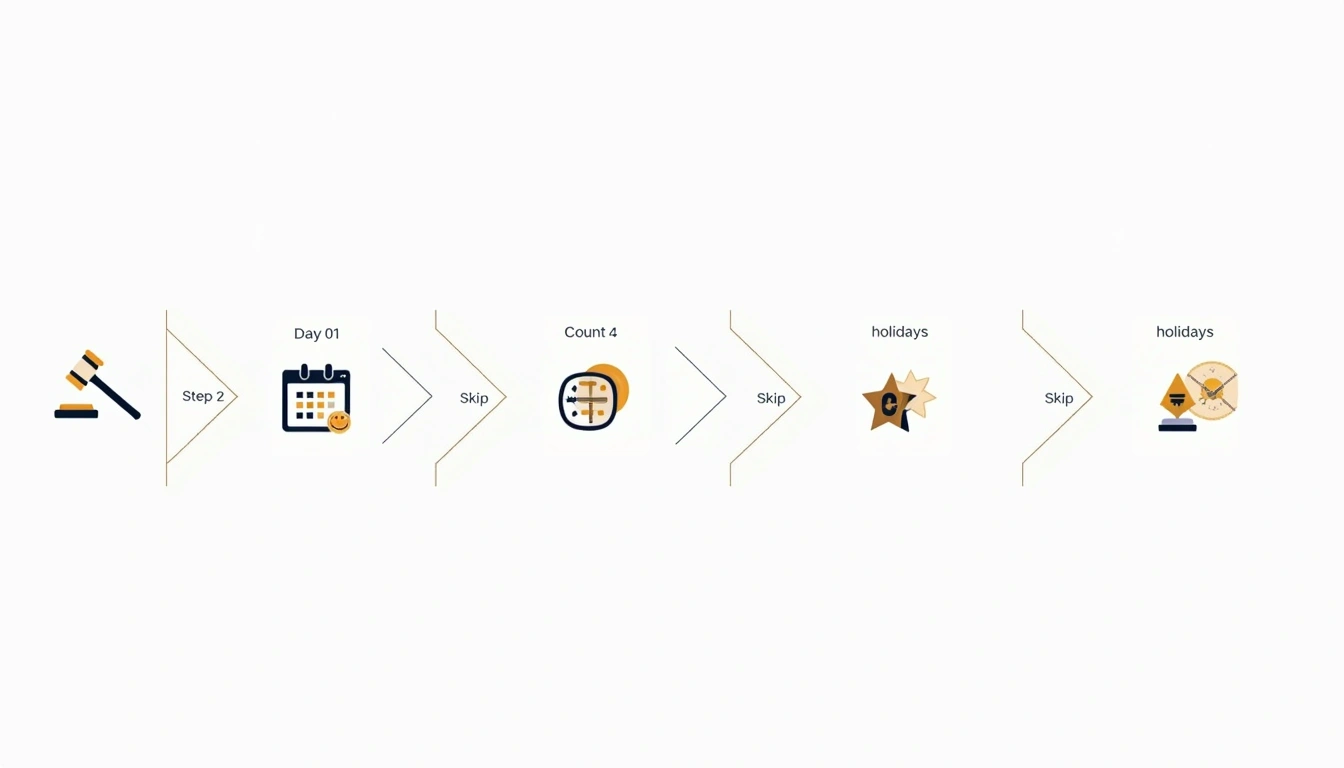
Under current FRCP Rule 6, every day in the middle of a deadline period counts, including Saturdays, Sundays, and holidays. Only the last day of the period triggers the weekend and holiday extension.
How Intermediate Saturdays and Sundays Are Handled
Intermediate Saturdays and Sundays count as full days toward the total. Always. If you have a 30-day deadline that spans four weekends, all four count. The 30-days-from-today count in federal court includes every one of those days. Also worth noting: 30 calendar days is not the same as one calendar month, a distinction that matters when a statute of limitations runs in months rather than days. See why 30 days from today and one month from today land on different dates for more on that specific issue.
What Happens When the Last Day Falls on a Non-Court Day
FRCP Rule 6(a)(1)(C) extends the deadline to the “next day that is not a Saturday, Sunday, or legal holiday.” That next open day is your actual filing deadline. This rule applies only to the last day: intermediate days are never adjusted. You can’t skip a Saturday that falls in the middle of your count.
“The last-day rule is a safety net, not a general skip-weekend rule. It moves only the endpoint of a period; it never changes how intermediate days are counted.” (Standard interpretation of FRCP Rule 6(a)(1)(C) applied uniformly across federal circuits.)
Short-Period Rules and the Pre-2009 Distinction
Before December 1, 2009, FRCP Rule 6 excluded intermediate Saturdays, Sundays, and holidays from any period under 11 days. The 2009 amendment eliminated that exception entirely and replaced it with one unified counting method for all periods, regardless of length.
How the 2009 Amendment to Rule 6 Changed the Count
The 2009 amendment restructured Rule 6(a) from two different counting methods into one. To compensate for the loss of weekend exclusions in short periods, the Judicial Conference simultaneously increased the length of many short deadlines. Former 5-day periods became 7-day periods. Former 10-day periods became 14-day periods. Former 20-day periods became 21-day periods. The goal was to eliminate the confusion over which method applied to which period length.
Periods Under 11 Days Before vs. After the Amendment
| Period Example | Pre-2009 Rule | Post-2009 Rule (Current) |
|---|---|---|
| 5-day response period | Skip Sat/Sun; actual calendar span stretched to ~7 days | Period changed to 7 calendar days; no weekend skipping |
| 10-day period crossing a holiday | Holiday excluded from count; period stretched further | Period changed to 14 days; holiday only matters on Day 14 |
| 14-day period (was ≥11 days old rule) | No weekend exclusion applied at ≥11 days | Same as today; counting method unchanged |
Practitioners who trained before 2009, or who use pre-amendment form books, sometimes still skip weekends in short-period calculations. That’s an error under current law. Confirm any legal manual reflects the post-2009 Rule 6 before relying on it.
Electronic Filing Deadlines and the Midnight Rule
When a filing deadline falls on a court day, your electronic filing through CM/ECF is due by midnight in the time zone of the court where the case is filed, not midnight in your time zone. FRCP Rule 6(a)(4) sets that default explicitly.
Time Zones and When “End of Day” Means
A New York attorney with a case in the Northern District of California has until midnight Pacific time, which is 3:00 AM Eastern the next morning. The reverse is tighter: a California attorney filing in the Southern District of New York must hit midnight Eastern, meaning 9:00 PM Pacific. Most practitioners find this out the hard way at least once. Set your calendar alerts to the court’s local time, not your own.
System Outages and Automatic Deadline Extensions
Under FRCP Rule 6(a)(3), if the clerk’s office is inaccessible on the last day for filing, including documented CM/ECF system outages, the deadline extends to the first accessible day that is not a Saturday, Sunday, or federal legal holiday. Courts require evidence of inaccessibility. Take timestamped screenshots of the error message and any CM/ECF status page records at the time of the outage. “I couldn’t log in” without documentation is not sufficient.
Tolling: When the Deadline Clock Pauses
Tolling suspends the running of a deadline (typically a statute of limitations) without resetting it. Time already elapsed before tolling begins still counts when the clock restarts.
Statutory Tolling vs. Equitable Tolling
Statutory tolling is written into law. Under 28 U.S.C. § 2244(d)(2), the one-year federal habeas corpus limitations period is tolled while a properly filed state post-conviction petition is pending. Equitable tolling is a court-made doctrine that applies when a party couldn’t have discovered the basis for a claim despite reasonable diligence, or when extraordinary circumstances blocked timely filing. Courts apply equitable tolling sparingly. Attorney negligence alone is not an extraordinary circumstance.
Common Events That Trigger Tolling
- Minority: Most statutes of limitations don’t begin running against a minor plaintiff until they turn 18.
- Mental incapacity: Some statutes toll when the plaintiff was legally incompetent at the time the claim accrued.
- Fraudulent concealment: A defendant who actively hid facts that would have revealed a claim triggers tolling from the time of concealment.
- Bankruptcy automatic stay: Filing a bankruptcy petition halts most civil actions and related deadlines under 11 U.S.C. § 362.
- Military service: The Servicemembers Civil Relief Act (50 U.S.C. § 3936) tolls certain civil deadlines for parties on active duty.
Statute of Limitations vs. Internal Court Deadlines
A statute of limitations is a legislatively set outer time boundary for filing a case. Internal court deadlines (like a response to a motion) are procedural time limits set by the Federal Rules or local rules. They look similar. They operate very differently.
Key Differences in How Each Is Calculated
Statutes of limitations typically run in years or months from the date a claim accrues. They involve choice-of-law analysis, discovery rules, and tolling doctrines that don’t apply to internal procedural deadlines. Internal deadlines run in days under FRCP Rule 6 and are mechanically precise: trigger event, Day Zero, count forward, apply the last-day rule. Less interpretive flexibility. Less room for argument.
Why Missing One Can Still Kill a Case
Missing the statute of limitations bars the claim entirely; courts lack the power to hear it once time has run. Missing an internal deadline like an opposition brief means the court may grant the opposing motion as unopposed, often ending the case on procedural grounds. The mechanisms differ. The result, dismissal, is frequently the same.
Motion Practice and Response Deadlines

Federal motion practice response deadlines run from service of the motion, not the date the motion is filed with the court. That one word makes a real difference when the motion is served by mail.
The 21-Day and 14-Day Response Windows
Under FRCP Rule 12, many response deadlines run 21 days from service of the motion. Reply briefs are often due within 14 days after the opposition is filed or served. Summary judgment oppositions are frequently 28 days under local rules. These are floors. Local rules in individual districts routinely set different windows, sometimes shorter. Always check the local rules and any standing orders from the assigned judge before computing any motion deadline.
How Service Method Affects the Clock
FRCP Rule 6(d) adds three days to a response deadline when service is made by mail, by leaving the document at the party’s office, or by other non-electronic methods listed in Rule 5(b)(2). The three-day add-on once applied broadly as the “mailbox rule.” Since CM/ECF electronic service became standard in federal court, the add-on no longer applies to ECF-registered parties served electronically through the system, but it still applies to email service outside ECF and to all paper mail service.
Common Deadline Calculation Mistakes That Sink Cases
Three errors account for most missed court deadlines. Each one is mechanical, not strategic, and each is completely preventable.
Miscounting the Trigger Date
Treating the day of service as Day 1 is the single most common calculation error. It shifts every subsequent day by one and produces a deadline that is one day too early. On a 21-day window, the filing lands on Day 22, which is untimely. Courts draw no distinction between one day late and one month late. “Almost on time” is not a legal standard recognized by any federal circuit.
Ignoring Local Rules That Override FRCP
FRCP sets minimums, not maximums. Under FRCP Rule 83, district courts may adopt local rules consistent with the national rules, and most do extensively. The Northern District of California, the Southern District of New York, and the Northern District of Texas all have local rules that modify FRCP deadlines for motion responses, page limits, and scheduling orders. Reading only FRCP without checking local rules is an incomplete analysis every single time.
Trusting Generic Business Day Calculators
A standard online date tool counts Monday through Friday and skips weekends. That’s the right tool for invoice payment terms. It’s wrong for court deadlines, which count calendar days and apply a specific federal holiday list. The math behind date tools is also subtler than it looks; see how date calculators compute day intervals for a detailed breakdown of how off-by-one errors appear even before legal rules apply. Use a tool that knows FRCP, not one built for commercial scheduling.
FAQ
What is the trigger date when counting court deadlines?
The trigger date is the event that starts the deadline period, typically service of a pleading, entry of a court order, or entry of judgment. Under FRCP Rule 6(a)(1)(A), this day is excluded from the count entirely. Day 1 is the following calendar day. Never include the day the trigger event occurs in your count.
Does the day of service count when calculating a filing deadline?
No. The day of service is Day Zero under FRCP Rule 6(a)(1)(A) and is excluded from the period. Your count always begins the next calendar day. This rule applies whether service was by hand delivery, mail, or electronic means through CM/ECF.
What happens if a court deadline falls on a Saturday or Sunday?
The deadline extends automatically to the following Monday, or to Tuesday if Monday is a federal legal holiday. This is the last-day rule under FRCP Rule 6(a)(1)(C). No motion for extension is needed; the extension applies by operation of the rule itself.
How do federal holidays affect legal deadlines?
A federal holiday only affects your deadline if it falls on the final day of the period. Intermediate holidays that land in the middle of a count don’t extend the period at all. Only the last day is tested against the Rule 6(a)(6) holiday list for the extension to apply.
What is the difference between calendar days and business days in court filings?
Calendar days count all seven days of the week. Business days count Monday through Friday only. Federal court deadlines almost universally use calendar days under FRCP Rule 6. If a rule doesn’t say “business days” explicitly, assume calendar days apply and verify before proceeding.
What does FRCP Rule 6(a) say about counting days?
FRCP Rule 6(a)(1) says: exclude the day of the trigger event, count every subsequent day including weekends and holidays, and extend to the next non-holiday weekday if the last day falls on a Saturday, Sunday, or legal holiday. Rule 6(a)(6) defines which 11 holidays qualify for that extension.
Can a deadline be extended if the court’s electronic filing system goes down?
Yes, under FRCP Rule 6(a)(3). If the clerk’s office is inaccessible on the last day of the filing period, including CM/ECF system outages, the deadline extends to the first accessible day that is not a Saturday, Sunday, or federal legal holiday. Document the outage with timestamped screenshots as proof.
What is tolling and how does it affect a statute of limitations?
Tolling pauses the statute of limitations clock without resetting it. Time that ran before the tolling event still counts; the clock stops until the tolling period ends, then restarts. Common triggers include a plaintiff’s minority, mental incapacity, fraudulent concealment by the defendant, bankruptcy stays, and active military service.
Are state court deadline rules the same as federal court rules?
No. Every state court operates under its own procedural code. California uses Code of Civil Procedure § 12, New York uses CPLR Article 22, and Texas uses Rule of Civil Procedure 4. Each has different holiday lists and trigger-date rules. Never assume FRCP Rule 6 applies in state court without checking the governing state statute.
What is the last day rule in legal deadline calculations?
The last day rule extends a filing deadline to the next court-open weekday when the computed last day falls on a Saturday, Sunday, or federal legal holiday under FRCP Rule 6(a)(1)(C). It applies only to the final day of the period: intermediate weekends and holidays always count and are never skipped.
Getting Your Deadlines Right Before It Costs You
This article provides general information about federal court deadline rules under the Federal Rules of Civil Procedure. It is not legal advice and does not create an attorney-client relationship. If you are facing an active litigation deadline or a statute of limitations that may have run, consult a licensed attorney in your jurisdiction before relying on any calculation.
Courts calculate deadlines through a three-step process: Day Zero exclusion, forward calendar-day counting, and the last-day extension when the period ends on a non-court day. FRCP Rule 6 governs every federal deadline. Missing any one piece (the trigger-date rule, the holiday list, the post-2009 counting method) produces a wrong date.
Confirm whether your deadline counts calendar days or business days, identify the correct trigger event, and verify the final date against the FRCP Rule 6 framework above before you file. For commercial scheduling use the business days calculator, but for any court deadline, legal counting rules are the only rules that count.
Source Links
- Cornell Law School Legal Information Institute: Federal Rules of Civil Procedure Rule 6: Computing and Extending Time
- Wikipedia: Federal Rules of Civil Procedure
- United States Courts: Current Rules of Practice and Procedure
- Cornell Law School Legal Information Institute: FRCP Rule 12: Defenses and Objections
- Cornell Law School Legal Information Institute: 28 U.S.C. § 2244: Finality of Determination (Federal Habeas Tolling Provision)
Author

Urooj Mukhtar is the Editorial and UX Content Manager at MultiCalculators.com, where she bridges content quality with user experience. She manages editorial review workflows, content clarity standards, and on-page usability — making sure every calculator is intuitive, well-explained, and accessible to users of all backgrounds. Urooj's work ensures that complex formulas and concepts are translated into clear, friendly, and trustworthy content that helps users get accurate results with confidence.
Areas of Expertise: Editorial Review, UX Writing, Content Accessibility, Information Architecture, Usability Standards