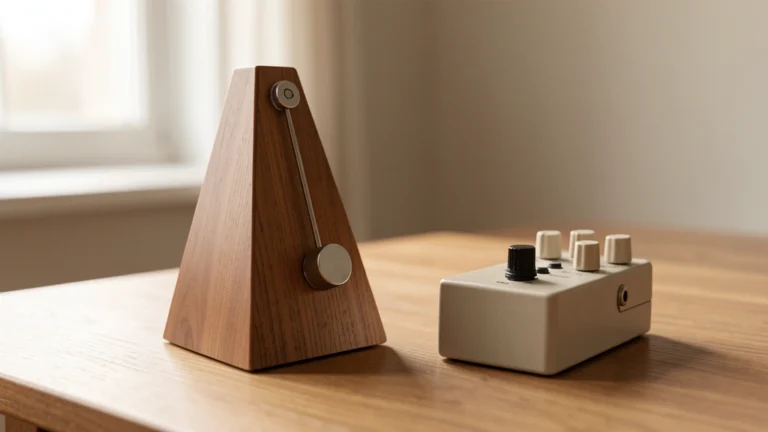
Why does one echo sit perfectly in the groove while another trips over the beat? The answer is usually a few milliseconds. At 120 BPM, one beat lasts exactly 500 ms, and every good delay setting in the song grows from that single number.
This guide shows where that number comes from and how to turn it into eighth, dotted and triplet delay times. You will also learn to convert milliseconds into Hz for tremolo and filter sweeps.
- A quarter note lasts 60000 divided by the BPM, in milliseconds.
- Halve it for an eighth, multiply by 1.5 for dotted and by 2/3 for triplets.
- Convert any note time to an LFO rate with 1000 divided by the milliseconds.
- At 120 BPM: quarter 500 ms, eighth 250 ms, dotted eighth 375 ms.
What Delay Time Means in Musical Terms
Delay time is the gap between a sound and its first repeat, measured in milliseconds. One millisecond is one-thousandth of a second, so 1,000 ms make one second. A delay set to 500 ms repeats each note half a second later.
Tempo is measured in beats per minute, or BPM. At 60 BPM, each beat lasts exactly one second. At 120 BPM, twice as many beats fit into the same minute, so each beat lasts half as long.
A delay becomes musical when its repeat time equals a note value at the track tempo. The echoes then land on the grid with the drums. A random setting such as 410 ms at 120 BPM lands between the beats and blurs the rhythm.
Why Milliseconds and Not Seconds?
Most effect plug-ins and hardware units show delay time in ms because the useful range is small. A sixteenth note at 140 BPM is only 107.14 ms. Writing that as 0.10714 seconds is harder to read and easier to mistype.
Digital recorders measure time in samples, too. At a 48 kHz sample rate, a 500 ms delay spans 24,000 samples. The same sample rate drives storage needs, as our guide on how to calculate audio file size explains.
How Do You Convert BPM to Milliseconds?
Divide 60,000 by the tempo in BPM. The result is the length of one quarter note in milliseconds. The number 60,000 is simply the count of milliseconds in one minute.
The logic is short. One minute holds 60 seconds, and each second holds 1,000 ms, so a minute holds 60,000 ms. Split that minute into the number of beats, and you get the length of each beat.
- Find the tempo. Read the exact BPM from your project or click track, such as 128.
- Get the quarter note. Divide 60,000 by the BPM. At 128 BPM, that is 468.75 ms.
- Scale to the note you want. Halve it for an eighth note and quarter it for a sixteenth. At 128 BPM, the eighth is 234.38 ms.
- Apply the feel. Multiply by 1.5 for a dotted note or by 2/3 for a triplet. The dotted eighth at 128 BPM is 351.56 ms.
- Enter the value. Type the milliseconds into the delay time field. Keep two decimal places when the unit accepts them.
The BPM to Delay Calculator turns any tempo into quarter, eighth, dotted eighth and sixteenth note times in milliseconds.
Dotted and Triplet Delays at Any Tempo
A dot adds half of a note’s own length. That makes a dotted note 1.5 times the plain note. A triplet squeezes three notes into the space of two, so each triplet note is 2/3 of the plain note.
The dotted eighth is a classic rhythmic delay setting. At 120 BPM, it repeats every 375 ms, which is three sixteenth notes. Its echoes fall between the beats and create a rolling, syncopated pattern against straight eighth-note playing.
Triplet delays give a swung, three-against-two feel. At 120 BPM, an eighth triplet lasts 166.67 ms, and three of them fill exactly one 500 ms beat. Longer values use the same math: a half note at 120 BPM is 1,000 ms, and one bar of 4/4 is 2,000 ms.
| Note value | Multiplier of quarter | 90 BPM | 120 BPM | 140 BPM |
|---|---|---|---|---|
| Dotted quarter | 1.5 | 1,000 | 750 | 642.86 |
| Quarter | 1 | 666.67 | 500 | 428.57 |
| Dotted eighth | 0.75 | 500 | 375 | 321.43 |
| Eighth | 0.5 | 333.33 | 250 | 214.29 |
| Eighth triplet | 1/3 | 222.22 | 166.67 | 142.86 |
| Sixteenth | 0.25 | 166.67 | 125 | 107.14 |
How Do You Sync LFOs, Pre-Delay and Reverb?
Divide 1,000 by the note time in milliseconds to get a rate in Hz. Hz means cycles per second, and frequency is the inverse of the period. A 500 ms quarter note at 120 BPM equals an LFO rate of 2 Hz.
This lets you lock tremolo, auto-pan and filter sweeps to the song. An eighth-note tremolo at 120 BPM runs at 4 Hz, and a one-bar sweep at 120 BPM runs at 0.5 Hz. These rates sit far below audible pitch. Musical notes vibrate hundreds of times per second, as our explainer on note frequencies and A440 shows.
Pre-Delay
Pre-delay is the short gap before a reverb starts. One practical approach is to set it to a small note value, so the reverb onset stays in time. At 120 BPM, a 1/64 note is 31.25 ms and a 1/32 note is 62.5 ms.
Reverb Decay
Another approach matches the reverb tail to a note length, such as a half note of 1,000 ms at 120 BPM. The tail then fades near the next strong beat instead of washing over it. Treat both settings as starting points, then judge the result by ear.
Timing Errors That Smear the Echo Rhythm
Small errors in delay math add up quickly, because each repeat inherits the error of the one before. The table below lists the errors that throw echoes off the grid most often.
| Mistake | Better approach |
|---|---|
| Rounding 128 BPM’s dotted eighth from 351.56 ms to 352 ms | Keep two decimals. The 0.44 ms error grows to 3.5 ms after eight repeats. |
| Dividing 1,000 by the BPM instead of 60,000 | Remember the minute: 60 seconds times 1,000 ms gives 60,000. |
| Using 0.5 as the dotted multiplier | A dotted note is 1.5 times the plain note, not half of it. |
| Treating a triplet as a sixteenth | A triplet is 2/3 of the plain note: 166.67 ms at 120 BPM, not 125 ms. |
| Keeping old delay times after a tempo change | Recalculate every time-based effect whenever the BPM changes. |
| Typing ms into a field set to Hz | Check the unit label, then convert with 1,000 divided by the ms. |
You can also work backward. Divide 60,000 by a known quarter-note delay to find the tempo. A 500 ms quarter note means the song runs at 120 BPM.
Try it with your own track: enter the tempo in the BPM delay time calculator and compare its results with your plug-in settings.
BPM and Delay Time: Frequently Asked Questions
What Is the Formula for BPM to Milliseconds?
Divide 60,000 by the tempo in BPM. The answer is one quarter note in milliseconds. At 100 BPM, a quarter note lasts 600 ms.
What Is the Delay Time for 120 BPM?
A quarter note at 120 BPM is 500 ms. The eighth note is 250 ms, the dotted eighth is 375 ms and the sixteenth is 125 ms.
How Do You Calculate a Dotted Eighth Delay?
Multiply the quarter note by 0.75, or multiply the eighth note by 1.5. At 128 BPM, the quarter note is 468.75 ms, so the dotted eighth is 351.56 ms.
How Do You Calculate a Triplet Delay Time?
Multiply the plain note value by 2/3. An eighth triplet at 120 BPM is 250 times 2/3, or 166.67 ms. Three of them fill one 500 ms beat.
How Do You Convert Delay Time to Hz?
Divide 1,000 by the time in milliseconds. A 250 ms eighth note at 120 BPM equals 4 Hz. Use this for tremolo, auto-pan and filter LFO rates.
Can You Find the BPM From a Delay Time?
Yes. Divide 60,000 by the quarter-note delay in milliseconds. A 375 ms dotted eighth comes from a 500 ms quarter note, which means 120 BPM.
Why Do Delay Times Get Shorter at Faster Tempos?
More beats fit into each minute, so each beat lasts less time. A quarter note is 666.67 ms at 90 BPM but only 428.57 ms at 140 BPM.
What Pre-Delay Should You Use for Reverb?
No single value fits every mix. One practical start is a short note value. At 120 BPM, a 1/64 note is 31.25 ms and a 1/32 note is 62.5 ms. Adjust by ear.
Sources and Further Reading
References Used in This Article
- University of Puget Sound, Music Theory for the 21st-Century Classroom: Meter (tempo in beats per minute)
- University of Puget Sound, Music Theory for the 21st-Century Classroom: Dots and Ties
- University of Puget Sound, Music Theory for the 21st-Century Classroom: Tuplets
- HyperPhysics, Georgia State University: Traveling Wave Relationship (f = 1/T)
- NIST, Metric (SI) Prefixes
This article is general music-production education. Effect settings are starting points, and your ears make the final call. Reviewed for accuracy by Prof. Dr. Khalil Mudassar, PhD. Last updated September 27, 2026.
Author

Shakeel Muzaffar is the Founder and Editor-in-Chief of MultiCalculators.com, bringing over 15 years of experience in digital publishing, product strategy, and online tool development. He leads the platform's editorial vision, ensuring every calculator meets strict standards for accuracy, usability, and real-world value. Shakeel personally oversees content quality, formula verification workflows, and the platform's commitment to publishing tools that are genuinely useful for students, professionals, and everyday users worldwide.