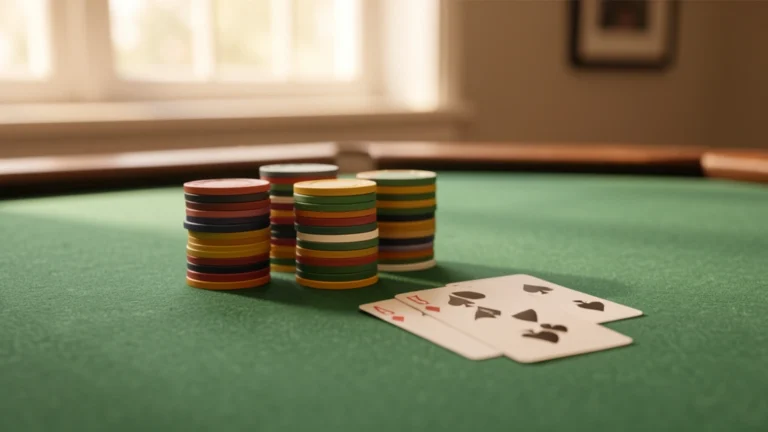
Should you call a 50 chip bet when the pot already holds 100 chips? Pot odds answer that question with one simple fraction. You pay 50 to win 150, so your hand must win at least 25 percent of the time. This guide shows the table, the formula, and the reasoning behind every call.
| Formula | Required equity = call / (pot after the bet + call) |
|---|---|
| Half-pot bet | You need 25 percent equity to call |
| Pot-sized bet | You need 33.3 percent equity to call |
| Flush draw, turn to river | 9 outs hit 19.6 percent of the time |
| Flush draw, flop to river | 9 outs hit 34.97 percent of the time |
Pot Odds Quick Reference Table
Bet size decides the price of a call. A larger bet relative to the pot means your hand must win more often to break even. The table lists common bet sizes against a pot of 100 chips.
| Bet size | Chips to call | Pot odds | Equity needed |
|---|---|---|---|
| Quarter pot | 25 | 5 to 1 | 16.7% |
| Third pot | 33.3 | 4 to 1 | 20.0% |
| Half pot | 50 | 3 to 1 | 25.0% |
| Two thirds pot | 66.7 | 2.5 to 1 | 28.6% |
| Three quarters pot | 75 | 2.33 to 1 | 30.0% |
| Full pot | 100 | 2 to 1 | 33.3% |
| Double pot | 200 | 1.5 to 1 | 40.0% |
The pattern holds for any stack size, because only the ratio matters. A half-pot bet always asks for 25 percent, whether the pot is 10 chips or 10,000. Even a huge overbet never pushes the required equity to 50 percent.
Five terms appear in almost every pot odds discussion. Here is what each one means in plain words.
- Pot odds
- The ratio of the chips you can win to the chips you must pay to call.
- Equity
- Your share of the pot based on how often your hand wins by the showdown.
- Outs
- The unseen cards that improve your hand into the likely winner.
- Break-even point
- The equity where calling neither gains nor loses chips over many repeats.
- Implied odds
- Pot odds that also count the chips you expect to win on later streets.
What Are Pot Odds in Poker?
Pot odds compare the chips you could win against the chips you must risk to call. Turned into a percentage, they show the minimum equity your hand needs for a profitable call.
Cornell University’s poker notes describe it the same way. They weigh the current pot against the cost of your next call, then compare that with your chance of winning.
The Formula in One Line
Required equity equals your call divided by the total pot after you call. Take a pot of 100 and a bet of 50. You call 50, the final pot is 200, and 50 divided by 200 equals 25 percent.
Players also say the same thing as a ratio. You risk 50 to win 150, so the pot lays you 3 to 1. The ratio and the percentage describe one price in two formats.
Switching between the two formats trips up many new players. Our guide on probability vs odds and how to convert between them walks through that step. The short version is that odds of 3 to 1 equal 1 in 4, or 25 percent.
How Do You Count Outs and Turn Them Into Equity?
Count the unseen cards that finish your hand, then divide by the cards left. On the turn, 46 cards are unseen, so 9 outs give 9 divided by 46, or 19.6 percent.
A flush draw is the classic example. You hold two hearts and the board shows two more, so nine hearts remain. Cornell’s notes use this exact spot and call the ratio roughly 1 in 5.
From the flop, you see two more cards, so the chance grows. The cleanest method finds the chance of missing twice and subtracts it from one. For 9 outs, that is 1 minus (38/47 x 37/46), or 34.97 percent.
| Draw | Outs | Turn to river | Flop to river |
|---|---|---|---|
| Inside straight draw | 4 | 8.7% | 16.47% |
| Open-ended straight draw | 8 | 17.4% | 31.45% |
| Flush draw | 9 | 19.6% | 34.97% |
| Flush plus straight draw | 15 | 32.6% | 54.12% |
Count outs honestly, though. A card that completes your straight but also pairs the board may help an opponent more. Treat those shaky cards as half an out, or skip them entirely.
Is the Rule of 2 and 4 Accurate Enough?
Yes, for small and medium draws. Multiply outs by 2 for one card, or by 4 for two cards. The shortcut stays within about 2 percentage points up to 9 outs, then starts to overshoot.
Check it with the flush draw. The rule says 9 x 2 = 18 percent on the turn, against a true 19.6 percent. From the flop, it says 9 x 4 = 36 percent, against a true 34.97 percent.
Big combo draws expose the weakness. Fifteen outs times 4 gives 60 percent, but the true figure is 54.12 percent. That gap of about 6 points can turn a close call into a costly one.
How Do You Decide Whether to Call?
Call when your equity is higher than the equity the pot odds require. Fold when it is lower. The gap between the two numbers tells you how much each call earns or costs on average.
Two Turn Decisions Side by Side
You hold a flush draw on the turn with 19.6 percent equity. Facing 50 into 100, you need 25 percent. Your draw falls short, and the average result is a loss of about 10.87 chips per call.
Now shrink the bet to 25 into 100. The price drops to 16.7 percent, which your draw beats. The same call now earns about 4.35 chips on average.
Those averages come from expected value, which weighs each result by its chance. Read expected value explained for the full method behind that math. To skip the arithmetic at the table, the poker pot odds calculator turns any pot and call into the break-even equity.
One detail matters here. A single call can still lose even when the math favors it. Pot odds describe the average over many repeats, not the next hand.
When Do Implied Odds Change the Answer?
Implied odds help when you expect to win more chips after you hit. Those future chips lower the equity you need now, so a slightly short draw can still earn a profitable call.
Return to the flush draw facing 50 into 100. Your 19.6 percent needs a total win of about 205.6 chips to break even. The pot offers 150, so you must collect about 55.6 more on the river.
Cornell’s notes show the same idea with a small pot. An extra river bet from each opponent turned a fold into a call for a four-out straight draw.
Where Implied Odds Break Down
Future chips are guesses, not guarantees. A cautious opponent may check and fold once the flush card lands. Short stacks also cap your gain, since nobody can bet more than they have.
The reverse case, called reverse implied odds, costs you. Hitting a weak flush against a stronger one can lose a big pot. Keep those spots in mind before you stretch past the plain pot odds.
Treat poker math as a tool for clearer thinking, not a promise of profit. Set a budget before you play, and never chase losses with money you need.
Enter the pot and the call amount in the Poker Pot Odds Calculator to see the pot odds ratio and the equity you need to call.
Questions People Ask About Pot Odds
How Do You Calculate Pot Odds Quickly?
Divide your call by the total pot after you call. A 50 bet into 100 means you call 50 into a final pot of 200, so you need 25 percent equity.
What Is the Difference Between Pot Odds and Equity?
Pot odds tell you the price of a call. Equity tells you how often your hand wins. You call when your equity is higher than the equity the pot odds require.
How Much Equity Do You Need to Call a Pot-Sized Bet?
You need 33.3 percent. A 100 bet into 100 means you call 100 to win 200, which is 2 to 1 pot odds, or one win in three tries.
Should You Use the Rule of 4 on the Flop?
Use it only when no more betting can happen before the river, such as all-in spots. Otherwise use the rule of 2, since you must pay again on the turn.
Do Pot Odds Guarantee a Profit?
No. Pot odds show the average result over many similar calls. A correct call still loses often, and poker results swing widely in the short run.
Where These Numbers Come From
References Used in This Article
- Cornell University, Math Explorers’ Club, Texas Hold’em (pot odds, outs, implied odds, 9 outs of 47 cards)
- OpenStax Contemporary Mathematics, 7.7 What Are the Odds? (converting odds to probability)
- OpenStax Contemporary Mathematics, 7.11 Expected Value (long-run average of outcomes)
- MIT OpenCourseWare, 15.S50 Poker Theory and Analytics (course on poker probability and strategy)
This article is math education about a card game, not gambling or financial advice. Percentages assume every unseen card is equally likely and are rounded from exact card counts. Reviewed for accuracy by Prof. Dr. Khalil Mudassar, PhD. Last updated September 27, 2026.
Author

Shakeel Muzaffar is the Founder and Editor-in-Chief of MultiCalculators.com, bringing over 15 years of experience in digital publishing, product strategy, and online tool development. He leads the platform's editorial vision, ensuring every calculator meets strict standards for accuracy, usability, and real-world value. Shakeel personally oversees content quality, formula verification workflows, and the platform's commitment to publishing tools that are genuinely useful for students, professionals, and everyday users worldwide.