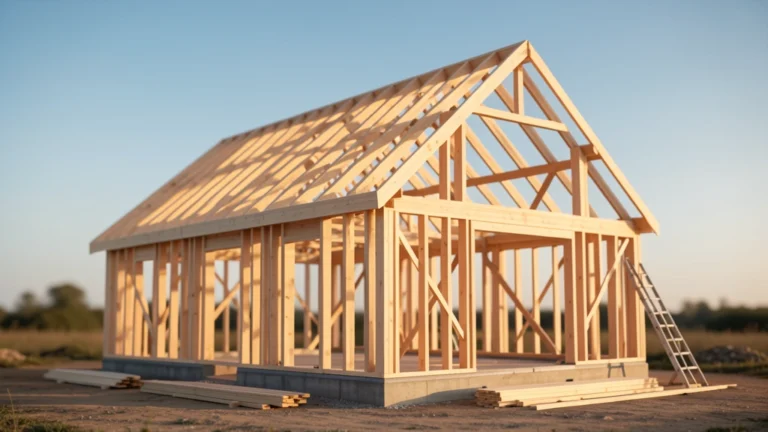
A 2,000 square foot home at $150 per square foot comes to $300,000 to rebuild in our calculator. That figure has nothing to do with what the house would sell for. It is the price of labor and materials to put the building back after a total loss, and it is the number your dwelling coverage should match.
Home rebuild cost is your finished floor area times a local build rate per square foot, plus an extra percentage for complex or high-end work. It leaves out the land, so it can sit far above or far below market value. Insurers use it to set dwelling coverage, and coverage below 80 percent of it can shrink a claim payment.
What Is Home Rebuild Cost?
Home rebuild cost is the money needed to construct your house again from the ground up after it is destroyed. Insurers call it replacement cost or reconstruction cost. It covers the structure, not the lot it stands on.
The national insurance regulators’ group, the NAIC, defines replacement cost as the cost to rebuild using materials of similar kind and quality. Your dwelling coverage should equal that full amount. The same guide warns that replacement cost and market value are not the same thing.
Think of it as a contractor’s bill, not a sale price. A buyer pays for the view, the school district, and the land. A builder charges for lumber, concrete, wiring, roofing, and the crew’s hours.
Floor Area Times a Local Build Rate
The method is short. Rebuild cost equals finished floor area times a build rate per square foot. Our calculator then adds an optional complexity adjustment as a percentage of that base.
- Base cost = floor area x build rate.
- Adjustment = base cost x complexity percent.
- Rebuild cost = base cost + adjustment.
- All-in rate = rebuild cost / floor area.
The Insurance Information Institute describes the same quick estimate: multiply total square footage by local building costs per square foot. It also notes that land is left out of rebuilding estimates.
Floor area is the input people get wrong most often. Measure the finished, heated rooms on every level, and follow our guide on how to calculate the square footage of a house for odd shapes. Our calculator uses $150 per square foot as its default rate, which is a starting point, not a local price.
Pricing a 2,000 Square Foot Rebuild
Start with the calculator’s own example. Enter 2,000 square feet and a build rate of $150. The base cost is 2,000 x 150, which equals $300,000.
Leave the complexity adjustment at 0 percent, and the rebuild cost stays at $300,000. The all-in rate reads $150 per square foot, the same as the input rate.
Adding Complexity
Now say the house has custom trim, a steep roof, and a tight hillside lot. Add a 10 percent adjustment. That adds $30,000, for a rebuild cost of $330,000 and an all-in rate of $165 per square foot.
| Complexity adjustment | Added amount | Rebuild cost | All-in rate |
|---|---|---|---|
| 0% | $0 | $300,000 | $150 / sq ft |
| 10% | $30,000 | $330,000 | $165 / sq ft |
| 20% | $60,000 | $360,000 | $180 / sq ft |
A Smaller Home
Try a 1,600 square foot home at the same $150 rate. The base is $240,000. With a 15 percent adjustment for a brick exterior and detailed finishes, the rebuild cost reaches $276,000, or $172.50 per square foot.
The Rebuild Cost Calculator takes your floor area, a local build rate, and a complexity percentage. It shows the rebuild cost, the base cost, and the all-in cost per square foot.
Why Is Rebuild Cost Different From Market Value?
Market value includes the land and the location, while rebuild cost covers only the structure. The NAIC guide says market value includes the price of your land and depends on the real estate market.
The two numbers move for different reasons. A hot housing market can push a sale price up while lumber and labor stay flat. A rise in building costs can push rebuild cost up while home prices stall.
| Item | Market value | Rebuild cost |
|---|---|---|
| Land and lot | Yes | No |
| Location, views, schools | Yes | No |
| Labor and materials for the structure | Yes, indirectly | Yes |
| Removing debris from the old house | No | Often needed |
| Meeting current building codes | No | Often needed |
When Rebuilding Costs More Than the Sale Price
In areas with cheap land, rebuild cost can top market value. The NAIC notes a policy form made for older homes where the cost to rebuild is greater than the market value. Old plaster walls, custom woodwork, and heavy masonry cost far more to replace than buyers pay for them.
In pricey areas the reverse holds. Much of the sale price is the lot, and a fire does not destroy the lot.
Where Rebuild Estimates Fall Short
A quick square-foot estimate misses real costs that show up after a disaster. These five gaps cause the biggest shortfalls.
- Using market value as the target. The California Department of Insurance says your dwelling limit may have nothing to do with the purchase price. Base it on labor and materials instead.
- Forgetting code upgrades. Rebuilt homes must meet today’s codes. The NAIC explains that an ordinance or law endorsement pays that extra expense, which a basic policy leaves out.
- Skipping debris and foundations. After California wildfires, the state insurance department found that some homes needed new foundations and debris removal. Those costs are easy to overlook.
- Mismeasuring the floor area. Counting 1,800 square feet instead of 2,000 at $150 gives $270,000, not $300,000. That single error leaves a $30,000 gap.
- Ignoring demand after a disaster. The Insurance Information Institute notes that labor and material prices can jump when many homes need rebuilding at once.
Floods add another layer. Under FEMA rules, a building is substantially damaged when repairs cost 50 percent or more of its pre-damage market value. Flood policyholders in high-risk areas may then receive up to $30,000 in Increased Cost of Compliance coverage to elevate, floodproof, relocate, or demolish.
How Much Dwelling Coverage Should You Carry?
Carry dwelling coverage equal to the full rebuild cost, and never let it fall below 80 percent. The NAIC warns that an insurer may cut claim payments when coverage drops below that line.
For the $300,000 example, 80 percent is $240,000. Coverage of $240,000 still leaves a $60,000 gap on a total loss, so treat 80 percent as a floor, not a target.
Some policies add extended replacement cost. The Insurance Information Institute says this option can pay 5 to 25 percent above your limit. At 25 percent, a $300,000 limit stretches to $375,000.
Review the number after any addition or remodel, and after local building costs rise. A higher limit raises your premium, so read our guide on how to lower your insurance premiums without cutting coverage. To refresh your figure with a new local build rate, open the home rebuild cost estimator and compare it with your policy’s dwelling limit.
Common Questions About Home Rebuild Cost
Is Home Rebuild Cost the Same as Market Value?
No. Rebuild cost is the price of labor and materials to reconstruct the house. Market value adds the land and the location, so the two figures can differ by a wide margin in either direction.
Does Home Rebuild Cost Include the Land?
No. A fire or storm rarely destroys the lot, so rebuild estimates and dwelling coverage leave the land out. Our calculator estimates the structure only.
What Is the 80 Percent Rule in Home Insurance?
The NAIC warns that an insurer may reduce claim payments when dwelling coverage falls below 80 percent of full replacement cost. For a $300,000 rebuild, that floor is $240,000.
What Build Rate Should I Use in the Calculator?
Use a local cost per square foot for your area, finish quality, and construction type. A local builders association or insurance agent can give you a figure. The $150 default is only a starting point.
Does Insurance Pay for Building Code Upgrades?
A basic policy often does not. An ordinance or law endorsement pays the extra expense to rebuild to codes that did not exist when your home was built.
How Often Should I Update My Rebuild Cost Estimate?
Check it after any addition or major remodel, and whenever local building costs climb. The NAIC advises reviewing dwelling coverage from time to time so it keeps pace with the cost to replace your home.
References
References Used in This Article
This article is general education, not insurance advice. Dollar figures are worked examples built on our calculator’s $150 default rate, not local construction prices. Reviewed for accuracy by Prof. Dr. Khalil Mudassar, PhD. Last updated September 27, 2026.
Author

Shakeel Muzaffar is the Founder and Editor-in-Chief of MultiCalculators.com, bringing over 15 years of experience in digital publishing, product strategy, and online tool development. He leads the platform's editorial vision, ensuring every calculator meets strict standards for accuracy, usability, and real-world value. Shakeel personally oversees content quality, formula verification workflows, and the platform's commitment to publishing tools that are genuinely useful for students, professionals, and everyday users worldwide.