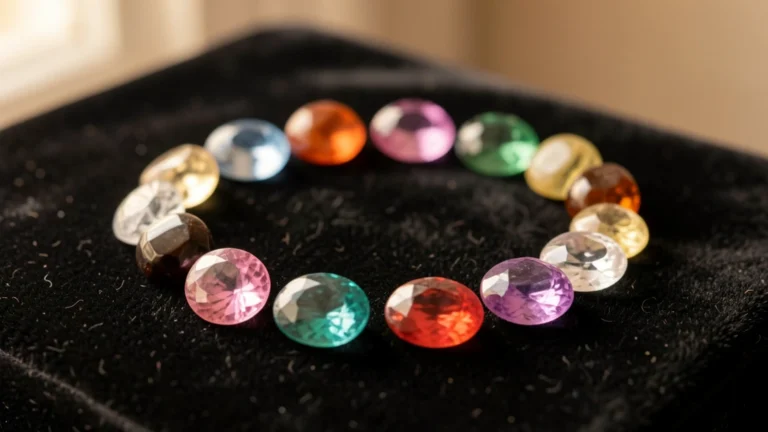
The calendar has 12 months, but the current American birthstone list names 21 stones. Six months share their spot with a second or third gem. That is why two gift guides can name different stones for the same birthday. This guide sorts out which list says what, and why.
A birthstone is a gem linked to the month you were born, from garnet in January to turquoise in December. The modern list began with American jewelers in 1912 and has gained stones several times since. Only your birth month matters, not the day or the year.
What Is a Birthstone?
A birthstone is a gemstone tied to the month a person was born. People wear it in rings and pendants or give it as a birthday gift. The link is a custom, not a property of the stone itself.
The idea is very old. The first-century historian Josephus linked the 12 stones on a high priest’s breastplate to the 12 months. Later writers matched stones to the 12 signs of the zodiac as well. Wearing one stone for your own birth month came much later.
The list you see today is far younger than those stories. In August 1912, a national jewelers’ trade group met in Kansas City and adopted a standard list. Historians point out that this list has little to do with the ancient breastplate. It is best seen as a modern custom with an old backstory.
That history explains one key point. Birthstones are cultural, not scientific. The gems themselves are real minerals with real hardness and color, but the month each one belongs to was chosen by people.
The Modern Birthstone List, Month by Month
Each month has one main modern stone, and some months add alternates. The table below shows the main stone first, then the other stones on the current American list. The color and mineral group come from the U.S. Geological Survey.
| Month | Main stone | Other stones today | Typical color | Mineral group |
|---|---|---|---|---|
| January | Garnet | None | Dark red | Garnet group |
| February | Amethyst | None | Purple | Quartz |
| March | Aquamarine | Bloodstone | Pale blue | Beryl |
| April | Diamond | None | Colorless | Carbon |
| May | Emerald | None | Bright green | Beryl |
| June | Pearl | Moonstone, alexandrite | Cream | Organic (from mollusks) |
| July | Ruby | None | Red | Corundum |
| August | Peridot | Spinel, sardonyx | Pale green | Olivine |
| September | Sapphire | None | Blue | Corundum |
| October | Opal | Tourmaline | Many colors | Hydrated silica |
| November | Topaz | Citrine | Yellow | Topaz |
| December | Turquoise | Zircon, tanzanite | Sky blue | Copper phosphate |
Look at the last column and a pattern appears. Ruby and sapphire are both corundum, just in different colors. Emerald and aquamarine are both beryl. Amethyst and citrine are both quartz, so February and November share a mineral.
Looking Up a July Birthday Step by Step
Our calculator uses a July birthday as its own example, so we will follow the same case. The steps work the same way for any date.
Step 1: Keep Only the Month
Take a birth date of July 14. Drop the day and the year, since neither one changes the answer. All that remains is July, the seventh month.
Step 2: Match the Month to the List
Find July in the modern table. The main stone is the ruby, and July has no official alternate on the current American list. So the answer is simply ruby.
Step 3: Read the Extras
The tool also shows a birth flower and a traditional meaning. For July, our calculator gives the larkspur as the flower. It says the ruby traditionally stands for passion and vitality. These meanings are customs, not measured facts.
An April birthday works the same way and gives the diamond. A birthday on February 29 still gives amethyst, because the stone follows the month. Our guide to what happens to February 29 birthdays in non-leap years covers the celebration date itself.
The Birthstone Calculator returns the modern stone, the birth flower and the traditional meaning in one step. Pick a date and read the result.
Why Do Some Months Have More Than One Stone?
Some months have extra stones because jewelers’ trade groups added them over time. Older stones were usually kept alongside the new ones, so the list grew instead of being replaced.
How the List Grew
The 1912 list named 17 stones across the 12 months. Five months had two stones each: March, June, August, October and December. In 1952, an industry council added alexandrite for June, citrine for November and pink tourmaline for October. It also swapped lapis lazuli out of December for zircon.
Two more stones arrived later. Tanzanite joined December in 2002, and spinel joined August in 2016. The current American list now has 21 stones, and six months have more than one.
Modern Versus Traditional Lists
A traditional list usually means an older European one. Those lists often differ a lot. One list from the 15th to 20th centuries gives turquoise or onyx for July and bloodstone or ruby for December.
Britain’s goldsmiths published their own standard list in 1937. The USGS birthstone table shows a similar mix, with rock crystal for April, chrysoprase for May and carnelian for July. None of these lists is wrong. Each one simply reflects a different place and time.
Where Birthstone Lookups Go Wrong
Most mix-ups come from using the wrong rule or the wrong list. These five errors cause the most confusing answers.
- Using the day of birth. The stone depends only on the month. A person born on March 1 and one born on March 31 share aquamarine.
- Mixing up birthstones and zodiac stones. Star signs run from about the 20th of one month to the 20th of the next. A zodiac stone chart gives a different answer for many people.
- Comparing two different lists. One site may use the modern American list while another uses a British or older list. Check which list a source follows before deciding one is wrong.
- Thinking an alternate stone is a mistake. A June birthday can properly use pearl, moonstone or alexandrite. All three are on the current American list.
- Treating meanings as science. Claims that a stone brings luck or health are traditions. No measured property of a gem links it to a birth month.
Which Birthstones Hold Up Best to Everyday Wear?
Diamond, ruby and sapphire hold up best, since they rate 9 to 10 on the Mohs hardness scale. Pearl, turquoise and opal are the softest main stones. Hardness measures how well a stone resists scratching.
The Mohs scale ranks 10 standard minerals, from talc at 1 to diamond at 10. Quartz sits at 7 and topaz at 8. The table below gives the USGS hardness for each main modern stone.
| Month | Stone | Mohs hardness |
|---|---|---|
| January | Garnet | 6.5 to 7.5 |
| February | Amethyst (quartz) | 7 |
| March | Aquamarine (beryl) | 7.5 to 8 |
| April | Diamond | 10 |
| May | Emerald (beryl) | 7.5 to 8 |
| June | Pearl | 2.5 to 4.5 |
| July | Ruby (corundum) | 9 |
| August | Peridot | 7 |
| September | Sapphire (corundum) | 9 |
| October | Opal | 5.5 to 6.5 |
| November | Topaz | 8 |
| December | Turquoise | 5 to 6 |
Pearl is the odd one out. The USGS lists it as an organic gem that forms inside a mollusk, and it is not as durable as mineral gems. For a daily ring, a June birthday can use moonstone or alexandrite instead. Alexandrite is a type of chrysoberyl, which rates 8.5.
Softer stones still work well in earrings and pendants, which take fewer knocks than rings. Match the setting to the stone and the gift will last longer. To check any birth date before you shop, run it through our birthstone lookup by birth date.
Common Questions About Birthstones
What Is My Birthstone if I Was Born on February 29?
Your birthstone is amethyst. The stone follows the month, and February 29 falls in February. Celebrating on March 1 in other years does not move your stone to aquamarine.
Which Months Have More Than One Birthstone?
On the current American list, six months have more than one stone. They are March, June, August, October, November and December. June, August and December each have three.
What Is the Difference Between Modern and Traditional Birthstones?
Modern birthstones come from the list American jewelers adopted in 1912 and revised later. Traditional stones come from older European customs, such as bloodstone for March or turquoise for July.
Are Ruby and Sapphire the Same Mineral?
Yes. Both are corundum, which rates 9 on the Mohs hardness scale. Red corundum is called ruby, and blue corundum is called sapphire. They are the July and September stones.
Is a Birthstone Based on My Zodiac Sign?
No. A birthstone follows the calendar month you were born in. Zodiac stones follow star signs, which start around the 20th of a month, so the two systems give different answers.
Do Birthstones Have Healing Powers?
No scientific evidence shows that any birthstone heals or changes luck. The meanings attached to each stone are cultural traditions, so enjoy them as symbols rather than as medicine.
References
References Used in This Article
- U.S. Geological Survey, Natural Gemstones: Birthstones
- U.S. Geological Survey, Natural Gemstones: Mineral Gemstones and the Mohs Scale
- U.S. Geological Survey, Natural Gemstones: Organic Gemstones
- U.S. Geological Survey, Gemstones Special Publication 14-95: Peridot
- Birthstone: History and Lists by Time Period
This article is general cultural and gem education. Birthstone lists differ by country and era, and this guide follows the current American list with older lists noted. Reviewed for accuracy by Prof. Dr. Khalil Mudassar, PhD. Last updated September 27, 2026.
Author

Shakeel Muzaffar is the Founder and Editor-in-Chief of MultiCalculators.com, bringing over 15 years of experience in digital publishing, product strategy, and online tool development. He leads the platform's editorial vision, ensuring every calculator meets strict standards for accuracy, usability, and real-world value. Shakeel personally oversees content quality, formula verification workflows, and the platform's commitment to publishing tools that are genuinely useful for students, professionals, and everyday users worldwide.