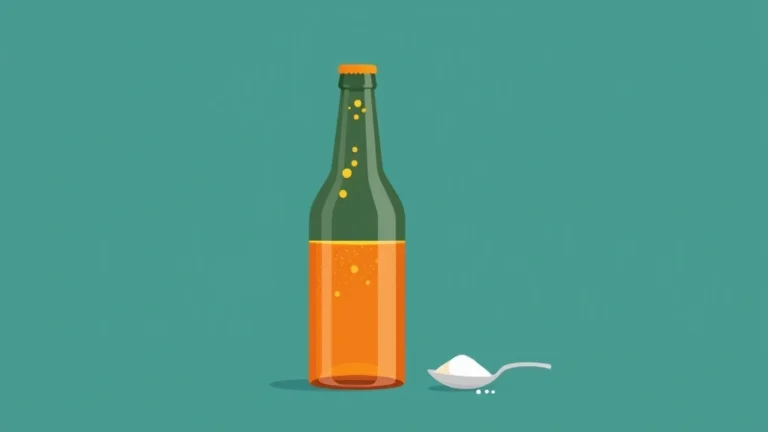
Ever wondered why a flat home brew turns fizzy a week after you cap the bottles? The secret is a small, measured dose of sugar added right before bottling. That sugar wakes up the leftover yeast, which produces carbon dioxide inside each sealed bottle and gives your beer its bubbles.
Priming sugar feeds leftover yeast at bottling, and that trapped yeast makes the carbon dioxide that carbonates your beer. To find the dose, use corn sugar grams equals 15.195 times gallons times target volumes minus residual volumes. A typical 5 gallon batch aimed at 2.4 volumes needs about 119 grams of corn sugar, or roughly 2.2 grams per bottle.
What Is Priming Sugar and How Does It Work?
Priming sugar is a small, weighed amount of fermentable sugar stirred into finished beer just before you fill the bottles. It is not there for sweetness. It is fuel for a second, tiny fermentation that happens inside each capped bottle.
Here is what happens. Live yeast is still suspended in your beer after the main fermentation ends. When you add sugar and seal the bottle, that yeast eats the sugar and gives off carbon dioxide gas. Because the bottle is closed, the gas cannot escape, so it dissolves into the beer as fizz.
The amount of sugar sets the pressure. Too little leaves the beer flat, and too much builds dangerous pressure. That is why brewers weigh priming sugar instead of guessing. You can get the exact dose for your batch from the priming sugar calculator, then read on to see where the number comes from.
How Much Priming Sugar Do You Need?
The standard dose comes from one simple formula. It links the grams of corn sugar to your batch size and to how much extra carbonation you want to add.
One key detail trips people up. The constant 15.195 is grams of corn sugar per US gallon per volume of carbon dioxide, not per liter. The per liter equivalent is about 4.01 grams per liter per volume. The on-site calculator handles that unit conversion for you, so you can enter liters or gallons safely.
A “volume” of CO2 means one volume of dissolved gas for each volume of beer. The formula asks for the gap between your target and what is already dissolved, which is where residual CO2 comes in next.
How To Find Your Target and Residual CO2
Two inputs drive the dose: your target carbonation and the CO2 already dissolved in the beer. Residual CO2 depends on the warmest temperature the beer reached during or after fermentation. Warmer beer holds less gas, so it keeps less residual CO2.
The residual CO2 estimate uses a formula credited to Michael Hall in his 1995 Zymurgy article, “Brew by the Numbers.” It reads:
Residual CO2 (volumes) = 3.0378 minus 0.050062 times T plus 0.00026555 times T squared, where T is the highest temperature in degrees Fahrenheit the beer reached. As a quick check, about 70 degrees Fahrenheit gives roughly 0.85 volumes.
Target carbonation depends on the style you are brewing. The table below lists typical ranges. Keep these as ranges, since brewers and style guides vary, and the cider figures are community estimates rather than lab values.
| Style | Typical CO2 volumes | Notes |
|---|---|---|
| British / English ales | 1.5 to 2.2 (up to about 2.4) | Soft, low carbonation |
| American ales | 2.2 to 3.0 | Medium to lively |
| German wheat / Weizen | 2.8 to 5.1 (Hefeweizen about 3.0 to 4.5) | High carbonation |
| Belgian ales | 2.0 to 4.5 | Wide range by sub-style |
| Cider | about 2.5 to 4.5 (sparkling 3.5 to 4.5) | Community estimate, approximate |
A Worked Example You Can Follow
The short answer is that a 5 gallon batch at a soft 2.4 volumes needs about 119 grams of corn sugar. Here is the full math, step by step, so you can check it by hand.
- Batch: 19 liters, which is 5.019 US gallons.
- Peak temperature: 70 degrees Fahrenheit.
- Target: 2.4 volumes of CO2, using corn sugar.
First, find the residual CO2 at 70 degrees. Plugging into the formula gives 3.0378 minus 3.50434 plus 1.30120, which equals 0.835 volumes. Next, subtract that from the target: 2.4 minus 0.835 leaves 1.565 volumes to add.
Now apply the dose formula: 15.195 times 5.019 times 1.565 equals about 119 grams of corn sugar for the whole batch. To split that across bottles, note that 19 liters fills about 53.5 bottles of 355 milliliters. So 119 divided by 53.5 is roughly 2.2 grams per bottle.
If you reach for table sugar instead, use about 9 percent less: 119 times 0.91 is about 108 grams. The next section explains why sugar type changes the number.
Corn Sugar vs Table Sugar vs DME
Different sugars carbonate at slightly different rates, so brewers scale the corn sugar dose by a factor. Corn sugar, also called dextrose, is the baseline at 1.00. Table sugar needs about 9 percent less, while malt extract and honey usually need more.
| Sugar type | Factor | Why |
|---|---|---|
| Corn sugar (dextrose) | 1.00 | Baseline, fully fermentable |
| Table sugar (sucrose) | about 0.91 (use 9 percent less) | Anhydrous, while dextrose carries about 9 percent water |
| Dry malt extract (DME) | about 1.20 to 1.47 (approximate) | Only partly fermentable, varies by product |
| Honey | about 1.11 to 1.25 (approximate) | About 75 to 85 percent fermentable, varies |
Treat the DME and honey figures as community estimates, since the fermentable share changes from one product to the next. Corn sugar and table sugar are the predictable choices. Measuring strength with the ABV calculator is a separate task from priming, but both rely on the same careful weighing habit. If you also bake, the same precision shows up in the sourdough hydration calculator, where small weight changes shift the result.
How To Avoid Over-Carbonation and Bottle Bombs
Too much priming sugar is the main risk at bottling. Extra sugar means extra gas, and extra gas means extra pressure. In a weak or overfilled bottle, that pressure can crack the glass, which brewers grimly call a bottle bomb.
Keep it practical, not scary. Weigh the sugar on a kitchen scale rather than using a scoop, since volume measures are unreliable. Use clean, sound bottles with no chips or cracks, and cap them properly. Make sure fermentation is truly finished before you bottle, so no surprise sugar is left over.
- Weigh priming sugar by grams, not by the spoonful.
- Match the target volumes to your style, not to the highest number you can find.
- Inspect every bottle for chips, and discard any that look weak.
- Store filled bottles at a steady, moderate room temperature.
When you want the exact dose for your batch, volume, temperature, and sugar type, let the tool do the arithmetic. It applies the same formulas shown here and converts units for you. You can find it alongside other brewing and kitchen tools in the hobby calculators hub.
Ready to prime a batch? Enter your volume, peak temperature, target style, and sugar type in the priming sugar calculator for an exact dose in grams, including per bottle.
FAQs About Priming Sugar
How Much Priming Sugar Per Gallon of Beer?
The dose depends on your target carbonation and residual CO2, not gallons alone. The formula uses 15.195 grams of corn sugar per US gallon per volume of CO2 added. For a soft 2.4 volume ale, that often lands near 24 grams per gallon.
Can I Use Regular Table Sugar Instead of Corn Sugar?
Yes. Table sugar, or sucrose, works fine for priming. Use about 9 percent less than corn sugar, because dextrose carries roughly 9 percent water while table sugar does not. So a 119 gram corn sugar dose becomes about 108 grams of table sugar.
What Is Residual CO2 and Why Does It Matter?
Residual CO2 is the gas already dissolved in your beer before priming. It depends on the warmest temperature the beer reached, since warmer beer holds less gas. You subtract it from your target, so ignoring it leads to over-carbonation.
Will Too Much Priming Sugar Cause Bottle Bombs?
Yes, it can. Excess sugar makes excess gas and pressure, which can crack a weak or overfilled bottle. Weigh the sugar carefully, match the target to your style, and use clean, sound bottles with no chips.
How Long Does Bottle Carbonation Take?
Most bottled beer carbonates over a couple of weeks at steady room temperature. The yeast needs time to eat the priming sugar and dissolve the gas. Cooler storage slows it down, so give flat bottles more time before judging them.
What Target CO2 Should I Use for My Style?
Match the style. British ales sit around 1.5 to 2.2 volumes, American ales around 2.2 to 3.0, and German wheat beers much higher, often 3.0 to 4.5. Cider is usually carbonated to about 2.5 to 4.5 volumes.
Can I Prime With Dry Malt Extract or Honey?
Yes, but scale up and expect variation. Dry malt extract needs roughly 1.2 to 1.47 times the corn sugar weight, and honey about 1.11 to 1.25 times, because both are only partly fermentable. Treat these as approximate figures.
Sources
Reference Sources Used in This Article
This article is for home brewing education only, not professional or safety advice. Measure carefully and use clean, sound bottles to avoid over-carbonation. Reviewed for accuracy by Prof. Dr. Khalil Mudassar, PhD. Last updated 2026-10-05.
Author

Shakeel Muzaffar is the Founder and Editor-in-Chief of MultiCalculators.com, bringing over 15 years of experience in digital publishing, product strategy, and online tool development. He leads the platform's editorial vision, ensuring every calculator meets strict standards for accuracy, usability, and real-world value. Shakeel personally oversees content quality, formula verification workflows, and the platform's commitment to publishing tools that are genuinely useful for students, professionals, and everyday users worldwide.