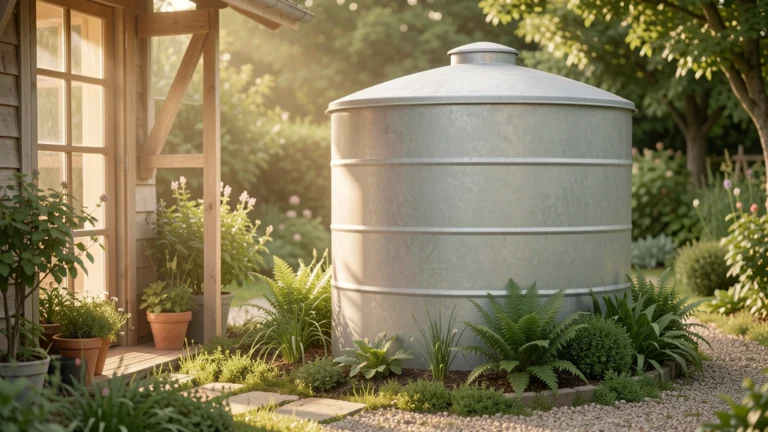
How much water fits in a round tank that is 1 m wide and 2 m tall? The answer is 1,571 liters, or about 415 US gallons. You can get that number with one short formula and a tape measure. The harder part is knowing how much of that water you can actually draw out.
Multiply length by width by height for a box tank, or use pi times radius squared times height for a round tank. Measure inside the walls in meters, then multiply cubic meters by 1,000 to get liters. Divide liters by 3.785 for US gallons, and subtract the water below the outlet and above the overflow to find usable capacity.
What Does Tank Capacity Actually Measure?
Tank capacity is the volume of water a tank holds when it is filled to the top. It is measured in liters, cubic meters or gallons. It depends only on the inside shape and size of the tank.
Volume and capacity describe the same space from two angles. Volume is the room inside the walls, usually in cubic units. Capacity is that same room stated in liquid units, such as liters or gallons.
The link between them is simple and exact. One liter equals one cubic decimeter, so 1 cubic meter holds exactly 1,000 liters. That rule is why metric tank math is so quick.
You will meet two capacity numbers on most tanks. Total capacity is the full inside volume, from floor to rim. Usable capacity is the water you can actually drain through the outlet. The gap between them often reaches 10 percent, as the last section shows.
Formulas for Box and Round Tanks
Most water tanks are either boxes or cylinders. Each shape has one formula, and both multiply a floor area by a height.
- Rectangular tank: volume = length x width x height.
- Vertical cylinder: volume = pi x r^2 x h, where r is half the inside diameter.
- Horizontal cylinder, full: volume = pi x r^2 x L, where L is the tank’s length.
These formulas come straight from solid geometry. Our guide to the volume of a cylinder, cone and sphere shows where pi x r^2 x h comes from. It also covers cone and dome shapes found on some tank tops.
Once you have the volume, convert it with the factors below. The exact US gallon is 3.785411784 liters, and 3.785 is close enough for any tank.
| From | To | Multiply by |
|---|---|---|
| Cubic meters | Liters | 1,000 |
| Cubic centimeters | Liters | 0.001 |
| Liters | US gallons | 0.2642 (or divide by 3.785) |
| Cubic feet | US gallons | 7.48 |
| Cubic feet | Liters | 28.32 |
The US gallon and the imperial gallon differ by about 20 percent. Our explainer on converting liters to gallons covers that trap in detail.
Sizing Two Real Tanks Step by Step
Let’s run the two sample tanks listed on our calculator page, then scale up to larger tanks. All sizes are inside measurements.
A Box Tank of 100 by 50 by 50 cm
Multiply 100 x 50 x 50 to get 250,000 cubic centimeters. Divide by 1,000 to get 250 liters. Divide 250 by 3.785 and you get about 66 US gallons.
A Round Tank 50 cm Wide and 100 cm Tall
The radius is half of 50 cm, which is 25 cm. Pi x 25^2 x 100 gives about 196,350 cubic centimeters. That is 196.35 liters, or about 51.9 US gallons.
Scaling Up to a Garden Tank
A 2 m x 1 m x 1 m box holds 2 cubic meters, or 2,000 liters. A round tank 1 m wide and 2 m tall holds pi x 0.5^2 x 2 = 1.571 cubic meters. That equals 1,571 liters, or 415.0 US gallons.
Working in feet instead? A 4 ft x 2 ft x 2 ft trough holds 16 cubic feet. Multiply by 7.48 to get about 119.7 US gallons, or 453 liters.
The Water Tank Capacity Calculator handles box, vertical cylinder, horizontal cylinder and capsule tanks. Enter sizes in centimeters and it returns total and filled volume. Divide its cubic centimeter result by 1,000 for liters.
How Do You Measure a Partly Full Horizontal Tank?
Find the area of the wet part of the circle, then multiply it by the tank’s length. That wet part is a circular segment, so a straight percentage of the depth gives the wrong answer.
A lying tank is narrow at the bottom and widest at the middle. The first few centimeters of water hold very little, and the middle band holds the most. So a tank filled to 25 percent of its depth holds far less than 25 percent of its volume.
The segment area for depth h in a circle of radius r is r^2 x acos((r – h) / r) – (r – h) x sqrt(2rh – h^2). Multiply that area by the length L to get the volume.
Take a tank 1 m wide and 2 m long, which holds 1,571 liters when full. At 25 cm deep it holds about 307 liters, which is 19.6 percent. At 10 cm deep it holds only about 82 liters, just 5.2 percent. At 75 cm it holds about 1,264 liters, which is 80.4 percent.
Five Ways Tank Estimates Go Wrong
Most tank errors come from the tape measure, not the formula. These five cause the biggest misses.
- Using the outside size. Walls on a plastic or concrete tank take up real space. A tank with 10 cm concrete walls loses 20 cm from every inside length and width.
- Plugging in the diameter as the radius. The radius is half the diameter. Using the full diameter makes the answer four times too big.
- Mixing units. Keep every length in the same unit before you multiply. One height in centimeters among lengths in meters throws the answer off by 100 times.
- Picking the wrong gallon. A tank sold in imperial gallons holds about 20 percent more per gallon than one sold in US gallons.
- Ignoring tapered or domed shapes. Many round tanks have sloped roofs or cone bottoms. Measure the straight wall section, then add the cone or dome part on its own.
A quick sanity check helps too. Count how many liters each centimeter of depth adds. A 1 m round tank gains 7.85 liters per centimeter, and a 2 m x 1 m box gains 20 liters.
How Much of the Tank Can You Really Use?
Usable capacity is the water between the outlet and the overflow. Water below the outlet never leaves, and water above the overflow spills out. So usable capacity is always smaller than the total.
Take the round tank again, 1 m wide and 2 m tall. Put the outlet 10 cm above the floor and the overflow 10 cm below the rim. The working height drops from 2.0 m to 1.8 m.
Pi x 0.5^2 x 1.8 gives 1.414 cubic meters, or about 1,414 liters. That is 90 percent of the 1,571 liter total. The missing 157 liters sit as dead water at the bottom and empty space at the top.
Air Gap and Freeboard
The empty band at the top is often called freeboard. It leaves room for the float valve, the inlet and the overflow pipe. The water left below the outlet lets sediment settle instead of flowing into your pipes.
For a vertical tank or a box, usable capacity is just the full formula with the working height. For a horizontal tank, run the segment formula at the overflow depth and at the outlet depth, then subtract. To size any box, round or capsule tank from its inside measurements, open our tank volume calculator in liters and gallons and adjust the height to your working level.
Common Questions About Water Tank Capacity
How Many Liters Are in 1 Cubic Meter?
One cubic meter holds exactly 1,000 liters. That is because 1 liter equals 1 cubic decimeter, and a cubic meter contains 1,000 cubic decimeters. A 2 m by 1 m by 1 m tank therefore holds 2,000 liters.
How Do You Find the Capacity of a Round Water Tank?
Multiply pi by the radius squared, then by the height, using inside measurements in meters. Multiply the result by 1,000 for liters. A tank 1 m wide and 2 m tall holds about 1,571 liters.
How Many Gallons Does a Cubic Foot of Water Hold?
One cubic foot holds about 7.48 US gallons. So a trough that measures 4 ft by 2 ft by 2 ft holds 16 cubic feet, or about 119.7 US gallons.
Why Does Depth Not Match Volume in a Horizontal Tank?
A lying cylinder is narrow near the bottom and widest in the middle. The volume matches the depth ratio only at exactly half full. At 25 percent of the depth, a horizontal tank holds just 19.6 percent of its volume.
Should You Measure a Tank Inside or Outside?
Measure inside the walls whenever you can. Outside measurements include the wall thickness, which can add several percent to the answer. For a closed tank, subtract twice the wall thickness from each outside length.
What Is the Difference Between Total and Usable Tank Capacity?
Total capacity fills the tank from floor to rim. Usable capacity counts only the water between the outlet and the overflow. A 1,571 liter round tank with 10 cm lost at each end gives about 1,414 usable liters.
References
References Used in This Article
- NIST Special Publication 811, Appendix B.9: Conversion Factors for Volume and Capacity
- NIST Special Publication 811, Chapter 5: The Liter and Other Units Outside the SI
- NIST Office of Weights and Measures, Approximate Conversions From US Customary Measures to Metric
- Wolfram MathWorld, Circular Segment: Area Formula
This article is general math and home water storage education. Volumes use inside measurements and the US gallon of 3.785411784 liters. Reviewed for accuracy by Prof. Dr. Khalil Mudassar, PhD. Last updated September 27, 2026.
Author

Shakeel Muzaffar is the Founder and Editor-in-Chief of MultiCalculators.com, bringing over 15 years of experience in digital publishing, product strategy, and online tool development. He leads the platform's editorial vision, ensuring every calculator meets strict standards for accuracy, usability, and real-world value. Shakeel personally oversees content quality, formula verification workflows, and the platform's commitment to publishing tools that are genuinely useful for students, professionals, and everyday users worldwide.