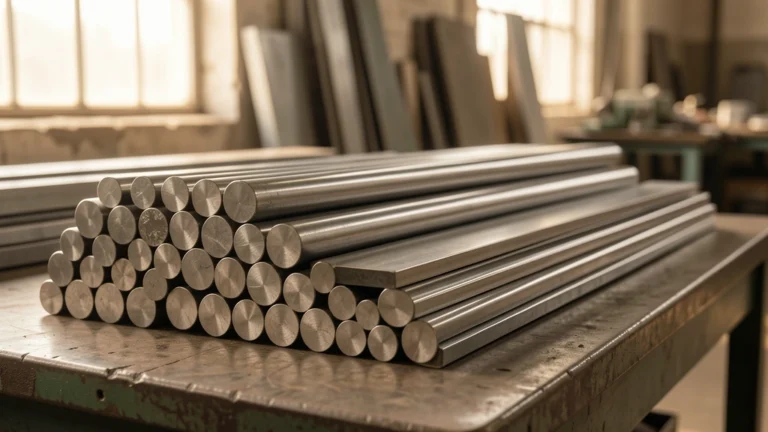
One 6 m length of 12 mm steel bar weighs about 5.3 kg. That sounds light until the truck arrives with 200 of them, which adds up to more than a tonne. You can work out that number by hand with one simple rule and a tape measure.
Steel weight equals volume times density, and steel weighs about 7,850 kg per cubic meter, or about 490 lb per cubic foot. Find the cross-section area of the shape, multiply by the length, then multiply by the density. A 12 mm round bar works out to 0.888 kg per meter.
What Sets the Weight of a Steel Piece?
Only two things set the weight: how much space the steel fills and how heavy each unit of that space is. The first is volume. The second is density.
Steel is an alloy of iron and a small amount of carbon. Its density changes a little with the recipe, usually between 7,750 and 8,050 kg per cubic meter. Most weight charts and calculators use 7,850 kg/m^3 for plain carbon steel.
In US units, that same steel weighs about 490 lb per cubic foot. The two figures agree, because 490 lb/ft^3 converts to 7,849 kg/m^3. For a deeper look at the idea itself, our guide to density with everyday examples compares metals, wood and water.
Here is the useful part. For a bar of the same shape all along its length, the volume is simply the cross-section area times the length. So the whole job comes down to one area and one multiplication.
Volume Times Density, Shape by Shape
The core formula is weight = area x length x density. Only the area formula changes from shape to shape:
- Round bar: area = pi x (d/2)^2, where d is the diameter.
- Square bar: area = side x side.
- Flat bar or plate: area = width x thickness.
- Pipe or tube: area = pi/4 x (outer diameter^2 – inner diameter^2).
Units cause most of the trouble. Bar sizes come in millimeters, lengths in meters, and density in kilograms per cubic meter. Convert the area from mm^2 to m^2 by dividing by 1,000,000 before you multiply.
Density matters as much as size. The table below uses the same densities as our calculator, applied to a 12 mm round bar.
| Material | Density (kg/m^3) | 12 mm round, per meter |
|---|---|---|
| Mild steel | 7,850 | 0.888 kg |
| Iron | 7,870 | 0.890 kg |
| Stainless steel | 8,000 | 0.905 kg |
| Brass | 8,500 | 0.961 kg |
| Aluminium | 2,700 | 0.305 kg |
Weighing a 12 mm Bar Step by Step
Take a 12 mm round mild steel bar, 6 m long, and an order of 10 pieces. This is the same example our calculator page uses, so you can check your work against it.
Step 1: Find the Area
The radius is half of 12 mm, which is 6 mm. The area is pi x 6^2 = 113.1 mm^2. Divide by 1,000,000 to get 0.0001131 m^2.
Step 2: Find the Weight per Meter
Multiply the area by the density: 0.0001131 x 7,850 = 0.888 kg per meter. This per-meter figure never depends on the length you cut.
Step 3: Scale Up to the Order
One 6 m bar weighs 0.888 x 6 = 5.33 kg. Ten bars weigh about 53.3 kg, easy for two people to carry. The same bar in aluminium drops to just 0.305 kg per meter.
Now watch what happens when the diameter doubles. A 24 mm bar weighs 3.551 kg per meter, four times as much. Weight grows with the square of the diameter, so small size jumps add real mass.
The Steel Weight Calculator returns the weight per piece, per meter and for the whole order. It handles round, square and flat bars in steel, stainless, iron, brass and aluminium.
How Do You Weigh Plates, Pipes and Rebar?
Use the same volume times density rule, but pick the right area. Plates use width x thickness, pipes subtract the hole, and rebar has its own handy shortcut.
Flat Plate
A plate 1 m wide, 2 m long and 10 mm thick holds 1 x 2 x 0.01 = 0.02 m^3 of steel. Multiply by 7,850 and it weighs 157 kg. That is too heavy for one person to lift safely.
In US units, a 1 inch plate weighs 490 / 12 = 40.8 lb per square foot. A 1/4 inch plate is a quarter of that, 10.2 lb per square foot. So a 4 ft x 8 ft sheet of 1/4 inch plate weighs about 327 lb.
Pipe and Tube
For a pipe, find the area of the outer circle and subtract the inner circle. A 60 mm pipe with a 4 mm wall has an inner diameter of 52 mm. Its steel area is 703.7 mm^2, so it weighs 5.524 kg per meter.
A solid 60 mm bar would weigh 22.195 kg per meter. The pipe uses only about 25 percent of that steel.
The Rebar Shortcut
Metric rebar users often divide the diameter squared by 162. That shortcut comes straight from the density: 7,850 x pi / 4 / 1,000,000 = 0.006165, and 1 / 0.006165 = 162.2.
For a 20 mm bar, the full formula gives 2.466 kg/m, and 20^2 / 162 gives 2.469 kg/m. The gap is only about 0.1 percent.
US rebar follows the same math. A #4 bar is 0.500 inch across and weighs 0.668 lb per foot, so a 20 ft stick weighs about 13.4 lb.
Where Steel Weight Estimates Go Wrong
Most bad estimates come from units or from the wrong area, not from the density. These five slips cause most of the errors.
- Mixing millimeters and meters. Forgetting to divide mm^2 by 1,000,000 makes the answer a million times too big.
- Squaring the diameter, not the radius. Using pi x d^2 gives a result four times too heavy. Halve the diameter first, or use pi/4 x d^2.
- Treating a pipe as solid. A 60 mm pipe with a 4 mm wall weighs 5.524 kg/m, not 22.195 kg/m. Always subtract the hole.
- Using the wrong metal. Aluminium is about one third as heavy as steel for the same shape. Check the material before you price it.
- Mixing weight per length with volume. Suppliers often price steel per meter or per foot, like lumber sold by length. Our guide on board feet vs linear feet shows the same trap in wood.
When Can You Trust a Calculated Weight?
Trust it for pricing, shipping and lifting plans. For certified loads, check it against the supplier’s data, because real bars differ slightly from the nominal size.
A calculated weight is a theoretical weight. It assumes the exact nominal size and a standard density. Real bars are rolled to a tolerance, so a piece can come out slightly heavier or lighter.
Coatings add weight too. Galvanizing and paint put extra material on the surface. Hollow sections with rounded corners also differ a little from a simple square formula.
For most jobs, a rough figure is enough. It tells you whether two people can carry a load, whether a trailer can take it, or roughly what the steel will cost. For quick numbers across many sizes, the bar and plate weight calculator saves the hand math and shows the per-meter figure.
For structural design, the stakes rise. Dead-load checks and crane lifts need certified mill data and an engineer’s review, not a rough estimate.
Common Questions About Steel Weight
What Is the Formula for Steel Weight?
Weight equals cross-section area times length times density. For steel, use a density of about 7,850 kg per cubic meter. Convert the area to square meters before you multiply.
How Much Does a Cubic Meter of Steel Weigh?
About 7,850 kg, or roughly 7.85 tonnes. The exact figure varies with the alloy, usually between 7,750 and 8,050 kg. In US units, a cubic foot of steel weighs about 490 lb.
How Do You Calculate the Weight of a Steel Pipe?
Subtract the inner circle area from the outer circle area, then multiply by length and density. A 60 mm pipe with a 4 mm wall weighs about 5.524 kg per meter.
Where Does the D Squared Over 162 Rebar Rule Come From?
It comes from the density of steel. Multiplying 7,850 by pi/4 and dividing by 1,000,000 gives 0.006165, which is 1 divided by 162.2. Enter the diameter in mm to get kg per meter.
Is Stainless Steel Heavier Than Mild Steel?
Slightly. Our calculator uses 8,000 kg per cubic meter for stainless and 7,850 for mild steel. A 12 mm stainless bar weighs 0.905 kg per meter, against 0.888 kg for mild steel.
How Much Does a Steel Plate Weigh per Square Foot?
A 1 inch steel plate weighs about 40.8 lb per square foot. Scale it by thickness, so a 1/4 inch plate weighs about 10.2 lb per square foot.
References
References Used in This Article
This article is general construction and metalwork education. Weights are theoretical figures at 7,850 kg/m^3 unless another metal is named. Reviewed for accuracy by Prof. Dr. Khalil Mudassar, PhD. Last updated September 27, 2026.
Author

Shakeel Muzaffar is the Founder and Editor-in-Chief of MultiCalculators.com, bringing over 15 years of experience in digital publishing, product strategy, and online tool development. He leads the platform's editorial vision, ensuring every calculator meets strict standards for accuracy, usability, and real-world value. Shakeel personally oversees content quality, formula verification workflows, and the platform's commitment to publishing tools that are genuinely useful for students, professionals, and everyday users worldwide.