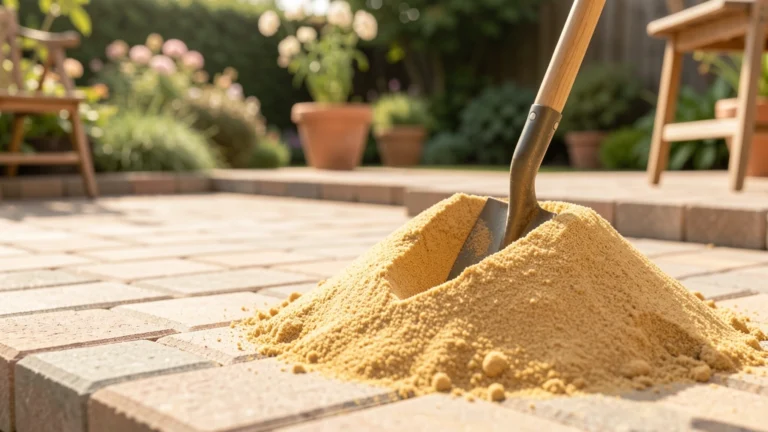
A 10 by 10 foot patio needs just 1 inch of bedding sand, yet that thin layer weighs about 830 pounds. Sand is heavy, and suppliers sell it by the cubic yard or the ton. So the real question is not only how much space you need to fill, but how that space turns into a load you can order.
Multiply length by width by depth, with every measurement in feet, to get cubic feet. Divide by 27 for cubic yards, then multiply by about 1.35 to estimate short tons of moderately damp sand. Add a small waste allowance, and add more for loose play sand that packs down over time.
What Are You Actually Measuring When You Order Sand?
You are measuring a volume: the space the sand will fill, in cubic feet, cubic yards, or cubic meters. Weight comes second, because suppliers convert that volume into tons using a density figure.
Every sand job is a slab of some shape. A sandbox, a paver bed, and a leveling layer under a pool are all flat shapes with a depth. Once you know the top area and the thickness, the math is the same for all of them.
Weight matters for two reasons. Bulk yards often price sand by the ton, and your truck or trailer has a load limit. A pickup that handles a cubic yard of mulch can be overloaded by the same yard of sand.
From Square Feet to Cubic Yards and Tons
The method has three steps, and each one is simple arithmetic:
- Volume. Length (ft) x width (ft) x depth (ft) = cubic feet. Convert inches to feet by dividing by 12.
- Cubic yards. Cubic feet / 27 = cubic yards, since 27 cubic feet make 1 cubic yard.
- Weight. Cubic yards x 1.35 = short tons, based on sand at 100 lb per cubic foot.
Round areas work the same way. Multiply pi by the radius squared to get the area, then multiply by the depth. Metric users multiply meters by meters by meters and use 1.6 tonnes per cubic meter.
The table below flips the math around. It shows how many square feet one cubic yard covers at common depths.
| Depth | Area covered | Typical use |
|---|---|---|
| 1 inch | 324 sq ft | Paver bedding layer |
| 2 inches | 162 sq ft | Leveling under a pool or shed |
| 4 inches | 81 sq ft | Thin fill or topdressing |
| 6 inches | 54 sq ft | Shallow sandbox |
| 9 inches | 36 sq ft | Settled play surfacing |
| 12 inches | 27 sq ft | Deep sandbox or fresh play surfacing |
Filling a 3 by 6 Foot Box, Step by Step
Our calculator’s own example is a box 3 feet wide, 6 feet long, and 1 foot deep. Here is the full run from dimensions to tons.
Volume and Cubic Yards
Multiply 3 x 6 x 1 to get 18 cubic feet, which matches the tool page. Divide 18 by 27 and you get 0.667 cubic yards, shown as 0.67 in the results.
Weight
Multiply 0.667 by 1.35 to get 0.90 short tons. That equals 1,800 pounds, the same as 18 cubic feet x 100 pounds per cubic foot.
A Thinner, Wider Job
Now try a 10 by 10 foot area leveled with 2 inches of sand. Convert 2 inches to 0.1667 feet, then multiply: 10 x 10 x 0.1667 = 16.67 cubic feet. That is 0.617 cubic yards and about 0.83 tons, or 1,667 pounds.
Metric works the same way. A 3 by 2 meter bed at 5 cm deep holds 0.3 cubic meters, which weighs about 0.48 tonnes.
The Sand Calculator turns width, length, and depth into cubic yards and tons, or cubic meters and tonnes. It handles rectangles and circles and adds a cost from your price per ton.
How Deep Should Sand Be for Pavers and Play Areas?
Paver bedding sand is about 1 inch thick, and play surfacing needs far more. Depth drives your order more than area does, so pick the right number before you measure anything else.
Under Pavers
Oregon State University Extension calls for 4 to 6 inches of compacted base, then 1 inch of bedding sand. Iowa State University Extension sets the maximum bedding depth at 1 1/2 inches. It also recommends concrete sand, and says to sweep dry sand into the joints.
The base below the sand is usually crushed gravel, not sand. Our guide to estimating gravel by depth and tonnage covers that layer, and the gravel calculator sizes it.
Under Play Equipment
The CPSC playground handbook lists sand among its loose-fill surfaces, with a minimum of 9 inches after settling. It warns that loose fill compresses at least 25 percent. Its own example turns a 9 inch requirement into a 12 inch initial fill.
| Job | Depth | Source |
|---|---|---|
| Paver bedding sand | 1 in (max 1 1/2 in) | Oregon State, Iowa State Extension |
| Play surfacing, settled | 9 in minimum | CPSC handbook |
| Play surfacing, fresh fill | About 12 in | CPSC 25 percent rule |
| Backyard sandbox | 6 to 12 in | Our calculator’s guide |
Five Ways a Sand Order Comes Up Short
Most bad sand estimates come from units, not from arithmetic. These five errors show up again and again on real jobs.
- Leaving depth in inches. Multiplying 10 x 10 x 2 gives 200, not 16.67. Always divide inches by 12 before you multiply.
- Dividing by 9 instead of 27. Nine converts square feet to square yards. Volume needs 27, because a cubic yard is 3 x 3 x 3 feet.
- Ignoring compaction. Loose play sand settles under feet and rain. Order enough to start about a third deeper than the settled depth you need.
- Mixing up tons and tonnes. A short ton is 2,000 pounds, or about 907 kg. A metric tonne is 1,000 kg, so 1 short ton of sand fills about 0.57 cubic meters, not 0.625.
- Measuring only the flat part. A dip or a slope holds extra sand. Split odd shapes into rectangles and circles, and add them up.
Our calculator’s guide suggests buying 5 to 6 percent more sand than the math gives, to cover spills and uneven ground.
Should You Buy Bags or a Bulk Load?
Buy bags for small jobs under about half a cubic yard, and buy bulk for anything larger. The break point depends on your local prices, but the bag count climbs fast.
One cubic yard weighs about 2,700 pounds at 100 pounds per cubic foot. That is roughly 54 bags of 50 pounds, or 45 bags of 60 pounds. The 3 by 6 foot box from earlier needs about 36 of those 50 pound bags.
Bulk sand comes by the yard or the ton on a truck. A cubic yard fits in a small pickup by volume, but its weight can pass the rated payload. Check the door sticker before you load.
Sand also shows up inside bigger projects. A slab with a sand base still needs its own concrete estimate, and our walkthrough on figuring concrete for a slab uses the same divide-by-27 step.
To size your job in seconds, enter the dimensions in our sand volume and tonnage calculator and compare the tons against your supplier’s price.
Common Questions About Sand Quantities
How Much Does a Cubic Yard of Sand Weigh?
Moderately damp sand at 100 pounds per cubic foot weighs about 2,700 pounds per cubic yard, or 1.35 short tons. Wet or coarse sand can weigh more, so ask your supplier for their figure.
How Much Sand Do I Need for a 10 by 10 Area?
At 2 inches deep, a 10 by 10 foot area needs 16.67 cubic feet, or 0.617 cubic yards. That weighs about 0.83 tons. At 1 inch deep, you need half as much.
How Much Sand Goes Under Pavers?
Extension guides call for about 1 inch of bedding sand over a compacted gravel base, with 1 1/2 inches as the maximum. A 10 by 12 foot patio at 1 inch needs 10 cubic feet, or 0.37 cubic yards.
How Deep Should Sand Be Under a Swing Set?
The CPSC playground handbook lists a 9 inch minimum for sand after it settles. Loose fill compresses at least 25 percent, so start closer to 12 inches deep.
Is a Ton of Sand the Same as a Cubic Yard?
No. A short ton of sand at 100 pounds per cubic foot fills about 20 cubic feet, or 0.74 cubic yards. A full cubic yard weighs about 1.35 tons.
How Many Bags of Sand Make a Cubic Yard?
At 100 pounds per cubic foot, one cubic yard weighs about 2,700 pounds. That equals about 54 bags of 50 pounds or 45 bags of 60 pounds.
References
References Used in This Article
This article is general estimating guidance for home and landscaping projects. Weights assume sand at 100 pounds per cubic foot (1,600 kg per cubic meter), and real loads vary with moisture and grain size. Reviewed for accuracy by Prof. Dr. Khalil Mudassar, PhD. Last updated September 27, 2026.
Author

Shakeel Muzaffar is the Founder and Editor-in-Chief of MultiCalculators.com, bringing over 15 years of experience in digital publishing, product strategy, and online tool development. He leads the platform's editorial vision, ensuring every calculator meets strict standards for accuracy, usability, and real-world value. Shakeel personally oversees content quality, formula verification workflows, and the platform's commitment to publishing tools that are genuinely useful for students, professionals, and everyday users worldwide.