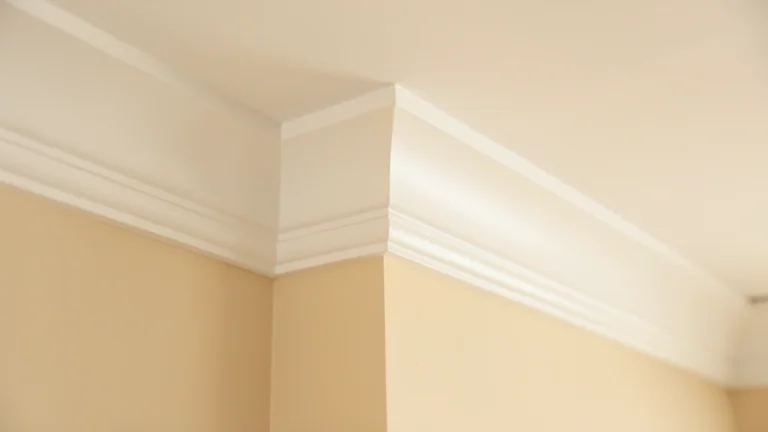
Why does a simple 90 degree corner ask for a 31.6 degree miter and a 33.9 degree bevel? Crown molding does not lie flat against the wall. It leans across the gap between wall and ceiling, so every corner cut runs through a tilted board. Two saw settings work together to copy that tilt while the molding lies flat on the table.
Standard 52/38 crown on a 90 degree corner needs a 31.6 degree miter and a 33.9 degree bevel when cut flat. Crown with a 45 degree spring needs a 35.3 degree miter and a 30 degree bevel. Both numbers come from two short formulas that use the spring angle and the corner angle.
Why Does Crown Molding Need Two Angles?
Crown needs two angles because it sits tilted between the wall and the ceiling. Laid flat on the saw, that tilt must be rebuilt with a table turn (the miter) and a blade tilt (the bevel).
A miter cut turns the saw away from square to the fence. A bevel cut tilts the blade away from square to the table. Santa Clara University’s maker lab calls a cut with both at once a compound cut.
The tilt of the molding has a name: the spring angle. It is the angle between the back of the crown and the wall. Most crown is sold with either a 38 degree or a 45 degree spring, and the formulas in this guide measure it from the wall.
Reading the Spring Angle on a Profile
Hold a scrap against a framing square, flats touching both blades, just as it sits on the wall. Measure the drop down the wall and the projection across the ceiling. A drop of 3.5 inches and a projection of 2.75 inches give a spring of 38.2 degrees from the wall.
The Miter and Bevel Formulas
Two formulas turn the spring angle S and the wall corner angle C into saw settings. The Wikipedia crown molding article lists the same pair.
- Miter = atan( sin S / tan(C/2) )
- Bevel = asin( cos S x cos(C/2) )
Try the 38 degree spring on a 90 degree corner. Sin 38 is 0.616 and tan 45 is 1, so the miter is atan(0.616), or 31.62 degrees. Cos 38 is 0.788 and cos 45 is 0.707, so the bevel is asin(0.557), or 33.86 degrees.
| Spring angle (from wall) | Common name | Miter | Bevel |
|---|---|---|---|
| 38 deg | 52/38 crown | 31.62 deg | 33.86 deg |
| 45 deg | 45/45 crown | 35.26 deg | 30.00 deg |
| 52 deg | 52/38 read from the ceiling side | 38.24 deg | 25.81 deg |
| 90 deg | flat trim | 45.00 deg | 0.00 deg |
The last row is a useful check. At a 90 degree spring the molding lies flat, the bevel drops to zero, and only a plain 45 degree miter remains. That flat-frame case, with its 180/n rule, is covered in our guide to miter angles for any shape.
Cutting a 52/38 Corner, Step by Step
Take a bedroom with a 90 degree inside corner and 52/38 crown. First, confirm the spring: a 3.5 inch drop and 2.75 inch projection give 38.2 degrees, so 38 is right.
Second, confirm the corner with an angle finder. It reads 90 degrees, so the table above applies. Set the table to 31.6 degrees and tilt the blade to 33.9 degrees.
Third, measure the length. At a 90 degree inside corner, the wall edge of the crown is the long point. It equals the wall length, while the ceiling edge is 2.75 inches shorter, one projection.
Fourth, lay the crown face up and flat on the table. Cut one test pair from 12 inch scraps before touching the long piece. Hold the pair in the corner and look for light at the top or the bottom.
Many compound miter saws carry detents at these standard crown settings, according to the Wikipedia crown article. Those stops make the 31.6 and 33.9 settings quick to repeat for every corner.
The Compound Miter Calculator takes your spring angle and corner angle and returns the table miter and the blade bevel.
How Do Odd Wall Corners Change the Settings?
A wider corner lowers both settings, and a tighter corner raises them. Always measure the real corner and split it evenly between the two pieces.
Walls are rarely perfect. A corner that measures 92 degrees needs a 30.73 degree miter and a 33.19 degree bevel with 38 degree crown. An 88 degree corner needs 32.52 and 34.53 degrees instead.
Bay windows and angled walls push the numbers down further. A 135 degree corner with 38 degree crown needs only a 14.31 degree miter and a 17.55 degree bevel. As the corner nears a straight 180 degrees, both settings shrink toward zero.
| Wall corner | Miter | Bevel |
|---|---|---|
| 88 deg | 32.52 deg | 34.53 deg |
| 90 deg | 31.62 deg | 33.86 deg |
| 92 deg | 30.73 deg | 33.19 deg |
| 120 deg | 19.57 deg | 23.20 deg |
| 135 deg | 14.31 deg | 17.55 deg |
Inside Versus Outside Corners
Inside and outside corners of the same angle use the same miter and bevel numbers. What changes is the direction the table swings and which piece is left or right. Label each scrap before cutting so the direction stays clear.
Length changes too. At a 90 degree outside corner, the ceiling edge becomes the long point instead of the wall edge.
Slip-Ups That Open Crown Joints
Most crown gaps trace back to a handful of setup errors, not bad math. Here are the five that show up most often.
- Swapping the two settings. The miter belongs on the table and the bevel on the blade. Reversing 31.6 and 33.9 looks close on the saw but leaves a clear gap on the wall.
- Assuming a 90 degree corner. A 2 degree error splits into 1 degree per piece. A 1 degree wedge opens about 0.06 inch across a 3.5 inch joint, which is easy to see.
- Using the wrong spring. Entering 45 for 38 degree crown shifts the miter by 3.6 degrees and the bevel by 3.9 degrees.
- Cutting on the line. The blade removes a strip as wide as its kerf. Cut on the waste side, as shown in our guide to saw kerf, so pieces stay full length.
- Ignoring wood movement. Purdue Extension notes that shrinking wood makes joints open, and miter joints show it badly. Let trim sit in the room before you cut.
Should You Cut Crown Flat or Nested?
Cut flat when your saw bevels and the crown is wide. Cut nested when the crown fits between table and fence, since that needs only a plain miter.
Flat cutting lays the crown face up on the table and uses both settings from the formulas. It handles wide profiles that will not stand up against a short fence.
Nested cutting stands the crown upside down against the fence, at its spring angle. The ceiling flat rests on the table and the wall flat rests on the fence. The blade stays square, and a 90 degree corner needs a plain 45 degree miter.
Nested cutting has a catch. The crown must sit at the same angle every time, or the corner drifts. A strip of wood clamped to the table as a stop holds it steady.
For inside corners, coping is a third option. The Wikipedia crown article describes it as a simple miter followed by a back-cut along the profile with a coping saw.
For flat cuts on any corner, run your numbers through the compound miter angle calculator first. Then confirm with one test pair before cutting the long pieces.
Common Questions About Crown Molding Miter Angles
What Are the Saw Settings for 38 Degree Crown Molding?
For a 90 degree corner, set a 31.6 degree miter and a 33.9 degree bevel with the crown lying flat. The exact values are 31.62 and 33.86 degrees. Other corners need new numbers from the two formulas.
Is 52/38 Crown the Same as 38 Degree Spring Crown?
Yes. The back of 52/38 crown makes about 52 degrees with the ceiling and 38 degrees with the wall. The formulas in this guide use the angle from the wall, so enter 38.
Do Inside and Outside Corners Use Different Angles?
No. A 90 degree inside corner and a 90 degree outside corner use the same miter and bevel. The direction of the table swing and the long point of each piece change, so label every cut.
How Do I Find the Spring Angle of My Crown?
Set a scrap in a framing square as it sits on the wall. Measure the drop and the projection, then take atan of projection over drop. A 3.5 inch drop and 2.75 inch projection give about 38 degrees.
Why Does My Crown Corner Gap Even With the Right Settings?
The wall corner is probably not 90 degrees, or the crown was not held at its true spring. Measure the corner with an angle finder and recalculate. A 92 degree corner needs a 30.7 degree miter with 38 degree crown.
Can I Cut Crown Molding Without Tilting the Blade?
Yes. Cut it nested, upside down against the fence at its spring angle. The blade stays square, and a 90 degree corner needs a plain 45 degree miter. Coping inside corners is another option.
References
References Used in This Article
- Crown molding: spring angle, 45 and 38 degree formats, miter and bevel formulas, coping
- Santa Clara University Maker Lab, Compound Miter Saw (miter, bevel and compound cuts)
- Miter joint: 45 degree cuts for a 90 degree corner
- Purdue Extension FNR-163, The Shrinking and Swelling of Wood and Its Effect on Furniture
This guide explains the geometry behind crown molding miter and bevel settings. Saws differ in how their scales read, so confirm every setting with a test pair of scraps. Reviewed for accuracy by Prof. Dr. Khalil Mudassar, PhD. Last updated September 27, 2026.
Author

Shakeel Muzaffar is the Founder and Editor-in-Chief of MultiCalculators.com, bringing over 15 years of experience in digital publishing, product strategy, and online tool development. He leads the platform's editorial vision, ensuring every calculator meets strict standards for accuracy, usability, and real-world value. Shakeel personally oversees content quality, formula verification workflows, and the platform's commitment to publishing tools that are genuinely useful for students, professionals, and everyday users worldwide.