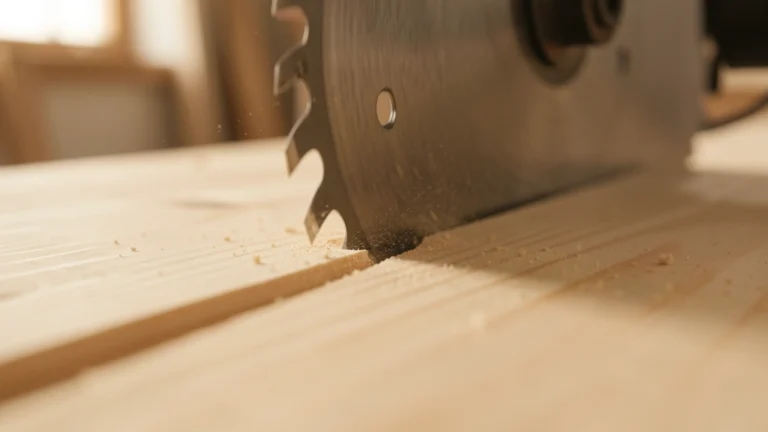
How much wood does a saw blade eat? A typical full-kerf table saw blade removes about 1/8 inch with every pass. Ten cuts turn 1.25 inches of good board into sawdust. That lost strip is called the kerf, and it quietly shortens every cut list.
Saw kerf is the width of the slot a blade cuts, and the wood in that slot becomes sawdust. Full-kerf blades often cut about 1/8 inch and thin-kerf blades about 3/32 inch, though every blade differs. Add one kerf per cut to your cut list, and keep the blade on the waste side of your pencil line.
What Is Saw Kerf?
Saw kerf is the slot a saw blade cuts through wood, and also the width of that slot. The wood that filled the slot leaves as sawdust, so neither piece gets it back.
The kerf is wider than the steel body of the blade. The teeth stick out slightly past the body on each side, and this overhang is called the set. The set clears a path so the blade body does not rub and bind in the cut.
Blade thickness alone does not decide the kerf width. Wobble, a worn arbor, and fibers torn from the cut walls all widen the slot. Two blades with the same listed size can cut slightly different kerfs.
Typical figures help with planning, but they are not rules. Many full-kerf table saw blades cut about 1/8 inch, or 0.125 inch. Many thin-kerf blades cut about 3/32 inch, or roughly 0.094 inch. The exact width is printed on most blades, and it varies from one model to the next.
The Stock Length Formula
The math takes one line. The stock length you need equals the total length of your pieces plus the number of cuts times the kerf.
Stock length = (pieces x piece length) + (cuts x kerf)
When you part pieces off a long board, count one cut per piece. That safe default covers the last cut that frees the final piece from the offcut. Cutting from both ends or nesting parts can save a cut now and then.
| Cuts | Full kerf, 1/8 in | Thin kerf, 3/32 in | Thin kerf saves |
|---|---|---|---|
| 5 | 0.625 in | 0.469 in | 0.156 in |
| 10 | 1.25 in | 0.938 in | 0.313 in |
| 20 | 2.5 in | 1.875 in | 0.625 in |
| 40 | 5.0 in | 3.75 in | 1.25 in |
The table shows why kerf hides on small jobs. Five cuts with a full-kerf blade cost only 5/8 inch. Forty cuts cost 5 full inches, which is close to half a foot of board.
Kerf also comes out of a board’s width. Rip a 5 1/2 inch wide board into two equal strips with a 1/8 inch blade. Each strip ends up 2 11/16 inches wide, not 2 3/4 inches. Once you know the total length, our guide to board feet vs linear feet shows how to turn it into a lumber order.
Twelve Slats From One 8-Foot Board
Say you need 12 slats, each 7 7/8 inches long, for a drawer divider. Your board is 8 feet, or 96 inches, and both ends are already square.
Before Counting Kerf
Twelve slats at 7.875 inches add up to 94.5 inches. That seems to leave 1.5 inches to spare, which feels like plenty of room.
With a Full-Kerf Blade
Twelve cuts at 1/8 inch remove 1.5 inches of wood. Add that to 94.5 and you need exactly 96 inches. The spare room vanishes, and one small slip leaves the last slat short.
With a Thin-Kerf Blade
Twelve cuts at 3/32 inch remove 1.125 inches. You now need 95.625 inches, which leaves 3/8 inch of margin. That thin margin separates finishing tonight from a second trip for lumber.
With the full-kerf blade, kerf takes about 1.56 percent of this board. That share sounds tiny, yet it erases the whole safety margin.
The Woodworking Kerf Calculator adds kerf to your pieces. It shows the stock length, total kerf loss, number of cuts, and kerf as a share of the board.
Which Side of the Line Should the Blade Cut?
Put the blade on the waste side of your pencil line. The line then marks the finished edge, and the kerf comes out of the scrap instead of your part.
Center the blade on the line and each side loses half a kerf. With a 1/8 inch blade, the piece ends up 1/16 inch short. Repeat that at both ends and one part loses the full 1/8 inch.
Measure From the Fresh Edge
Many cut lists go wrong at the marking stage. Hooking a tape once and marking 12, 24, and 36 inches ignores the kerf between pieces. Each cut takes 1/8 inch from the next piece, so every piece after the first comes out short.
Cut the first piece, then measure the next one from the new square end. A stop block on a saw fence does the same job, because it sets each length from the blade’s cutting face.
Habits That Leave Boards Short
Most kerf trouble starts before the saw even turns on. These five habits cause the classic short last piece.
- Buying the exact total. Pieces that add up to the board length leave no room for a single kerf. Add one kerf per cut before you shop.
- Skipping the squaring cut. Rough or split board ends need a trim before the first piece. That trim costs its own offcut plus one more kerf.
- Guessing the blade width. Read the width printed on the blade, or measure a test slot with calipers. Kerf widths vary more than most people expect.
- Treating kerf as the waste allowance. Kerf covers sawdust only. Knots, splits, and cutting errors need a separate allowance, and our guide on how to calculate material waste and overage covers that step.
- Switching saws mid-project. A circular saw, a band saw, and a table saw blade each cut a different width. Recheck the cut list whenever the tool changes.
One small habit prevents most of these errors. Write the kerf width at the top of every cut list, right next to the board length.
Is a Thin-Kerf Blade Worth It?
A thin-kerf blade pays off for long runs of cuts, costly hardwood, and lower-power saws. A full-kerf blade suits heavy ripping, where its stiffer body stays straighter in the cut.
The savings are real but small per cut. Going from 1/8 to 3/32 inch saves 1/32 inch per cut, which is 25 percent less sawdust. Over 40 cuts, that adds up to 1.25 inches of board.
Sawmills see the same effect on a bigger scale. One forest products study describes seven boards sawn from one log face. Cutting the kerf by 0.085 inch gained 0.595 inch on that face, or 1.19 inches across two faces. The authors note that real gains depend on log diameter and lumber thickness.
Match the Riving Knife
Check your saw’s splitter or riving knife before you switch blades. Federal workplace rules require a ripsaw spreader to be slightly thinner than the kerf and slightly thicker than the blade body. A knife made for a full-kerf blade is often thicker than a thin kerf, and the board then catches on it.
Ready to plan a real project? Enter your piece count, piece length, and measured kerf into our kerf and stock length calculator before you buy lumber.
Common Questions About Saw Kerf
How Wide Is a Typical Saw Kerf?
Many full-kerf table saw blades cut about 1/8 inch, and many thin-kerf blades cut about 3/32 inch. Exact widths vary by blade, so check the printed spec or measure a test cut.
Does Kerf Matter When You Make Only a Few Cuts?
One cut with a 1/8 inch blade loses only 1/8 inch. It matters when a part needs an exact length or when cuts add up. Ten cuts with that blade lose 1.25 inches.
How Many 1-Foot Pieces Can You Cut From an 8-Foot Board?
You get seven full pieces with a 1/8 inch kerf. Seven cuts remove 7/8 inch, so the eighth piece measures 11 1/8 inches instead of 12 inches.
Should You Cut on the Pencil Line or Beside It?
Cut beside it, on the waste side. The line then stays on your finished piece, and the kerf comes out of the scrap. Centering a 1/8 inch blade on the line leaves the piece 1/16 inch short.
How Do You Measure Your Own Blade’s Kerf?
Make a short cut in a piece of scrap and measure the slot width with calipers. A slot wider than the printed spec points to blade wobble, so use the measured number in your plans.
Does Kerf Count When Ripping Plywood Into Strips?
Yes. Ripping a 48 inch wide sheet into 4 equal strips takes 3 cuts. With a 1/8 inch kerf, each strip comes out 11 29/32 inches wide, not 12 inches.
References
References Used in This Article
- Virginia Tech and USDA Forest Service, The Effect of Kerf Thickness on Hardwood Log Recovery (Forest Products Journal, 2022)
- USDA Forest Service Treesearch, Software Analyzes Feasibility of Saw Kerf Reduction for Hardwood Mills
- eCFR, 29 CFR 1910.213 Woodworking Machinery Requirements (Spreader Thinner Than the Saw Kerf)
- Saw: Kerf, Tooth Set, and Blade Wobble
This article is general woodworking education. Kerf widths shown are typical values, so measure your own blade before you plan a cut list. Reviewed for accuracy by Prof. Dr. Khalil Mudassar, PhD. Last updated September 27, 2026.
Author

Shakeel Muzaffar is the Founder and Editor-in-Chief of MultiCalculators.com, bringing over 15 years of experience in digital publishing, product strategy, and online tool development. He leads the platform's editorial vision, ensuring every calculator meets strict standards for accuracy, usability, and real-world value. Shakeel personally oversees content quality, formula verification workflows, and the platform's commitment to publishing tools that are genuinely useful for students, professionals, and everyday users worldwide.