Why does a picture frame need 45 degree cuts while a hexagon needs only 30? One short rule explains both. Divide 180 by the number of sides, and you have the saw setting for any equal-sided frame. This guide shows where that rule comes from, how to handle uneven corners, and why tiny errors grow into gaps.
For a frame with equal sides, set the miter saw to 180 divided by the number of sides. That gives 45 for a square, 30 for a hexagon, and 22.5 for an octagon. For an uneven corner, halve the measured corner angle and subtract that from 90 to get the saw setting. Every cut error counts twice at each joint, so test on scrap first.
What Is a Miter Angle?
A miter angle is the angle you cut across the end of a board so two boards meet cleanly at a corner. Each board takes half of the turn, so the joint line splits the corner into two equal parts.
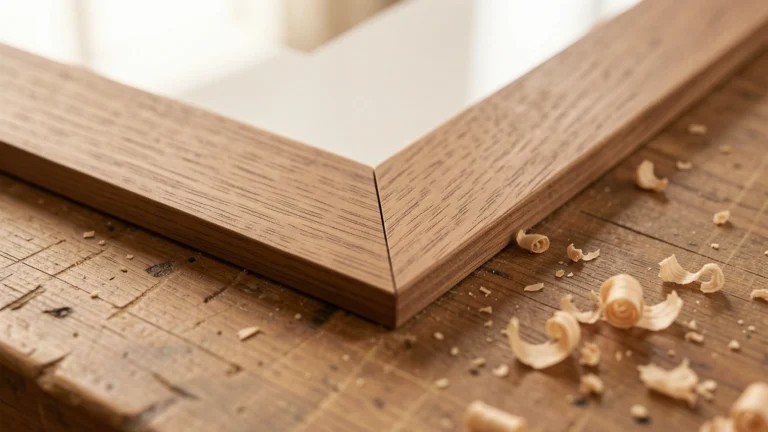
The classic case is a picture frame. Four pieces, each cut at 45 degrees, meet to form four 90 degree corners. The joint hides the end grain and gives the frame one smooth, continuous look.
Three angles show up in every mitered frame, and mixing them up causes most bad cuts:
- Corner angle. The inside angle where two pieces meet, such as 90 degrees in a square.
- Turn angle. How far the frame turns at each corner, which is 180 minus the corner angle.
- Saw setting. The number you dial on the saw, which equals half the turn angle.
A miter saw scale reads 0 for a plain square cut. Every setting is measured away from that square line, not from the edge of the board. That detail matters once you leave the square frame behind.
The 180-Over-Sides Rule
For any frame with equal sides and equal corners, the saw setting is 180 divided by the number of sides. A square needs 180 / 4 = 45 degrees, and a hexagon needs 180 / 6 = 30 degrees.
The rule comes from basic geometry. Walk once around any closed shape and you turn a full 360 degrees in total. A corollary to Euclid’s Proposition 32 states that these outside turns add up to four right angles.
Split 360 degrees evenly over n corners, and each corner turns 360 / n. Two boards share that turn, so each cut takes half: 180 / n. The corner angle itself is (n – 2) x 180 / n.
| Sides | Saw setting | Corner angle | Turn at each corner | Mitered ends to cut |
|---|---|---|---|---|
| 3 (triangle) | 60 deg | 60 deg | 120 deg | 6 |
| 4 (square) | 45 deg | 90 deg | 90 deg | 8 |
| 5 (pentagon) | 36 deg | 108 deg | 72 deg | 10 |
| 6 (hexagon) | 30 deg | 120 deg | 60 deg | 12 |
| 8 (octagon) | 22.5 deg | 135 deg | 45 deg | 16 |
| 12 sides | 15 deg | 150 deg | 30 deg | 24 |
Building a Six-Sided Planter
Say you want a hexagon planter with six sides, each 12 inches long on the outside. The boards are 3.5 inches wide. Here is the full plan.
First, find the saw setting. 180 / 6 = 30 degrees, and each corner closes at 120 degrees. Six pieces with two ends each means 12 mitered cuts.
Next, find the short side of each piece. A mitered end shifts the inside edge by the board width times the tangent of the saw setting. Both ends shift, so the inside edge is 2 x 3.5 x tan 30 = 4.04 inches shorter.
That makes each piece 12 inches on the long point and 7.96 inches on the short point. You need 72 inches of outside length, or 6 linear feet, before waste.
The Miter Angle Calculator takes the number of sides and returns the saw setting, the corner angle, the turn angle, and the number of joints.
How Do You Split an Uneven Corner?
Measure the real corner angle, halve it, and subtract that half from 90. The result is your saw setting. A true 90 degree corner gives 90 – 45 = 45, which matches the square frame.
Walls and old furniture are rarely perfect. A wall corner that measures 92 degrees needs 90 – 46 = 44 degrees on the saw. A tight 88 degree corner needs 46 degrees instead.
Wider corners need smaller settings. A 135 degree corner, common on bay windows, needs 90 – 67.5 = 22.5 degrees. A 150 degree corner needs just 15 degrees.
Frames With Mixed Corners
Some shapes mix corner sizes, like a kite or a long, stretched hexagon. Treat each corner on its own. Both pieces at one corner share the same setting, but the next corner can differ.
Use an angle finder or a sliding bevel to read each corner. Write the setting on both pieces before you cut, because a mixed frame is easy to assemble in the wrong order.
Why Do Tiny Cut Errors Open Big Gaps?
Every corner joins two cut ends, so each error counts twice per joint. Around a whole frame, the errors add up and all land on the last corner you close.
Take a square frame cut at 45.5 degrees instead of 45. Each corner closes at 89 degrees, and four corners total 356 instead of 360. The final joint opens by 4 degrees.
On 2 inch wide molding, a 4 degree wedge opens to roughly 0.14 inch at its wide end. More sides make it worse. An octagon has 16 cuts, so the same slip adds up to 8 degrees.
Other habits cause gaps too. Reading 30 on the wrong side of the scale flips the cut. Cutting pieces to slightly different lengths also skews the frame, even with perfect angles.
Seasons move joints as well. Oregon State University Extension notes that fully dried wood shrinks about 8 percent along its growth rings. Along its length, it shrinks only about 0.1 percent. A miter can open slightly as the board narrows.
Planning Your Next Mitered Project
Start with the shape, then check that your saw can reach the setting. Many miter saws have quick stops at 15, 22.5, 30, and 45 degrees, which cover 12, 8, 6, and 4 sides.
A triangle needs 60 degrees, which sits at or past the edge of many saw scales. A simple sled or a table saw jig handles it more easily. Pentagons need 36 degrees, which has no common stop, so set it by the scale and test it.
Next, work out how much stock to buy. Add up the long points of every piece, then add extra for test cuts and mistakes. Trim is sold by length, so read how board feet and linear feet differ before you order.
Flat frames need only the miter. Pieces that tilt against the wall, like crown, need a bevel too. That case is covered in our guide to crown molding compound miter angles.
For any equal-sided frame, the miter angle calculator for frames and polygons gives the setting, the corner angle, and the joint count at once. Check it against a scrap test before cutting good stock.
Common Questions About Miter Angles
What Angle Do I Cut for a Picture Frame?
Set the saw to 45 degrees for a standard four-sided frame. Each of the 8 ends gets the same cut, and each pair of ends closes into a 90 degree corner.
Is the Miter Angle the Same as the Corner Angle?
No. The saw setting is half the turn at each corner, measured from a square cut. A hexagon has 120 degree corners, yet the saw setting is only 30 degrees.
What Miter Angle Does an Octagon Need?
An octagon needs 22.5 degrees, since 180 divided by 8 is 22.5. It has eight 135 degree corners and 16 mitered ends, and many miter saws have a stop at 22.5.
How Do I Cut a Miter for a Wall Corner That Is Not Square?
Measure the corner, halve it, and subtract the half from 90. A 92 degree corner gives 90 minus 46, so set the saw to 44 degrees on both pieces.
Why Does My Frame Have a Gap at the Last Corner?
Small errors add up across every cut. A half degree error on each of 8 cuts leaves a 4 degree gap in a square frame. Test on scrap and adjust the setting.
When Do I Need a Compound Miter Instead of a Simple One?
You need a compound miter when the pieces tilt instead of lying flat, as crown molding does. The saw then needs a bevel setting as well as a miter setting.
References
References Used in This Article
This guide covers flat miter cuts for frames, polygons, and uneven corners. Saw scales and wood vary, so confirm each setting with a test cut. Reviewed for accuracy by Prof. Dr. Khalil Mudassar, PhD. Last updated September 27, 2026.
Author

Shakeel Muzaffar is the Founder and Editor-in-Chief of MultiCalculators.com, bringing over 15 years of experience in digital publishing, product strategy, and online tool development. He leads the platform's editorial vision, ensuring every calculator meets strict standards for accuracy, usability, and real-world value. Shakeel personally oversees content quality, formula verification workflows, and the platform's commitment to publishing tools that are genuinely useful for students, professionals, and everyday users worldwide.