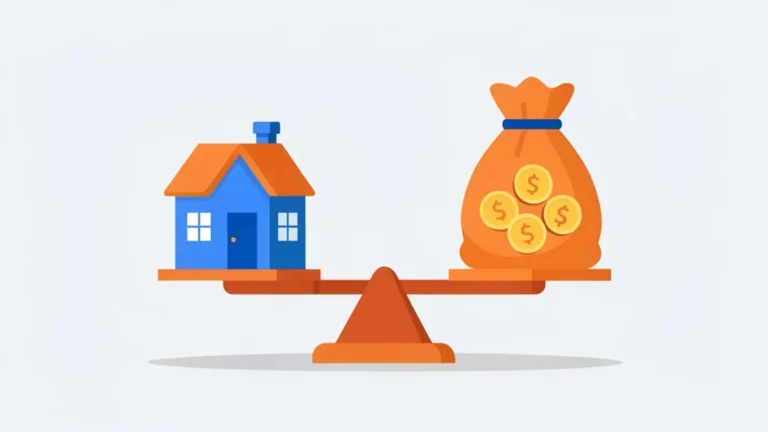
Could one quick sum tell you whether a rental is worth a closer look? That is the promise of the 1% rule. It says the monthly rent should be at least 1% of the purchase price. So a $200,000 home would need to rent for about $2,000 per month to pass. The rule is a fast first screen, not a full deal analysis, but it helps you sort many listings in seconds.
The 1% rule says a rental property’s monthly rent should be at least 1% of its purchase price. To check, multiply the price by 0.01 and compare that target to the expected rent. A $200,000 home needs about $2,000 per month to pass. It is a quick screening filter only. It ignores expenses, taxes, and financing, so run a full analysis before you ever buy.
What Is the 1% Rule?
The 1% rule is a simple shortcut real estate investors use to screen rental properties fast. It compares one number to another and gives you a quick yes or no.
The idea is easy to state. A property’s monthly rent should equal at least 1% of the price you pay for it. If the rent meets or beats that mark, the property passes the screen.
Think of it as a filter, not a verdict. It does not tell you a deal is good. It only tells you a property may be worth the time it takes to study it closely.
Investors like it because screening homes one by one is slow. A quick rule lets you skip the obvious misses and save your energy for the few listings that deserve a real look.
How to Apply the 1% Rule in Seconds
You only need two numbers: the purchase price and the expected monthly rent. The math takes a few seconds in your head or on a phone.
Here is the formula in plain terms:
- Target rent = Purchase Price x 1% (that is price x 0.01).
- If expected monthly rent is greater than or equal to the target, it passes.
- If expected monthly rent is below the target, it fails.
You can also flip it into a ratio. Divide the monthly rent by the purchase price. If the result is 1% or higher, the property clears the screen.
Worked Examples: Pass and Fail
Numbers make the rule click. Below are three quick checks using realistic prices and rents. Do the math yourself to see how fast it goes.
A $200,000 home needs at least $2,000 per month. If it rents for $1,500, divide: $1,500 / $200,000 = 0.0075, or 0.75%. That is below 1%, so it fails.
Now take a $150,000 home that rents for $1,600. Divide: $1,600 / $150,000 = 0.0107, or about 1.07%. That clears 1%, so it passes the screen.
The cheaper home passed even with lower rent. That is the point: the rule rewards rent that is high relative to price, not high in dollars alone.
The Rent-to-Price Ratio Zones
Every property lands somewhere on a simple scale. That scale is the rent-to-price ratio, which is monthly rent divided by purchase price.
Below 1% means the property fails the screen for now. At exactly 1% it sits right on the line and just clears it. Above 1% means it passes with room to spare.
Higher is not automatically better, though. A very high ratio can signal a low-cost area with added risks, like weaker demand or higher upkeep. The ratio is a starting point, not a final score.
The 2% Rule and Why It Is Rare Today
You may also hear about the 2% rule. It works the same way but sets a higher bar for rent.
Under the 2% rule, monthly rent should be at least 2% of the price. So a $100,000 home would need to rent for about $2,000 per month to pass.
That target is very hard to hit in most markets now. Home prices have climbed faster than rents in many areas, so few standard properties clear 2%. Treat the 2% rule as a rare stretch goal, not a normal expectation.
If a listing does clear 2%, be extra careful. Such high ratios often appear in low-price areas that carry real risks, so a strong screen there still demands a close look.
What the 1% Rule Ignores
The rule is fast because it leaves almost everything out. That speed is its strength and its biggest weakness.
It looks only at rent and price. It tells you nothing about the real costs and risks of owning the property.
- Operating expenses: repairs, maintenance, property management, and insurance.
- Property taxes: these vary widely by location and can change over time.
- Financing: your mortgage rate and loan terms shape your real cash flow.
- Vacancy: months with no tenant reduce the income you actually collect.
- Local market: demand, job growth, and rent trends differ from place to place.
Because of these gaps, a property can pass the 1% rule and still lose money. The rule is a filter, not a full analysis.
When the Rule Helps and When It Misleads
The 1% rule shines at the very start of a search. It helps you skim a long list and drop the clear non-starters fast.
It is useful when you are comparing many similar properties in one area. It gives you a quick, consistent way to rank them before deeper study.
It misleads when you treat a pass as a green light. High-tax areas, costly repairs, or high interest rates can sink a property that looks fine on paper. It can also wrongly reject strong homes in pricey, high-demand markets where ratios rarely reach 1%.
What to Do After a Property Passes
A passing score means one thing: keep looking. The rule has done its job as a filter, and now the real work starts.
Next, study the full picture with proper return metrics. Each one answers a different question that the 1% rule cannot.
- Cap Rate Explained for Real Estate Investors covers income versus value after expenses.
- Gross Rent Multiplier Explained shows another quick price-to-rent measure.
- How to Analyze a Rental Property Deal walks through a complete review.
To turn rough numbers into a real estimate, try our Real Estate ROI Calculator. It factors in costs and financing that the 1% rule leaves out.
Passed the 1% screen? Run the real numbers next. Our Real Estate ROI Calculator weighs expenses, taxes, and financing so you can see whether a property truly pencils out before you make an offer.
Frequently Asked Questions About the 1% Rule
What Is the 1% Rule in Real Estate?
The 1% rule says a rental property’s monthly rent should be at least 1% of its purchase price. You multiply the price by 0.01 to get the target rent. If the expected rent meets or beats that number, the property passes this quick screen. It is a filter for sorting listings, not a full analysis.
How Do I Calculate the 1% Rule?
Multiply the purchase price by 1%, which is the same as multiplying by 0.01. That gives your target monthly rent. For a $200,000 home, the target is $2,000 per month. If the expected rent is equal to or higher than the target, the property passes the screen.
Does a $200,000 Home Pass the 1% Rule?
A $200,000 home needs at least $2,000 per month to pass. If it rents for $1,500, the ratio is 0.75%, so it fails. If it rents for $2,000 or more, it passes. The outcome depends entirely on the rent the property can realistically earn.
Is the 1% Rule Still Realistic Today?
In many markets, fewer properties clear 1% because prices have risen faster than rents. Some lower-cost areas still offer deals above 1%, while high-demand cities rarely do. Use the rule as a quick screen, and adjust your expectations to local conditions rather than treating 1% as a fixed law.
What Is the Difference Between the 1% Rule and the 2% Rule?
Both compare rent to price, but the 2% rule sets a higher bar. It asks for rent equal to at least 2% of the price. A $100,000 home would need about $2,000 per month. The 2% rule is very hard to meet in most markets today.
What Does the 1% Rule Leave Out?
The rule ignores operating expenses, property taxes, insurance, repairs, vacancy, and financing costs. It looks only at rent and price. Because of these gaps, a property can pass the 1% rule and still lose money. Always follow a passing screen with a full deal analysis before buying.
Should I Buy a Property Just Because It Passes?
No. Passing the 1% rule only means a property is worth a closer look. It does not confirm the deal is profitable. After a property passes, study its costs, financing, and local market, and review return metrics like cap rate before you decide to make an offer.
Sources
Authoritative Sources Used in This Article
This article is for general education only, not financial or investment advice. Real estate returns depend on price, rent, costs, financing, and local market conditions that vary and change, so run your own numbers and consult a professional. Reviewed for accuracy by Prof. Dr. Khalil Mudassar, PhD. Last updated September 12, 2026.
Author

Shakeel Muzaffar is the Founder and Editor-in-Chief of MultiCalculators.com, bringing over 15 years of experience in digital publishing, product strategy, and online tool development. He leads the platform's editorial vision, ensuring every calculator meets strict standards for accuracy, usability, and real-world value. Shakeel personally oversees content quality, formula verification workflows, and the platform's commitment to publishing tools that are genuinely useful for students, professionals, and everyday users worldwide.