Why does one sourdough bake up tight and dense while the next turns airy and open? The answer is often a single number called hydration. It measures how much water a dough holds against its flour, written in a shorthand called baker’s percentage. Learn to read that number and you can predict how a dough will feel and bake before you ever touch it. This guide teaches the concept behind the percentage, not just the calculator that spits out the weights.
- Hydration is the weight of water as a percentage of the flour weight.
- In baker’s percentage, flour is always 100 percent, and everything else compares to it.
- A 70 percent hydration dough has 700 grams of water per 1000 grams of flour.
- Higher hydration gives a wetter dough, an opener crumb, and a harder handle.
- Most sourdough sits between 65 and 80 percent, tuned to the bread you want.
What Is Baker’s Percentage?
Baker’s percentage is a recipe shorthand where flour always equals 100 percent and every other ingredient is written as a share of that flour weight. The numbers can climb past 100, and that is fully intentional. Flour is the fixed anchor, so nothing is measured against the finished dough.
Water at 70 percent means the water weighs 70 percent of the flour weight. Salt at 2 percent means the salt weighs 2 percent of the flour. Most loaves keep salt near that 2 percent mark, which seasons the crumb without stalling fermentation.
The system exists to make recipes scale cleanly. Double the flour and every other weight doubles with it, so the ratios hold steady. A formula for one loaf becomes a formula for ten with simple multiplication.
It also makes recipes easy to compare. Two bakers can trade percentages and know at a glance how wet or salty each dough runs. The batch size drops out, and only the true proportions remain.
How Do You Read a Hydration Number?
Hydration is just the water percentage: divide the total water weight by the total flour weight, then multiply by 100. So 700 grams of water with 1000 grams of flour gives exactly 70 percent hydration.
The math stays clean only when you work in weights, never volumes. A cup of flour can vary widely depending on how you scoop and settle it. Weighing removes that swing and makes every percentage repeatable across bakes.
Grams beat ounces here for the same reason. Whole gram numbers are easy to add, halve, and scale in your head. A kitchen scale that reads to one gram is the single best tool for consistent bread.
You can also convert an older volume recipe before mixing. Our guide on baking measurement conversions from cups to grams turns cups into the gram weights this formula needs. Once every ingredient is in grams, the hydration figure falls out in one quick step.
Does the Starter Count Toward Hydration?
Yes, the starter counts, because a ripe 100 percent starter is roughly half flour and half water by weight. Both halves must join your totals for an honest hydration figure.
Picture adding 200 grams of a 100 percent starter to a dough. That folds in about 100 grams of water and 100 grams of flour on top of your main ingredients. Ignore it and your real hydration drifts well away from the number you planned.
The effect grows with larger levains. A high proportion of starter can move your true hydration by several points, which changes how the dough feels in the hand. Careful bakers always account for it.
Tracking that by hand is fiddly and easy to get wrong. The Sourdough Hydration Calculator folds the starter in automatically and returns the exact water and flour weights for your target. That keeps results steady from one loaf to the next.
What Does Hydration Do to the Crumb?
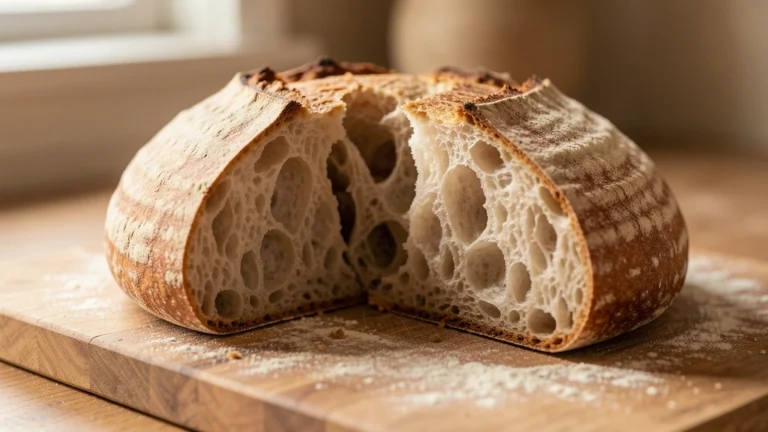
More water opens the crumb, because a wetter dough traps steam and blows larger holes as it bakes. That open, glossy interior is the signature of ciabatta and rustic country loaves.
Wetter dough also handles harder. It spreads on the bench, sticks to your fingers, and demands strong gluten and confident shaping. The payoff is lightness and those dramatic irregular holes.
Drier dough behaves the opposite way. It stays firm, kneads easily, and holds a tidy shape with far less skill. The trade is a tighter, more even crumb that slices cleanly.
Neither extreme is better on its own. A close crumb suits sandwiches and toast, while an open crumb suits dunking in soup or oil. Match the water to the bread you actually want.
What Hydration Should You Aim For?
Aim for the hydration that matches your bread, not one universal target, because every style has its own comfortable range. Most sourdough settles between 65 and 80 percent.
Stiff breads sit at the low end. Bagels and pretzels run about 50 to 57 percent, which builds their dense, chewy bite and firm shape. A soft sandwich loaf lands near 60 to 68 percent for an even, tender crumb.
Rustic loaves climb higher. Country sourdough works around 68 to 78 percent, giving the open, irregular structure bakers prize. Ciabatta and focaccia push 80 to 90 percent, slack and wet, for the most dramatic holes of all.
Treat these as starting points, not rules. Your flour, your climate, and your handling all shift the sweet spot. Pick a range, bake it twice, then nudge the water up or down.
| Bread | Hydration | Character |
|---|---|---|
| Bagels, pretzels | 50 to 57% | Stiff, chewy, dense |
| Sandwich loaf | 60 to 68% | Even, soft crumb |
| Country sourdough | 68 to 78% | Open, rustic |
| Ciabatta, focaccia | 80 to 90% | Very open, wet |
How Do You Adjust Hydration for Your Flour?
Adjust hydration to your flour, because different flours drink different amounts of water. Whole grain and high protein flours absorb more, so they carry higher hydration comfortably.
Start any unfamiliar flour a little drier than the recipe states. Hold back a portion of the water, mix, then judge the dough before adding the rest. Reaching wetter later is easy; pulling back a soupy dough is not.
Weather matters more than people expect. Humid days leave flour holding extra moisture, so the same recipe feels wetter on your hands. Dry winter air does the reverse.
Keep short notes on every bake. Record the flour, the hydration, and how the dough felt, and your ideal numbers will settle within a handful of loaves. That log is worth more than any single recipe.
The Sourdough Hydration Calculator takes your target hydration and starter, then gives you the precise amounts to weigh out.
FAQs About Sourdough Hydration
What Is Sourdough Hydration?
Hydration is the weight of water as a percentage of the flour weight. A dough with 700 grams of water and 1000 grams of flour is 70 percent hydration. It controls how wet the dough is and how open the crumb turns out.
What Does Baker’s Percentage Mean?
It is a way of writing a recipe where flour is always 100 percent and every other ingredient is a percentage of the flour weight. It makes recipes easy to scale and compare, which is why the numbers can add up past 100.
Why Is Flour Always 100 Percent in Baker’s Percentage?
Flour is the base ingredient in bread, so bakers use it as the fixed reference point at 100 percent. Every other weight is then written as a share of the flour, which keeps recipes easy to scale and compare.
What Is a Good Hydration for Beginners?
Around 65 to 70 percent. That dough is wet enough for a nice crumb but firm enough to shape without frustration. You can raise the hydration as your handling improves.
Does Higher Hydration Make Better Bread?
Not better, just different. Higher hydration gives a more open, airy crumb but is harder to handle. Lower hydration gives a tighter crumb that is easier to shape. The right level depends on the bread you want.
Does the Starter Count Toward Hydration?
Yes. A starter is roughly half flour and half water, so its water and flour add to the totals. Accurate hydration math includes the starter, which is why a calculator helps.
How Do I Calculate Hydration Percentage?
Divide the total water weight by the total flour weight, then multiply by 100. Include the flour and water from your starter for an accurate figure.
Sources
References Used in This Article
This article is general baking education. Reviewed for accuracy by Prof. Dr. Khalil Mudassar, PhD. Last updated September 26, 2026.
Author

Shakeel Muzaffar is the Founder and Editor-in-Chief of MultiCalculators.com, bringing over 15 years of experience in digital publishing, product strategy, and online tool development. He leads the platform's editorial vision, ensuring every calculator meets strict standards for accuracy, usability, and real-world value. Shakeel personally oversees content quality, formula verification workflows, and the platform's commitment to publishing tools that are genuinely useful for students, professionals, and everyday users worldwide.