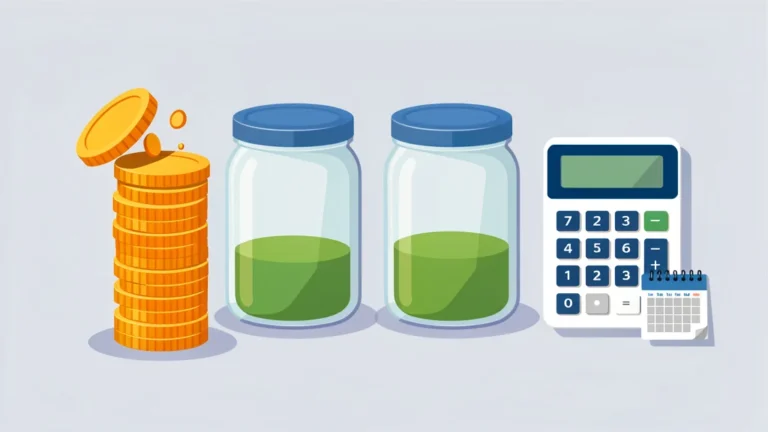
Got your first big 1099 check and wondering how much is really yours to keep? For most freelancers, a safe plan is to set aside about 25% to 30% of your net self-employment income for taxes. That pot has to cover two things: the 15.3% self-employment tax and the federal income tax you owe on top of it. Saving a fixed slice from every payment keeps you ready when the tax bill comes due.
Save about 25% to 30% of your net self-employment income (your profit after business expenses) for taxes. This covers the 15.3% self-employment tax, which applies to roughly 92.35% of that profit, plus federal income tax. Aim toward the higher end, or more, as your income climbs. You usually pay this money in four quarterly estimated tax payments, not once a year.
Why the Self-Employed Owe This Tax
When you work a regular job, your paycheck shows Social Security and Medicare taxes taken out. Your employer quietly pays a matching half behind the scenes.
When you are self-employed, you are both the worker and the employer. So you pay both halves yourself. That combined amount is the self-employment tax.
The total rate is 15.3% of your net earnings, and it breaks down like this:
- 12.4% for Social Security, charged only up to a yearly wage cap that rises most years.
- 2.9% for Medicare, with no income cap at all.
Higher earners may also owe a small extra Medicare tax above certain income levels. This SE tax is separate from income tax, and you owe it once your net self-employment earnings reach $400.
How Self-Employment Tax Is Calculated
You do not pay the 15.3% on every dollar you earn. The tax is built on your net profit, which is your income after subtracting business expenses.
First, you multiply that net profit by 0.9235 (92.35%). This step roughly mirrors the employer-side deduction that regular workers get automatically.
Then you apply the 15.3% rate to that smaller number. The result is your self-employment tax.
You Also Owe Income Tax on Top
Here is the part that surprises many new freelancers. The 15.3% self-employment tax is not your whole tax bill.
Your net self-employment profit is also regular taxable income. So it gets taxed again under the federal income tax, and maybe a state income tax too.
That is why a set-aside of just 15.3% falls short. Your savings pot needs to hold both taxes at once.
How much income tax you owe depends on your tax bracket and your total household income. We keep the bracket math in a sibling guide so this page stays focused. To see how brackets turn into a single percentage, read how to calculate your effective tax rate.
A Simple Set-Aside Rule of Thumb
Since two taxes stack up, a practical habit is to save a flat share of every payment you receive. For many freelancers, 25% to 30% of net income works as a starting point.
Think of that percentage as two layers in one bucket. Part covers the self-employment tax, and part covers the income tax.
- Lower income or many deductions: closer to 25% may be enough.
- Higher income or a higher bracket: lean toward 30%, 35%, or more.
- A state income tax: add a few points on top for it.
Move the money to a separate savings account the moment a client pays you. That way it is never mistaken for spending money.
A percentage rule is a starting guess, not a promise. Your real number depends on your profit, your bracket, and your deductions. A Self-Employment Tax Estimator can turn your numbers into a closer figure in seconds.
A Worked Example: $50,000 in Net Profit
Numbers make this clearer. Say you are a freelancer with $50,000 in net profit for the year after business expenses.
First, find the self-employment tax:
- SE tax base: $50,000 x 0.9235 = $46,175
- SE tax: $46,175 x 15.3% = about $7,065
Next, you also owe federal income tax on that $50,000. The exact amount depends on your bracket, filing status, and deductions.
A simple plan is to save 30% of the $50,000, which is $15,000. That $15,000 covers the roughly $7,065 SE tax and leaves a cushion for income tax. If your income tax turns out lower, you simply keep the extra.
Notice how the SE tax is the predictable piece at $7,065, while the income tax is the part that flexes with your situation. Building your set-aside around both keeps you from scrambling at tax time.
Pay Quarterly With Estimated Taxes
Freelancers do not wait until April to pay. The IRS expects tax as you earn it, so most self-employed people send payments four times a year. These are called estimated taxes.
The payments usually fall in mid-April, mid-June, mid-September, and mid-January of the next year. The dates shift slightly when they land on a weekend or holiday, so confirm the current deadlines with the IRS.
Paying quarterly spreads the cost out and helps you dodge underpayment penalties. Your set-aside account is where each quarterly payment comes from.
Half of Your SE Tax Is Deductible
There is a built-in break that softens the hit. You can deduct one half of your self-employment tax when figuring your income tax.
In the example above, half of the roughly $7,065 is about $3,533. That amount lowers your taxable income, not your tax bill dollar for dollar.
This deduction is separate from choosing the standard deduction or itemizing. For how that bigger choice works, see our guide on standard vs itemized deductions.
Tax rates, the Social Security wage cap, and deadlines change most years and can vary by state. Treat the numbers here as general examples and always confirm the current figures with the IRS for your situation.
Simple Habits That Make This Painless
The self-employment tax feels heavy only when it catches you by surprise. A few small habits keep it under control all year.
- Save as you earn: move 25% to 30% off the top of every payment, not at year end.
- Use a separate account: keep tax money apart so it never looks spendable.
- Track expenses: lower net profit means lower SE tax and lower income tax.
- Mark the quarterly dates: pay on time to avoid penalties.
None of this requires fancy software. A spreadsheet and a second savings account handle most freelancers just fine.
Ready to replace guesswork with a real number? Use our Self-Employment Tax Estimator to see your estimated SE tax and a smart amount to set aside from each payment you receive.
Frequently Asked Questions About Self-Employment Taxes
How Much Should I Set Aside for Self-Employment Taxes?
A common rule of thumb is to save about 25% to 30% of your net self-employment income. That pot covers both the 15.3% self-employment tax and your federal income tax. Lean toward the higher end as your income rises or if your state has an income tax. When unsure, saving a little extra is safer than saving too little.
What Is the Self-Employment Tax Rate?
The self-employment tax rate is 15.3% of your net earnings. It is made up of 12.4% for Social Security and 2.9% for Medicare. The Social Security portion applies only up to a yearly wage cap, while the Medicare portion has no cap. Higher earners may owe a small additional Medicare tax on top.
Is Self-Employment Tax the Same as Income Tax?
No, they are two separate taxes. Self-employment tax funds Social Security and Medicare, much like payroll taxes for employees. Income tax is charged on your profit based on your tax bracket. As a self-employed person, you typically owe both on the same net profit, which is why a set-aside needs to cover each one.
Do I Pay SE Tax on Gross Income or Net Profit?
You pay it on your net profit, which is your income after subtracting business expenses. You then multiply that net profit by 0.9235 before applying the 15.3% rate. So the tax actually lands on about 92.35% of your net profit, not your full gross income. Tracking expenses carefully lowers the profit that gets taxed.
When Do I Have to Pay Self-Employment Taxes?
Most self-employed people pay through quarterly estimated taxes rather than once a year. The payments generally fall in mid-April, mid-June, mid-September, and mid-January of the next year. Exact dates shift when they land on a weekend or holiday. Paying on schedule helps you avoid underpayment penalties, so check the current IRS deadlines.
Do I Owe SE Tax if I Only Earned a Little?
You generally owe self-employment tax once your net self-employment earnings reach $400 for the year. Below that threshold, the SE tax usually does not apply. You may still owe income tax on that money, though. Keep records of even small side income so you can report it correctly at tax time.
Can I Deduct Part of My Self-Employment Tax?
Yes. You can deduct one half of your self-employment tax when calculating your income tax. This lowers your taxable income, which reduces your income tax. It does not reduce the self-employment tax itself. In a $50,000 profit example, the deductible half is about $3,533, but the exact benefit depends on your bracket.
Sources
Authoritative Sources Used in This Article
This article is for general education only, not tax advice. Tax laws, rates, brackets, and limits change often and vary by state and situation, so check the current IRS rules and consult a tax professional for your situation. Reviewed for accuracy by Prof. Dr. Khalil Mudassar, PhD. Last updated September 12, 2026.
Author

Shakeel Muzaffar is the Founder and Editor-in-Chief of MultiCalculators.com, bringing over 15 years of experience in digital publishing, product strategy, and online tool development. He leads the platform's editorial vision, ensuring every calculator meets strict standards for accuracy, usability, and real-world value. Shakeel personally oversees content quality, formula verification workflows, and the platform's commitment to publishing tools that are genuinely useful for students, professionals, and everyday users worldwide.