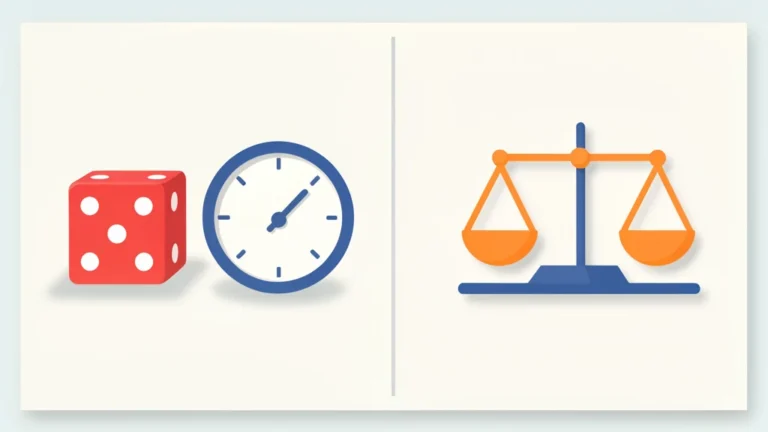
Would you rather hear a weather forecast say “a 20% chance of rain” or “the odds are 1 to 4”? Both sentences describe the exact same chance, but they come from two different kinds of math. Probability and odds are close cousins, not the same number, and mixing them up leads to real errors. This guide shows the exact formulas that connect them, plus a simple dice example you can check by hand.
Probability is the chance of an event, shown as favorable outcomes over total outcomes (a value from 0 to 1, or 0% to 100%). Odds compare favorable outcomes directly to unfavorable outcomes, often written like “1 to 5”. You convert probability to odds with odds = P / (1 – P), and you convert odds back to probability with P = odds / (1 + odds).
What Is Probability?
Probability measures how likely a single event is to happen out of all the outcomes that could happen. It is written as a fraction: the number of favorable outcomes divided by the total number of possible outcomes.
Probability always falls between 0 and 1. A probability of 0 means the event cannot happen, and a probability of 1 means it is certain. People often show it as a percent instead, so 0.5 becomes “50%”.
- Formula: P = favorable outcomes / total outcomes
- Range: 0 to 1, or 0% to 100%
- Example: flipping heads on a fair coin is P = 1/2 = 50%
What Are Odds?
Odds compare favorable outcomes straight to unfavorable outcomes, instead of comparing favorable outcomes to the total. They are usually written as a ratio, like “3 to 1” or “3:1”.
Unlike probability, odds have no upper limit. An event that is very likely can have odds like “9 to 1”, meaning nine favorable outcomes for every one unfavorable outcome.
- Formula: Odds = favorable outcomes : unfavorable outcomes
- Range: 0 to infinity, with no fixed ceiling
- Example: drawing a red card from a standard deck is odds of 1 to 1 (26 red to 26 black)
Odds also show up in a few different written formats. You might see a ratio like “3 to 1” or “3:1”, or a single decimal such as 3.0, which just packs the same ratio into one number. Odds can also point in two directions: “3 to 1 for” favors the event happening, while “3 to 1 against” favors it not happening. These are labeling habits, not different math.
Probability vs Odds at a Glance
The table below lines up the two ideas side by side. Read it top to bottom to see exactly where each one differs.
| Attribute | Probability | Odds |
|---|---|---|
| What it compares | Favorable outcomes to all outcomes | Favorable outcomes to unfavorable outcomes |
| Formula | P = favorable / total | Odds = favorable / unfavorable |
| Range of values | 0 to 1 (0% to 100%) | 0 to infinity (no fixed ceiling) |
| Common format | A decimal or a percent, like 16.7% | A ratio, like “1 to 5” or “5 to 1” |
| Where it is common | Science, statistics, weather, medicine | Gambling, sports betting, casual talk |
The Formula: Converting Probability to Odds
Once you have a probability, turning it into odds takes one simple formula. Divide the probability of success by the probability of failure.
Since the probability of failure is always 1 minus the probability of success, the formula becomes: odds = P / (1 – P). Plug in any probability between 0 and 1, and this formula gives you the matching odds.
Going the other direction works just as easily. If you know the odds, you can find the probability with P = odds / (1 + odds). These two formulas are simply mirror images of each other.
Worked Example: Rolling a Four on a Die
Numbers make this clearer than words alone, so here is a full example using a standard six sided die. Rolling a 4 is the event we care about.
There is exactly 1 favorable outcome (rolling a 4) out of 6 total possible outcomes (1, 2, 3, 4, 5, 6). So the probability is P = 1/6, which is about 0.167, or 16.7%.
To find the odds, compare that 1 favorable outcome to the 5 unfavorable outcomes (rolling a 1, 2, 3, 5, or 6). The odds are 1 to 5, meaning for every 1 way to win, there are 5 ways to lose.
Check the formula both ways. Odds = P / (1 – P) = (1/6) / (5/6) = 1/5, which matches “1 to 5” exactly. Going backward, P = odds / (1 + odds) = (1/5) / (6/5) = 1/6, which matches the original probability. The math checks out both directions.
Want to test more rolls, sums, or multiple dice at once? Our Dice Probability Calculator runs these numbers for you instantly, for any target number or combination.
A Second Example: Drawing a Card
A different example confirms the same formulas still work with fresh numbers. Picture drawing one card from a standard deck of 52 playing cards, and the event is drawing a King.
A deck has exactly 4 Kings, so there are 4 favorable outcomes out of 52 total cards. That makes the probability P = 4/52, which simplifies to 1/13, or about 7.7%.
The unfavorable outcomes are every card that is not a King, which is 52 – 4 = 48 cards. Comparing favorable to unfavorable gives odds of 4 to 48, which simplifies to 1 to 12.
Check it with the formula: odds = P / (1 – P) = (4/52) / (48/52) = 4/48 = 1/12, which matches. Going backward, P = odds / (1 + odds) = (1/12) / (13/12) = 1/13, which matches the original probability too.
Why “Odds” and “Probability” Get Confused in Speech
In everyday talk, people often say “odds” when they really mean probability. Hearing “the odds of rain are 40 percent” actually describes a probability, not a true ratio of favorable to unfavorable outcomes.
A true odds statement sounds more like “2 to 3 against rain” instead of a percent. The mix up happens because both words describe chance, so they feel interchangeable in casual conversation.
In math and statistics, keeping the two separate matters. Once you start converting between them with the formulas above, using the wrong one can throw off every number that follows.
Where Probability and Odds Are Commonly Used
Probability shows up most often in science, statistics, weather forecasting, and medicine. Researchers prefer it because it is bounded between 0 and 1, which makes it easy to compare across studies.
Odds show up most often in gambling and sports betting, where they also connect to potential payouts. This article covers odds purely as a math comparison to probability, not as betting advice or a strategy tip.
- Probability: lab results, weather forecasts, medical risk, survey statistics
- Odds: casino games, sports betting lines, horse racing, casual wagers
Both describe the exact same underlying chance. They are just two different ways of packaging that chance for two different audiences.
Related Probability and Statistics Concepts
Probability and odds are only one part of a much bigger toolkit for measuring chance and uncertainty. A few close neighbors are worth knowing about, though they are separate topics from this one.
- Counting the outcomes themselves often uses combinations and permutations. See our guide on Combinations vs Permutations for that difference.
- Deciding whether a bet or a choice is worthwhile on average uses a related idea. See Expected Value Explained for that formula.
Ready to try the math yourself? Plug in any target number, sum, or number of dice with our Dice Probability Calculator, and see the probability and odds calculated instantly.
Frequently Asked Questions About Probability vs Odds
What Is the Main Difference Between Probability and Odds?
Probability compares favorable outcomes to all possible outcomes, so it always falls between 0 and 1. Odds compare favorable outcomes directly to unfavorable outcomes, so they can run from 0 all the way up to infinity. Both describe the same chance, just with different math.
How Do You Turn a Probability Into Odds?
Use the formula odds = P / (1 – P), where P is the probability of the event happening. For example, a probability of 1/6 gives odds of (1/6) / (5/6), which simplifies to 1 to 5. The formula works for any probability between 0 and 1.
How Do You Turn Odds Into a Probability?
Use the reverse formula P = odds / (1 + odds). If the odds are 1 to 5, written as the fraction 1/5, then P = (1/5) / (1 + 1/5) = (1/5) / (6/5), which equals 1/6. That matches the original probability exactly.
What Do “Odds of 1 to 5” Actually Mean?
Odds of “1 to 5” mean that for every 1 way an event can happen, there are 5 ways it cannot. Picture 6 equally likely outcomes total, with 1 counted as a win and 5 counted as a loss. It does not mean a 1 in 5 chance, which is a common mix up.
Why Do Betting and Gambling Use Odds Instead of Probability?
Odds connect naturally to payouts, since a ratio of favorable to unfavorable outcomes maps directly onto how much a bet might pay. Probability is more common in science because it is bounded and easy to compare. Both are simply different formats for the same underlying chance.
Can Probability and Odds Ever Show the Same Number?
Yes, at one specific point. When the probability is exactly 50% (P = 0.5), the odds come out to 1 to 1, since favorable and unfavorable outcomes are equal. Away from that halfway point, the two numbers always diverge from each other.
Can Probability or Odds Be Negative?
No. Both describe counts of outcomes, so neither can go below 0. Probability is capped at a maximum of 1 (or 100%), while odds have no fixed upper limit and can grow very large when an event is almost certain.
Sources
Authoritative Sources Used in This Article
This article is for general education only. Statistical methods and examples use standard conventions and simplified data, so real-world analysis can be more complex. Reviewed for accuracy by Prof. Dr. Khalil Mudassar, PhD. Last updated September 13, 2026.
Author

Shakeel Muzaffar is the Founder and Editor-in-Chief of MultiCalculators.com, bringing over 15 years of experience in digital publishing, product strategy, and online tool development. He leads the platform's editorial vision, ensuring every calculator meets strict standards for accuracy, usability, and real-world value. Shakeel personally oversees content quality, formula verification workflows, and the platform's commitment to publishing tools that are genuinely useful for students, professionals, and everyday users worldwide.