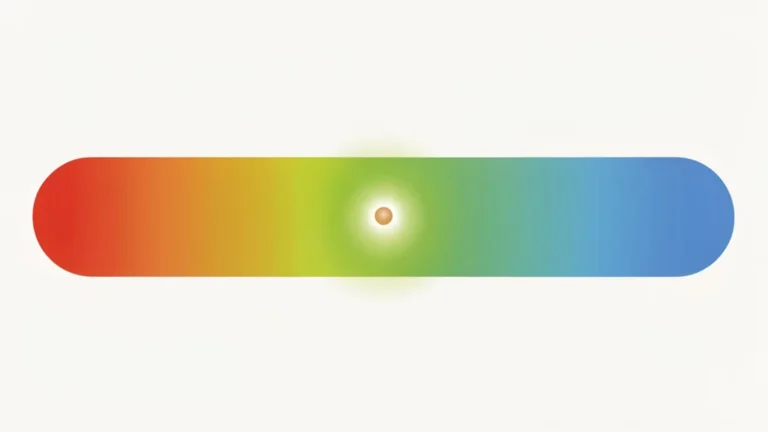
What do lemon juice and baking soda have in common with a single two-letter symbol? Both sit on the same simple scale that chemists use to describe every water-based solution on Earth: pH. pH and acidity measure the same underlying thing, the concentration of hydrogen ions dissolved in a solution, and that single number tells you almost everything about how an acid or a base will behave.
pH measures how much hydrogen ion is dissolved in a water-based solution, usually on a scale from 0 to 14.
A pH of 7 is neutral, below 7 is acidic, and above 7 is basic, also called alkaline.
The scale is logarithmic, so each single pH step equals a 10x change in hydrogen ion concentration.
The formula is pH = -log10[H+], where [H+] is hydrogen ion concentration in mol/L.
What Does pH Actually Measure?
pH stands for “potential of hydrogen.” It measures the concentration of hydrogen ions, written [H+], dissolved in a water-based solution. More hydrogen ions floating around means a more acidic solution.
That concentration is normally measured in moles per liter (mol/L, also written M for molar). If you want a refresher on that unit itself, our sibling guide on how to calculate molarity covers it in depth. Here, we only need molarity as the unit that goes into the pH formula.
Because hydrogen ion concentrations can span a huge range of tiny numbers, chemists compress them onto a simple logarithmic scale. That compression is exactly what pH does, and it is why the scale feels so small even though the underlying concentrations vary enormously.
Without pH, chemists would have to compare awkward numbers like 0.001 mol/L against 0.0000000001 mol/L. Writing those as pH 3 and pH 10 instead makes the comparison instant and easy to communicate in a lab notebook or a textbook.
The pH Formula Explained
The formula chemists use is short and fixed:
pH = -log10[H+]
Here, [H+] is the hydrogen ion concentration in mol/L, and log10 means the base-10 logarithm. The minus sign flips the result, so a tiny concentration produces a positive, easy-to-read pH number.
This matters because raw hydrogen ion concentrations are awkward numbers like 0.0000001 mol/L. Taking the negative log10 of that turns it into a clean, simple 7. That is the entire point of the pH scale: turning tiny exponential numbers into a friendly 0 to 14 range.
Worked Example: Calculating pH From Hydrogen Ion Concentration
Let’s calculate pH by hand using the formula, step by step, for a sample solution.
- Start with the given hydrogen ion concentration: [H+] = 1 x 10^-3 mol/L.
- Apply the formula: pH = -log10(1 x 10^-3).
- Find the log10 of 1 x 10^-3, which is exactly -3.
- Flip the sign: pH = -(-3) = 3.
The result is pH 3, a strongly acidic reading. Now try a second example with a much smaller hydrogen ion concentration: [H+] = 1 x 10^-10 mol/L.
log10(1 x 10^-10) equals -10, and flipping that sign gives pH = 10. That reading is basic, since it lands above 7. Notice the pattern: a bigger, less negative exponent on [H+] gives a lower pH, and a smaller, more negative exponent gives a higher pH.
You can check arithmetic like this instantly, or work the formula in reverse from a target pH, with our pH Calculator. It handles the log math for you and reduces the chance of a manual error.
Why the pH Scale Runs From 0 to 14
The 0 to 14 range is not arbitrary. It comes from a property of water itself, called self-ionization, where a small fraction of water molecules split into H+ and OH- ions even in pure water.
At 25 degrees Celsius, the product of those two ion concentrations is a fixed number: [H+] times [OH-] equals 1 x 10^-14. In pure, neutral water, the two concentrations are equal, so each one works out to 1 x 10^-7 mol/L, which is exactly pH 7.
For typical dilute water-based solutions, [H+] realistically ranges from about 1 mol/L down to about 1 x 10^-14 mol/L. Running that range through the pH formula produces values from 0 up to 14, which is why the standard scale is built around those endpoints.
Very strong or very concentrated solutions can technically push pH slightly below 0 or above 14, but those cases are unusual. For everyday general chemistry, 0 to 14 covers essentially everything you will measure.
Why Every Whole Number Step Means a 10x Change
Because pH is a base-10 logarithm, it is not a straight-line scale, it is a logarithmic one. That single fact is the most important thing to understand about pH.
Each time the pH number changes by exactly one whole unit, the hydrogen ion concentration changes by a factor of 10. This holds true anywhere on the scale, not just near neutral.
- A solution at pH 3 has 10 times more H+ than a solution at pH 4.
- A solution at pH 3 has 100 times more H+ than a solution at pH 5.
- A solution at pH 3 has 1000 times more H+ than a solution at pH 6.
This is why a “small” pH difference, like going from pH 5 to pH 4, actually represents a large real change in acidity. Always think in multiples of 10, not in simple subtraction, when comparing two pH values.
Acidic, Neutral, and Basic: Common Reference Points
General chemistry uses a handful of everyday substances as reference points to make the scale concrete. These are simple lab and kitchen chemistry examples, not medical or biological readings.
| Zone | pH Range | Ion Balance | General Example |
|---|---|---|---|
| Acidic | Below 7 | More H+ ions than OH- ions | Lemon juice, about pH 2 |
| Neutral | Exactly 7 | Equal H+ and OH- ions | Pure water, pH 7 |
| Basic (Alkaline) | Above 7 | More OH- ions than H+ ions | Baking soda solution, about pH 9 |
Lemon juice sits low on the scale because citric acid releases many hydrogen ions into the water. Pure water sits exactly at the midpoint because its H+ and OH- ions are perfectly balanced. A baking soda solution sits above 7 because dissolved sodium bicarbonate produces extra OH- ions.
Acids vs Bases at the Particle Level
Zoom in far enough, and the difference between an acid and a base comes down to a simple ion count. An acid is a solution where H+ ions outnumber OH- ions. A base is the opposite: OH- ions outnumber H+ ions.
In pure, neutral water, the two ion types are perfectly balanced, one for one. Add an acid, and extra H+ ions flood in, pushing the balance toward hydrogen. Add a base, and extra OH- ions flood in instead, pushing the balance the other way.
This particle-level view explains why pH and its ion counts always move in opposite directions. More H+ ions means a lower pH number, and more OH- ions means a higher pH number, even though both are just describing the same shifting balance.
It also explains why mixing a strong acid and a strong base can cancel each other out. The extra H+ ions from the acid pair up with the extra OH- ions from the base, pulling the solution back toward a neutral balance.
How pH Connects to Molarity and Dilution
pH calculations always start from a hydrogen ion concentration in mol/L, so the two topics are closely linked. If you need a refresher on that concentration unit itself, see our guide on how to calculate molarity.
Diluting a solution with more water lowers the hydrogen ion concentration, which changes the pH. For the math behind that process, our sibling guide on how to do dilution calculations walks through it step by step.
This article stays focused on what pH itself measures and how to calculate it. Think of molarity and dilution as the supporting math that often feeds into a pH problem.
Ready to find pH without doing the log math by hand? Try our pH Calculator to compute pH directly from any hydrogen ion concentration, or work backward from a target pH.
Frequently Asked Questions About pH and Acidity
What Is pH and What Does It Measure?
pH measures the concentration of hydrogen ions, written [H+], dissolved in a water-based solution. It is reported on a simple scale, usually from 0 to 14, where a lower number means more hydrogen ions and a more acidic solution.
What Is the Formula for Calculating pH?
The formula is pH = -log10[H+], where [H+] is the hydrogen ion concentration in mol/L. Taking the negative base-10 logarithm turns a tiny concentration number into a simple, readable pH value.
Why Does the pH Scale Go From 0 to 14?
The range comes from water’s own chemistry. At 25 degrees Celsius, [H+] times [OH-] always equals 1 x 10^-14, and typical dilute solutions keep [H+] between about 1 and 1 x 10^-14 mol/L, which maps to pH 0 through 14.
What Does It Mean That pH Is Logarithmic?
It means each whole pH step equals a tenfold change in hydrogen ion concentration. A solution at pH 4 has 10 times more H+ than one at pH 5, and 100 times more than one at pH 6.
What Is the Difference Between an Acid and a Base?
An acid has more H+ ions than OH- ions dissolved in it, giving a pH below 7. A base, also called alkaline, has more OH- ions than H+ ions, giving a pH above 7. Neutral water has the two in equal balance.
Can pH Values Go Below 0 or Above 14?
Yes, in unusually strong or highly concentrated solutions, pH can technically fall below 0 or rise above 14. Those cases are rare, and the standard 0 to 14 scale covers essentially all typical general chemistry solutions.
How Is pH Different From Molarity?
Molarity (mol/L) is simply a way to express concentration. pH is a calculated result that uses the molar concentration of hydrogen ions as its input. For a full walkthrough of the concentration unit itself, see how to calculate molarity.
Sources
Authoritative Sources Used in This Article
This article is for general education only. Formulas and examples use standard chemistry conventions and ideal conditions, so real-world lab results can vary with technique, purity, and equipment. Reviewed for accuracy by Prof. Dr. Khalil Mudassar, PhD. Last updated September 13, 2026.
Author

Shakeel Muzaffar is the Founder and Editor-in-Chief of MultiCalculators.com, bringing over 15 years of experience in digital publishing, product strategy, and online tool development. He leads the platform's editorial vision, ensuring every calculator meets strict standards for accuracy, usability, and real-world value. Shakeel personally oversees content quality, formula verification workflows, and the platform's commitment to publishing tools that are genuinely useful for students, professionals, and everyday users worldwide.



1 thought on “pH and Acidity Explained”