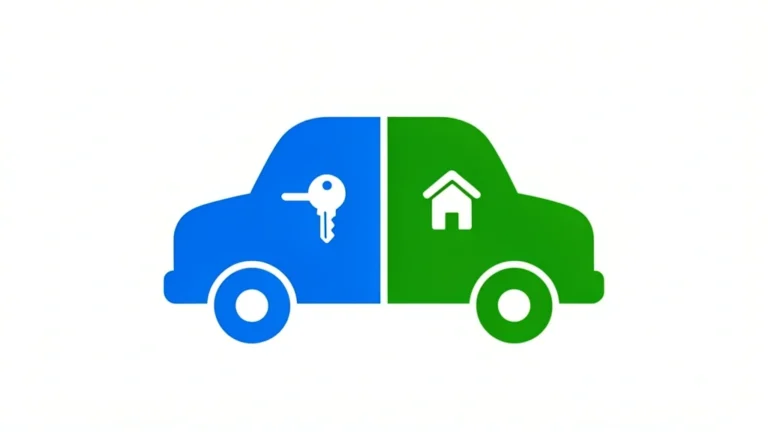
Why can a lease payment be $50 to $100 lower than a loan payment on the very same car? The answer is not a discount. It is a different math problem. Financing charges you for the whole vehicle, while leasing charges you for only the slice of value you use up while driving it. Once you see that split, the full lease vs finance total cost picture, including mileage limits, wear and tear fees, and what you walk away with, gets much easier to compare side by side.
Leasing usually has a lower monthly payment because you only pay for the depreciation during your term, plus a finance charge. Financing costs more per month but you build equity and own the car once the loan is paid off. Over a 3-year lease, total out-of-pocket is often lower than the same 3 years of a 5- to 6-year loan. The tradeoffs are mileage limits, wear and tear fees, and owning nothing when a lease ends.
Why Lease Payments Are Usually Lower Each Month
A car loan is priced off the full purchase price. You borrow the whole amount, minus any down payment, and pay it back with interest until the balance hits zero.
A lease works differently. The leasing company already expects the car to be worth less when you return it. Your monthly payment mostly covers that expected drop in value, called depreciation, plus a small finance charge on top.
Since you are only paying for part of the car’s value instead of all of it, the monthly number is almost always smaller. Our guide on how fast a new car depreciates covers how that value drop actually works in more depth.
What You Own When the Term Ends
The monthly payment is only half the story. What happens at the end of the term is just as important to the total cost picture.
| Factor | Leasing | Financing (Loan) |
|---|---|---|
| Typical term | 2 to 3 years | 5 to 6 years (60 to 72 months) |
| Monthly payment | Usually lower | Usually higher |
| What you pay for | The depreciation you use, plus a finance charge | The full purchase price, plus interest |
| Equity at term end | None, unless you buy the car | Full ownership once paid off |
| Mileage limit | Often 10,000 to 12,000 miles a year | None |
| Wear and tear risk | Fees charged for damage past normal wear | No fees; only affects resale value later |
A loan ends with an asset in your driveway that still has resale value. A lease ends with an empty spot where a car used to be, unless you sign up for another one or buy this one out.
Mileage Limits and Excess Mileage Fees on Leases
Most leases cap how far you can drive, often 10,000 to 12,000 miles a year. Go over that limit, and you owe a fee for every extra mile when you return the car.
That fee typically runs about $0.15 to $0.30 per mile, depending on the leasing company. It sounds small per mile, but it adds up fast over a full term.
- Driving 3,000 miles a year over a 12,000-mile limit adds up to 9,000 extra miles across a 3-year lease.
- At $0.20 a mile, that is about $1,800 due at return, on top of your regular payments.
- Some leases let you buy extra miles upfront for less per mile than the end-of-term penalty.
A loan has no mileage limit at all. Drive as much as you want; the only cost is more wear on a car you already own.
Wear and Tear Charges on a Lease
Leasing companies expect the car back in normal condition, allowing for ordinary use. Anything beyond that is billed as excess wear and tear when you return the keys.
Typical charged items include dents, cracked windshields, worn tires, stains, and scratches deeper than a small coin. Fees usually run from about $50 for a minor scuff up to several hundred dollars for larger repairs.
Some lessees buy a wear-and-tear waiver upfront, often a few hundred dollars, to cap this risk. Financing has no equivalent charge, since the same wear just shows up later as a lower resale or trade-in value.
Total Cost Over 3 Years of Leasing vs 5 to 6 Years of a Loan
Compared over the same 3-year window, a lease usually wins on total dollars paid. Lower monthly payments and lower upfront costs add up to less spent by year three.
Compared over the full loan term, the math shifts. A 5- to 6-year loan eventually reaches zero balance, and you keep an asset worth real money on resale. Two back-to-back 3-year leases over that same 6 years typically cost a similar or higher total, and you still own nothing at the end.
Neither answer is universally cheaper. It depends on how long you keep vehicles, how many miles you drive, and whether owning an asset matters to you. These are illustrative patterns, not guarantees, since real prices, rates, and residual values vary by vehicle and market.
Worked Example: Same $35,000 Car, Two Payment Paths
Numbers make this easier to picture. Say the car costs $35,000 either way. Here is one illustrative way the total cost of leasing and financing could split out, using typical, rounded figures.
| Item | 3-Year Lease | Loan (6-Year Term) |
|---|---|---|
| Due at signing or down payment | $2,000 | $5,000 |
| Estimated monthly payment | about $505 | about $511 |
| Paid over 36 months | $18,180 | $18,396 |
| Total paid after 3 years | about $20,200 | about $23,400 |
| What you own after 3 years | Nothing; return or buy for about $19,250 | Partial equity; loan balance still owed |
Keep going another 3 years and the picture changes. The 6-year loan finishes around $41,800 total, but ends with a fully owned car worth something on resale. Two back-to-back 3-year leases would run roughly $37,000 to $40,000 total over the same 6 years, with no car to show for it either time.
These figures are illustrative only. Real numbers depend on your credit, the lender’s rate, the leasing company’s money factor, and the specific vehicle’s residual value. Run your own numbers with the Auto Loan & Car Payment Calculator to see a realistic loan payment for a price and rate close to yours.
The Lease Idea vs the Loan Idea in One Picture
It helps to boil each option down to one sentence. Leasing means you pay for the depreciation you use. Financing means you pay for the whole car.
Costs That Show Up No Matter Which Path You Pick
Some expenses do not care whether you lease or finance. Budget for these on top of whichever payment you choose.
- Insurance, which is often similar or slightly higher on a leased car due to coverage requirements.
- Fuel or charging costs based on how much you drive.
- Routine maintenance like oil changes, tires, and brakes.
- Sales tax and registration fees, which vary by state.
For the full rundown of how that ownership cost adds up over time, see our guide on how fast a new car depreciates.
How to Decide Which Path Fits You
This guide focuses only on the numbers. Choosing between leasing and financing also depends on your driving habits, how long you keep cars, and your credit.
Weigh those factors alongside the numbers above before you sign anything, since the cheaper total on paper is not always the better fit for how you actually use a car.
Curious what a loan would actually cost you each month on the car you are considering? Plug in a price, rate, and term with the Auto Loan & Car Payment Calculator and compare it against a lease quote side by side.
Frequently Asked Questions About Lease vs Finance Total Cost
What Is the Main Cost Difference Between Leasing and Financing?
Financing charges you for the entire purchase price of the car, plus interest, until you own it outright. Leasing charges you mainly for the depreciation expected during your term, plus a finance charge. That is why lease payments are usually lower each month than loan payments on the same car.
Is Leasing Always Cheaper Than Financing in Total?
Not always. Leasing often costs less over a single 3-year term. But financing usually costs less over the long run if you keep the car for many years past payoff, since you stop making payments and still own a valuable asset.
Do I Own Anything at the End of a Car Lease?
No. At the end of a standard lease you return the car and own nothing, unless your contract lets you buy it for a set payoff price, often called the residual value. With a loan, once the final payment clears, the car is yours free and clear.
What Happens if I Drive More Than My Lease Allows?
You pay an excess mileage fee, typically about $0.15 to $0.30 per mile, when you return the car. Going 9,000 miles over a 3-year lease could add roughly $1,350 to $2,700 in fees. Financed cars have no mileage limit or fee at all.
What Counts as Excess Wear and Tear on a Lease?
Excess wear usually means damage beyond normal use, such as large dents, cracked glass, worn-out tires, or deep stains. Charges often range from about $50 for small issues to several hundred dollars for larger repairs. Financing carries no such fee since you already own the car.
Why Are Loan Terms Now Often 6 Years Instead of 3 or 4?
Stretching a loan to 5 or 6 years lowers the monthly payment, since the same purchase price is spread across more months. The tradeoff is more total interest paid over the life of the loan. Shorter loans cost less in total interest but require higher monthly payments.
Can I Switch From Leasing to Buying the Same Car?
Often yes. Many leases include a purchase option at a set payoff price, usually close to the car’s expected residual value, once the term ends. You would typically need a new loan or cash to cover that payoff amount if you choose to keep the car.
Sources
Authoritative Sources Used in This Article
This article is for general education only, not financial or purchasing advice. Prices, rates, and vehicle specs vary by make, model, and market, so always confirm exact numbers with a dealer, lender, or manufacturer before you decide. Reviewed for accuracy by Prof. Dr. Khalil Mudassar, PhD. Last updated September 14, 2026.
Author

Shakeel Muzaffar is the Founder and Editor-in-Chief of MultiCalculators.com, bringing over 15 years of experience in digital publishing, product strategy, and online tool development. He leads the platform's editorial vision, ensuring every calculator meets strict standards for accuracy, usability, and real-world value. Shakeel personally oversees content quality, formula verification workflows, and the platform's commitment to publishing tools that are genuinely useful for students, professionals, and everyday users worldwide.