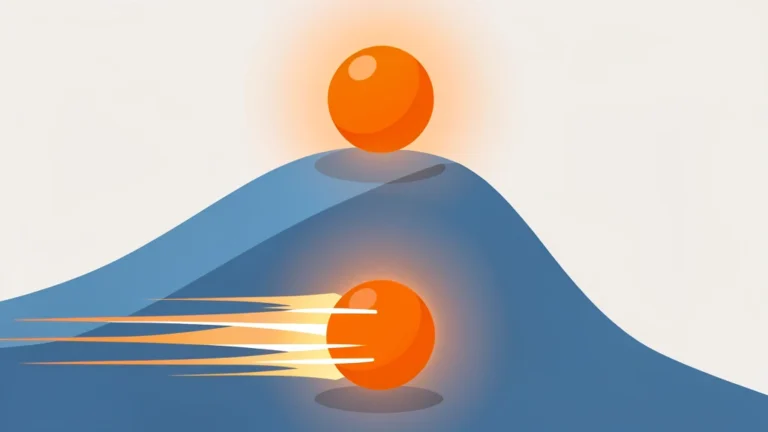
Why does a roller coaster feel slow at the top of the first hill and wild at the bottom? At the top, the cars barely move but sit high in the air. At the bottom, they are low but flying fast. That swap is kinetic energy and potential energy trading places right in front of you.
Kinetic energy is the energy of motion, found with KE = 1/2 x mass x velocity^2. Potential energy is stored energy from position, found with PE = mass x gravity x height. Both are measured in joules (J). As an object falls, its potential energy turns into kinetic energy, and the total stays the same without friction or air resistance.
What Is Kinetic Energy?
Kinetic energy is the energy an object has because it is moving. A rolling ball, a flying baseball, and a driving car all have kinetic energy. The faster something moves, the more kinetic energy it carries.
The formula is KE = 1/2 x m x v^2, where m is mass in kilograms and v is velocity in meters per second. Because velocity is squared, speed matters much more than mass. Doubling an object’s speed makes its kinetic energy four times bigger, not just twice as big.
Try a quick example. A 2 kg object moving at 4 m/s has: KE = 0.5 x 2 x 4^2 = 0.5 x 2 x 16 = 16 J.
- A skateboard rolling down a sidewalk
- A thrown football in the air
- Wind moving across an open field
What Is Potential Energy?
Potential energy is stored energy an object has because of where it is, not because it is moving. A book on a high shelf and water behind a dam both hold potential energy. This article focuses on gravitational potential energy, the type tied to height above the ground.
The formula is PE = m x g x h, where m is mass in kilograms, g is gravity (9.8 m/s^2 on Earth), and h is height in meters above a chosen reference point. Raise an object higher, and its potential energy grows in a straight, steady line.
Here is the same style of example. A 2 kg object held 5 m above the ground has: PE = 2 x 9.8 x 5 = 98 J.
- A backpack sitting on a top bunk
- Water pooled at the top of a waterfall
- A roller coaster car parked at the peak
Kinetic Energy vs Potential Energy at a Glance
Both quantities describe energy, and both are measured in joules. The table below lines them up so the differences are easy to scan in one pass.
| Attribute | Kinetic Energy | Potential Energy |
|---|---|---|
| What it measures | Energy of motion | Stored energy from position |
| Formula | KE = 1/2 x m x v^2 | PE = m x g x h |
| Depends on | Mass and velocity, with velocity squared | Mass, gravity, and height |
| Simple example | A ball rolling across a table | A book resting on a high shelf |
| When it is zero | When the object is completely still | When the object is at the reference height |
Calculating Each Formula Step by Step
Both formulas are simple once you plug in the right numbers. The key is keeping units consistent: kilograms for mass, meters per second for velocity, and meters for height.
For kinetic energy, square the velocity first, then multiply by mass, then multiply by one half. For potential energy, multiply mass, gravity, and height together in any order, since they are all multiplied straight through.
How Energy Converts: Potential to Kinetic
Energy does not just sit still in one form. It can change from potential to kinetic, and back again, as an object moves. This idea is called the conservation of energy.
Picture the 2 kg object from before, held 5 m up. At that height, it has 98 J of potential energy and 0 J of kinetic energy, since it is not moving yet.
- At the top: PE = 98 J, KE = 0 J. The object is still.
- While falling: PE drops as height drops, and KE rises to match.
- Just before landing: PE = 0 J, KE = 98 J. Nearly all the energy is now motion.
Without friction or air resistance, the total energy stays at 98 J the whole time. It just keeps changing form as height turns into speed.
Why Velocity and Height Affect Energy Differently
Both formulas use multiplication, but they do not behave the same way. Potential energy rises in a straight line with height. Double the height, and PE simply doubles.
Kinetic energy behaves differently because velocity is squared. Double an object’s speed, and its kinetic energy becomes four times larger, not two times larger. Triple the speed, and kinetic energy grows nine times.
This is why speed has such a big effect on impact energy in crashes and collisions, while height has a steady, predictable effect on stored energy.
Real-World Examples You Can Picture
Seeing both types of energy in one scene makes the idea click faster. Here are a few everyday moments where kinetic and potential energy trade places.
- A pendulum swings highest (potential energy) at each side and fastest (kinetic energy) at the bottom of its swing.
- A skier at the top of a slope has stored energy, then gains speed and kinetic energy on the way down.
- An arrow pulled back on a bow, then released, quickly turns stored energy into a fast, moving arrow.
- Water held behind a dam has potential energy, then gains kinetic energy as it rushes downhill.
In every case, the total energy is conserved. It simply shifts between stored position and active motion.
Where to Go Next for Related Physics
Kinetic energy leans heavily on velocity, but this article does not cover how to find velocity or acceleration in depth. For that, see our guide on how to calculate velocity and acceleration.
If you want to know how fast energy is used or produced over time, that is measured in watts, not joules. Our guide on how to calculate power in watts covers that separately.
The forces that cause objects to speed up or slow down follow Newton’s laws of motion, which is a topic for its own dedicated guide.
Want to check your own numbers? Plug in mass and velocity with our Kinetic Energy Calculator to get an instant result in joules, no manual math required.
Frequently Asked Questions About Kinetic vs Potential Energy
What Is the Difference Between Kinetic and Potential Energy?
Kinetic energy is the energy an object has because it is moving, found with KE = 1/2 x m x v^2. Potential energy is stored energy an object has because of its position, found with PE = m x g x h. A moving car has kinetic energy, while a car parked on a hill has potential energy.
What Is the Formula for Kinetic Energy?
The formula is KE = 1/2 x mass x velocity^2, written as KE = 1/2 x m x v^2. Mass is in kilograms and velocity is in meters per second. Because velocity is squared, doubling an object’s speed makes its kinetic energy four times bigger, not just double.
What Is the Formula for Gravitational Potential Energy?
Gravitational potential energy uses PE = m x g x h, where m is mass in kilograms, g is gravity at 9.8 m/s^2 on Earth, and h is height in meters above a reference point. Raising an object higher always increases its potential energy, since height and PE rise together.
Can Kinetic Energy Turn Into Potential Energy?
Yes, energy can convert both ways. A ball thrown straight up loses kinetic energy as it slows down, and that energy becomes potential energy as it rises higher. At the very top of its path, nearly all the kinetic energy has become potential energy, and the ball briefly stops.
What Units Are Kinetic and Potential Energy Measured In?
Both kinetic energy and potential energy are measured in joules (J), the standard unit of energy in the International System of Units. One joule equals the energy used to push with one newton of force over one meter. Formulas built from kilograms, meters, and seconds naturally give an answer in joules.
Does Potential Energy Depend on Speed?
No, gravitational potential energy does not depend on speed at all. It only depends on mass, gravity, and height above a reference point. Speed only affects kinetic energy, which is why a still object sitting high up can still hold a large amount of stored energy.
Why Does a Falling Object Speed Up as It Loses Height?
As an object falls, it loses height, so its potential energy drops. Without friction or air resistance, that lost potential energy does not disappear; it converts into kinetic energy, which is why the object speeds up. This is the conservation of energy in action.
Sources
Authoritative Sources Used in This Article
This article is for general education only. Formulas and examples use standard physics conventions and idealized conditions (no friction or air resistance unless noted), so real-world results can vary. Reviewed for accuracy by Prof. Dr. Khalil Mudassar, PhD. Last updated September 13, 2026.
Author

Shakeel Muzaffar is the Founder and Editor-in-Chief of MultiCalculators.com, bringing over 15 years of experience in digital publishing, product strategy, and online tool development. He leads the platform's editorial vision, ensuring every calculator meets strict standards for accuracy, usability, and real-world value. Shakeel personally oversees content quality, formula verification workflows, and the platform's commitment to publishing tools that are genuinely useful for students, professionals, and everyday users worldwide.