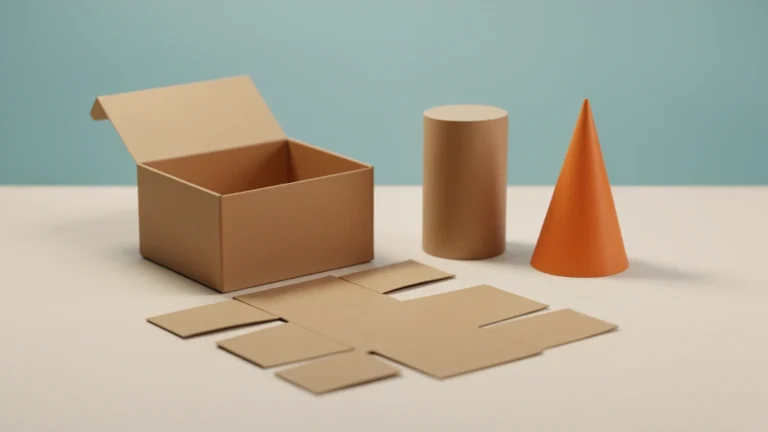
How much paper does it take to wrap a box that measures 30 by 20 by 10 centimeters? The answer is 2,200 square centimeters, and you find it by adding the areas of six flat rectangles. That is the whole idea behind the surface area of 3D shapes. Unfold the solid, measure each face, and add the pieces together.
- Surface area is the total area of every outer face of a solid, in square units.
- Unfold the shape into a flat net, find the area of each face, and add them.
- Box: 2(lw + lh + wh). Cylinder: 2 x pi x r x h + 2 x pi x r2. Sphere: 4 x pi x r2.
- Cones and pyramids use the slant height, not the vertical height.
- Lateral area covers only the sides; total area adds the bases.
What Is Surface Area and Why Is It in Square Units?
Surface area is the total area of all the outer faces of a 3D shape, measured in square units. It tells you how much material covers the outside, such as paint, paper, or sheet metal.
The units are squared because every face is a flat, two-dimensional region. A face that measures 4 cm by 3 cm covers 12 square centimeters. Adding faces together keeps the same unit, so the total stays in cm2, ft2, or m2.
Surface area is not the same as capacity. Space inside a solid is volume, measured in cubic units. Our guide to the volume of a cylinder, cone, and sphere covers that side of the problem.
Lateral Versus Total Surface Area
Lateral surface area counts only the sides of a solid. Total surface area adds the top and bottom bases. A can label is lateral area, while a sealed can uses the total.
| Shape | Lateral area | Total area | Example total |
|---|---|---|---|
| Cube, side s | 4s2 | 6s2 | s = 5: 150 |
| Rectangular box | 2h(l + w) | 2(lw + lh + wh) | 4 x 3 x 2: 52 |
| Cylinder | 2 x pi x r x h | 2 x pi x r x h + 2 x pi x r2 | r = 3, h = 10: 245.04 |
| Cone | pi x r x l | pi x r2 + pi x r x l | r = 3, h = 4: 75.40 |
| Square pyramid | 2 x b x s | b2 + 2 x b x s | b = 6, h = 4: 96 |
| Sphere | none | 4 x pi x r2 | r = 5: 314.16 |
How Does the Net Method Work?
The net method unfolds a solid into flat faces, finds the area of each face, and adds them up. It works for any solid with flat faces, and it explains every formula in the table above.
Take a box that is 4 units long, 3 wide, and 2 tall. Cut it along its edges and lay it flat. You get six rectangles in three matching pairs: top and bottom, front and back, and two sides.
Each face is a plain rectangle, so length times width gives its area. Our guide on how to find the area of any shape covers rectangles, triangles, and circles in detail. Here the pairs are 12, 8, and 6 square units. Double each pair and add: 24 + 16 + 12 = 52 square units.
The Cube Shortcut
A cube has six identical square faces, so its surface area is 6s2. A cube with 5 cm edges has faces of 25 cm2 each, for a total of 150 cm2.
How Do You Find the Surface Area of a Cylinder?
Add the curved side, 2 x pi x r x h, to the two circular bases, 2 x pi x r2. The curved side unrolls into a flat rectangle, which makes the formula easy to see.
Picture peeling the label off a can. The label becomes a rectangle whose height matches the can. Its width equals the distance around the can, which is the circumference, 2 x pi x r.
For a cylinder with radius 3 and height 10, the label measures 18.85 by 10, or 188.50 square units. The two bases add 2 x pi x 9 = 56.55. The total surface area is 245.04 square units.
Drop the bases when the job only covers the side. A soup can 7.5 cm across and 11 cm tall needs a label of pi x 7.5 x 11 = 259.18 cm2, before any overlap for the glue seam.
How Do You Find the Surface Area of a Cone, Pyramid, or Sphere?
Cones and pyramids use the slant height, the distance along the sloping face, while a sphere uses only its radius. The slant height comes from the Pythagorean theorem.
Cone
The total is pi x r2 for the base plus pi x r x l for the side. The slant height is l = sqrt(r2 + h2). For r = 3 and h = 4, l = sqrt(9 + 16) = 5. The base is 28.27, the side is 47.12, and the total is 75.40.
Square Pyramid and Sphere
A square pyramid adds the base, b2, to four triangles, 2 x b x s. With a base of 6 and a height of 4, the slant is sqrt(16 + 9) = 5. The total is 36 + 60 = 96 square units.
A sphere has no flat faces, so it uses one formula: 4 x pi x r2. A ball with a 5 cm radius has 314.16 cm2 of surface. The volume and surface area calculator returns this figure for spheres, cubes, boxes, cylinders, and cones.
How Do You Use Surface Area for Paint, Wrapping, and Coatings?
Find the surface area of the parts you will cover, then add a 10 percent waste allowance. That extra covers overlaps, trimming, uneven coats, and small measuring errors.
Wrapping a Gift Box
The box from the introduction measures 30 x 20 x 10 cm. Its surface area is 2(600 + 300 + 200) = 2,200 cm2. With 10 percent added for folds, cut a sheet that covers about 2,420 cm2.
Painting a Toy Chest
A chest that is 3 ft long, 2 ft wide, and 2 ft tall has 2(6 + 6 + 4) = 32 ft2 of surface. Adding 10 percent gives 35.2 ft2. Divide that by the coverage printed on the paint can to get the amount to buy.
Coating a Tank
A cylindrical tank with a 1.5 m radius and 4 m height has a side of 37.70 m2. The two ends add 14.14 m2, for 51.84 m2 in total. With the 10 percent allowance, order coating for about 57.02 m2.
Skip faces that stay uncovered. An open-top planter or a tank sitting on a slab loses one base from the count.
What Mistakes Throw Off Surface Area Answers?
The three most common errors are using the vertical height instead of the slant height, forgetting the bases, and mixing units. Each one produces a clean-looking answer that is wrong.
Height instead of slant height. For the cone above, pi x 3 x 4 gives 37.70 instead of 47.12. That side area comes out 20 percent too low.
Forgetting the bases. The lateral area of the 3 by 10 cylinder is 188.50. Leaving out the two bases drops 56.55 square units, nearly a quarter of the total.
Mixing units. A box 2 ft by 1 ft by 6 in has 7 ft2 of surface once 6 in becomes 0.5 ft. Treating the 6 as feet gives 40 ft2, which is more than five times too much. Convert every measurement to one unit before you multiply.
Square units convert differently from lengths. One square foot equals 144 square inches, not 12, and one square meter equals 10,000 square centimeters.
The Volume Calculator returns both volume and surface area for a sphere, cube, rectangular box, cylinder, or cone from a few measurements.
FAQs About Surface Area
What Is the Formula for Surface Area of a 3D Shape?
There is no single formula for every solid. Add the area of every outer face. Each common shape has a shortcut, such as 6s squared for a cube or 4 x pi x r squared for a sphere.
What Is the Difference Between Surface Area and Volume?
Surface area measures the outside covering of a solid in square units. Volume measures the space inside in cubic units. Paint and wrapping paper depend on surface area, while filling a tank depends on volume.
Why Is Surface Area Measured in Square Units?
Every face of a solid is a flat, two-dimensional region. Its area is length times width, which gives square units such as square centimeters or square feet. Adding faces keeps the same unit.
Does Lateral Surface Area Include the Bases?
No. Lateral surface area covers only the sides. For a cylinder with radius 3 and height 10, the lateral area is 188.50 square units, and the total with both bases is 245.04.
How Do You Find the Surface Area of an Open Cylinder?
Use the side plus one base: 2 x pi x r x h + pi x r squared. For a radius of 3 and a height of 10, that is 188.50 + 28.27 = 216.77 square units.
How Much Wrapping Paper Do I Need for a Box?
Find the surface area with 2(lw + lh + wh), then add about 10 percent for folds. A 30 by 20 by 10 cm box has 2,200 square centimeters of surface, so cut about 2,420.
Why Does My Cone Answer Come Out Too Small?
The usual cause is using the vertical height instead of the slant height. Find the slant with sqrt(r squared + h squared). For r = 3 and h = 4, the slant is 5, not 4.
Sources
References Used in This Article
This article covers the surface area of common solids with flat or simple curved faces. Volume and 2D area are covered in separate guides. Reviewed for accuracy by Prof. Dr. Khalil Mudassar, PhD. Last updated September 26, 2026.
Author

Shakeel Muzaffar is the Founder and Editor-in-Chief of MultiCalculators.com, bringing over 15 years of experience in digital publishing, product strategy, and online tool development. He leads the platform's editorial vision, ensuring every calculator meets strict standards for accuracy, usability, and real-world value. Shakeel personally oversees content quality, formula verification workflows, and the platform's commitment to publishing tools that are genuinely useful for students, professionals, and everyday users worldwide.