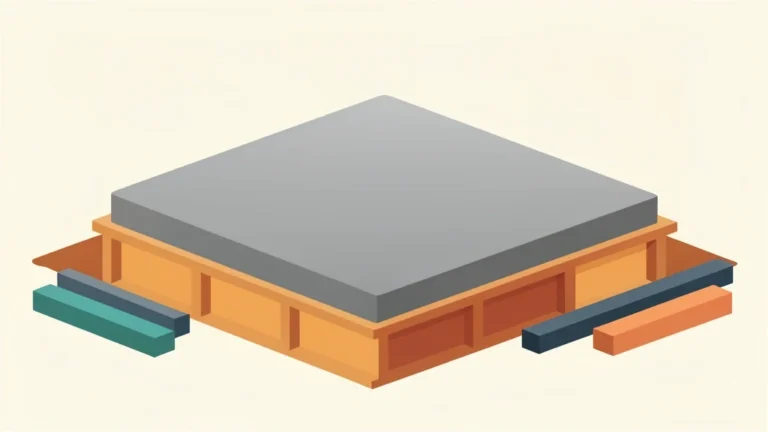
You are pouring a new patio, and one question stops you cold: do you order a few bags from the store, or a whole truck of concrete? The answer comes down to one number, the volume of your slab. Once you know that, everything else falls into place. To find how much concrete for a slab you need, you measure the slab, multiply to get its volume, and turn that into cubic yards or bags.
Multiply length x width x thickness, with every measurement in feet, to get the volume in cubic feet. Divide that by 27 to get cubic yards, since ready-mix concrete is sold by the cubic yard. A 10 ft x 10 ft slab at 4 in thick is about 33.3 cu ft, or 1.23 cu yd. Then add 5 to 10 percent extra for waste, and confirm the final amount with your supplier.
The Concrete Volume Formula
Concrete for a flat slab is a volume problem. You are filling a box shape: so long, so wide, and a certain thickness deep. The formula is short and easy to use.
Volume (cu ft) = Length x Width x Thickness, with every measurement in feet.
The catch is the thickness. Slab thickness is almost always given in inches, but the formula needs feet. So divide the inch value by 12 first. A 4 in slab is 4/12, which equals 0.333 ft. A 6 in slab is 6/12, or 0.5 ft.
Keep the units straight and the math is simple. Measure the length and width in feet, convert the thickness to feet, then multiply all three together. That single number, in cubic feet, is the amount of concrete the slab will hold.
Measure carefully before you multiply, because small errors grow. If a side is not perfectly square, measure it in two spots and use the larger value. It is safer to round measurements up than down.
Convert to Cubic Yards
Cubic feet is a fine start, but it is not how concrete is sold. Ready-mix concrete, the kind that arrives on a truck, is priced and delivered by the cubic yard. So you need to switch units.
One cubic yard equals 27 cubic feet. To convert, just divide your cubic feet by 27.
Cubic yards = Cubic feet / 27
Say your slab works out to 33.3 cu ft. Divide by 27 and you get about 1.23 cu yd. That is the figure a ready-mix supplier will want to hear. Bags of concrete, on the other hand, are measured in cubic feet, so keep both numbers handy.
This one conversion trips up many first-time pourers. Order in cubic feet by mistake and you could end up with far too little. Always turn the volume into cubic yards before you call the plant.
Cubic yard results are rarely round numbers, and that is normal. A slab might come out to 1.23 or 2.47 cu yd. Keep the decimal for now, since you will round up only after adding waste at the end.
A Worked Example
Numbers make this clearer, so let us pour a real slab. Picture a backyard patio that is 10 ft long, 10 ft wide, and 4 in thick.
Follow the steps in order:
- Convert the thickness: 4 in / 12 = 0.333 ft.
- Find the volume: 10 x 10 x 0.333 = 33.3 cu ft.
- Convert to cubic yards: 33.3 / 27 = 1.23 cu yd.
- Estimate bags: an 80 lb bag yields about 0.6 cu ft, so 33.3 / 0.6 = about 56 bags.
So this patio needs roughly 1.23 cu yd of concrete before waste. That is about 56 bags of the 80 lb size, or a small ready-mix order. In the next sections we add a waste factor and decide between bags and a truck.
Bags or Ready-Mix?
Once you know the volume, you can pick how to buy it. Bagged concrete you mix yourself works for small jobs. Ready-mix from a truck fits larger pours. The right choice depends mostly on size.
A common 80 lb bag yields about 0.6 cu ft of mixed concrete. A 60 lb bag yields about 0.45 cu ft. Bag counts add up fast, so check the yield printed on the actual bag before you buy.
- Choose bags for small slabs, repairs, and posts, roughly under 1 cu yd, where mixing by hand is manageable.
- Choose ready-mix once you pass about 1 cu yd, where dozens of bags become slow, tiring, and hard to blend evenly.
- Watch the clock: a big slab must be placed before the concrete sets, and a truck delivers it all at once.
- Ask about minimums: many plants have a minimum load and a short-load fee for small orders.
For the 1.23 cu yd patio above, either path can work, but that is right at the line where many people call for a truck. Bigger slabs almost always favor ready-mix.
Cost matters too. Bags feel cheap, but the price climbs fast once you need 50 or 60. A ready-mix load can be the better value, and it saves hours of mixing.
Add a Waste Factor
Never order the exact volume you calculated. Real pours lose concrete to spills, uneven ground, spread-out forms, and material stuck in the mixer or wheelbarrow. Running short mid-pour is a serious problem.
The fix is a waste factor. Order 5 to 10 percent extra on top of your calculated volume. Use the higher end for rough ground, odd shapes, or a first-time pour.
Back to the example: 33.3 cu ft plus 10 percent is about 36.6 cu ft. That works out to roughly 1.35 cu yd, or about 62 of the 80 lb bags. A little extra is cheap insurance against a half-finished slab.
These figures are estimates based on typical bag yields and standard math. Product yields, slab depth, and site conditions vary, so confirm the final amount with your supplier and follow your local building codes.
Skip the hand math and let our Concrete Calculator do the work. Enter your length, width, and thickness, and it returns the volume in cubic yards and bags, with a waste factor built in.
Planning the rest of the project? A slab often needs reinforcement, edging, or a base. See our guides on rebar spacing and quantity, how many bricks per square foot, and how much gravel for a driveway.
Frequently Asked Questions About Concrete for a Slab
How Do I Calculate Concrete for a Slab?
Multiply length x width x thickness, with all three in feet, to get cubic feet. Convert the thickness from inches to feet first by dividing by 12. Then divide the cubic feet by 27 to get cubic yards, the unit ready-mix is sold in. Add 5 to 10 percent for waste.
How Many Cubic Yards Are in a 10×10 Slab?
A 10 ft x 10 ft slab at 4 in thick holds about 1.23 cu yd. The math is 10 x 10 x 0.333, which equals 33.3 cu ft, divided by 27. A thicker slab needs more, so a 6 in version of the same slab would be about 1.85 cu yd. Add waste on top.
How Many Bags of Concrete Do I Need for a Slab?
Divide the slab volume in cubic feet by the yield printed on the bag. An 80 lb bag yields about 0.6 cu ft, and a 60 lb bag about 0.45 cu ft. A 33.3 cu ft slab needs about 56 of the 80 lb bags. Always check the yield on your actual bag.
When Should I Order Ready-Mix Instead of Bags?
Ready-mix usually makes sense once you pass about 1 cu yd. Beyond that, mixing dozens of bags by hand is slow and hard to keep consistent. A truck delivers it all at once, which matters because concrete sets fast. Ask the plant about load minimums and any short-load fees.
How Much Extra Concrete Should I Order for Waste?
Order 5 to 10 percent more than your calculated volume. Spills, uneven ground, and spread forms all consume extra concrete. Use the higher end for rough sites, odd shapes, or a first pour. Running short during a pour can ruin the finish, so a small buffer is worth the cost.
How Do I Convert Slab Thickness From Inches to Feet?
Divide the inch value by 12, since 12 inches make one foot. A 4 in slab is 4/12, or 0.333 ft. A 5 in slab is 5/12, about 0.417 ft, and a 6 in slab is 0.5 ft. Use the foot value in the volume formula so all units match.
Does a Thicker Slab Need Much More Concrete?
Yes, and the increase is direct. Going from 4 in to 6 in raises the volume by half, because thickness is a straight multiplier in the formula. Slab thickness is usually set by its use and by local code, so follow the required depth rather than trimming it to save concrete.
Sources
Authoritative Sources Used in This Article
This article is for general education only, not professional construction or engineering advice. Material needs vary by product, site, and local building codes, so confirm quantities with your supplier and follow local rules. Reviewed for accuracy by Prof. Dr. Khalil Mudassar, PhD. Last updated September 12, 2026.
Author

Shakeel Muzaffar is the Founder and Editor-in-Chief of MultiCalculators.com, bringing over 15 years of experience in digital publishing, product strategy, and online tool development. He leads the platform's editorial vision, ensuring every calculator meets strict standards for accuracy, usability, and real-world value. Shakeel personally oversees content quality, formula verification workflows, and the platform's commitment to publishing tools that are genuinely useful for students, professionals, and everyday users worldwide.