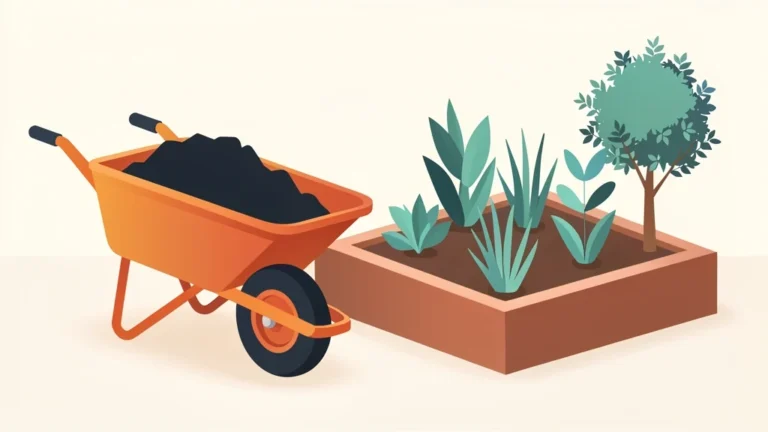
Your flower bed looks bare, so how many bags of mulch will actually fill it? The answer comes from one simple idea: figure out how much mulch or topsoil you need by area times depth. Measure the bed, pick a depth, and the volume falls right out. This guide shows the formula, converts it to cubic yards and bags, and shares the depths that work best for garden beds.
To find how much mulch or topsoil you need, multiply the bed area (in square feet) by the depth (in feet). That gives cubic feet. Divide by 27 to get cubic yards, or divide by 2 to count standard 2 cu ft bags. Handy rule: 1 cubic yard covers about 100 sq ft at 3 inches deep. Mulch usually goes 2 to 3 inches deep. These are estimates, so add 5 to 10 percent extra and confirm with your supplier.
The Volume Formula
Mulch and topsoil are sold by volume, not by area. So you need to think in three dimensions, not two. The formula is short and easy to use.
Volume (cu ft) = Area (sq ft) x Depth (ft)
Area is just length times width for a rectangular bed. Depth is how thick you want the layer to be, measured in feet. Since most depths are given in inches, convert first by dividing inches by 12.
For example, 3 inches is 3 / 12 = 0.25 ft. A 4 inch layer is 4 / 12 = 0.33 ft. Keep depth in feet so all your units match. That single step prevents the most common estimating mistake.
Not every bed is a neat rectangle. For an L-shaped bed, split it into two rectangles and add the volumes. For a rough oval, measure the longest length and widest width, then treat it like a rectangle for a safe over-estimate.
When in doubt, round the bed size up a little. A slightly high estimate beats running out halfway through the job.
Convert to Cubic Yards or Bags
Cubic feet is the starting number, but suppliers usually talk in cubic yards or bags. Both conversions are one quick step each.
To get cubic yards, divide cubic feet by 27. That number, 27, is how many cubic feet fit in one cubic yard (3 x 3 x 3). Bulk mulch and topsoil are almost always priced per cubic yard.
To count bags, divide cubic feet by the bag size. Most bagged mulch holds 2 cu ft, so divide by 2. Topsoil bags are often smaller, near 1 cu ft or 0.75 cu ft, so always read the label. Round bag counts up, since a partial bag still means buying a whole one.
One quick check keeps you honest: cubic yards and bag counts should point to the same volume. If 13 bags at 2 cu ft each equal 26 cu ft, that matches just under one cubic yard. When the two numbers disagree, recheck your depth conversion first, since that is the usual slip.
A Worked Example
Let us walk through a real bed from start to finish. Say you have a rectangular bed that is 10 ft long and 10 ft wide. You want a 3 inch mulch layer.
- Area = 10 ft x 10 ft = 100 sq ft.
- Depth = 3 in / 12 = 0.25 ft.
- Volume = 100 sq ft x 0.25 ft = 25 cu ft.
- Cubic yards = 25 / 27 = about 0.93 cu yd.
- Bags at 2 cu ft each = 25 / 2 = 12.5, so 13 bags.
So this bed needs roughly 0.93 cubic yards, or 13 standard bags. If you order bulk, one cubic yard is a clean, slightly generous amount. The Mulch Calculator runs these same steps for any bed size in seconds.
Want to change the depth? Just swap the depth value and redo the last three steps. At 2 inches, this same bed needs 100 x 0.17 = 17 cu ft, which is about 0.63 cubic yards. Deeper layers cost more, so pick a depth that fits both the plants and the budget.
Add a small buffer for uneven ground, settling, and spillage. Ordering 5 to 10 percent extra is a smart habit, and always confirm the final amount with your supplier.
Recommended Depths for Mulch and Topsoil
Depth changes both the look and the cost of your project. The right depth depends on what the material is doing. Here are common targets for garden beds.
- Mulch: 2 to 3 inches is the usual range for beds. It blocks weeds and holds moisture without smothering roots.
- Topsoil for new beds: a few inches worked into the ground, or more when building a raised bed from scratch.
- Refreshing old mulch: often just 1 inch on top to top up faded coverage.
- The coverage rule: 1 cubic yard covers about 100 sq ft at 3 inches deep. The exact figure is 27 / 0.25 = 108 sq ft, so about 100 for planning.
Topping up beats stripping and starting over. Old mulch breaks down and feeds the soil as it goes. Each spring, just add enough fresh mulch to bring the layer back to 2 or 3 inches.
Keep mulch off plant stems and tree trunks. Piling it against the base can trap moisture and invite rot or pests.
Bags vs Bulk: Which Is Cheaper?
Once you know your volume, you can pick how to buy it. Bags and bulk each have a sweet spot.
- Bags: best for small or one-off jobs. Easy to carry and store, but they cost more per cubic foot.
- Bulk: usually cheaper once you need about 1 to 2 cubic yards, roughly 13 to 27 bags.
Bulk also cuts plastic waste and store trips. The tradeoff is a delivery pile you move by wheelbarrow. Remember that moist topsoil weighs far more than dry mulch, so heavy loads take more trips. Price your exact load with the Mulch Calculator, and check soil with the topsoil calculator.
Ready to order the right amount? Enter your bed size and depth in our Mulch Calculator to get cubic yards and bag counts instantly. It handles the area, depth, and 27 conversion for you, so you can buy with confidence and skip the guesswork.
Estimating other materials for the yard? Our sibling guides cover how much gravel for a driveway and how much concrete for a slab, each with its own depth rules.
Frequently Asked Questions About Mulch and Topsoil
How Much Mulch or Topsoil Do I Need?
Multiply your bed area in square feet by the depth in feet to get cubic feet. Divide by 27 for cubic yards, or by the bag size for bags. For a 100 sq ft bed at 3 inches deep, that is 25 cubic feet, or about 0.93 cubic yards, or 13 standard 2 cu ft bags.
How Many Bags of Mulch Are in a Cubic Yard?
It depends on the bag size. One cubic yard is 27 cubic feet. Standard mulch bags hold 2 cubic feet, so a cubic yard is about 27 / 2 = 13.5 bags, round up to 14. Always check the bag label, since some hold 1 or 3 cubic feet.
How Deep Should Mulch Be?
For most garden beds, 2 to 3 inches of mulch works well. That depth blocks weeds and holds moisture without smothering roots. Deeper than 3 inches can trap too much water. Keep mulch a few inches away from plant stems and tree trunks to prevent rot.
What Does 1 Cubic Yard of Mulch Cover?
One cubic yard covers about 100 square feet at 3 inches deep. The exact math is 27 divided by 0.25 feet, which equals 108 square feet, so around 100 is a safe planning number. At 2 inches deep, the same yard covers roughly 160 square feet.
Is Bulk Mulch Cheaper Than Bags?
Bulk is usually cheaper per cubic foot once you need about 1 to 2 cubic yards or more. That is roughly 13 or more bags. Bags are handier for small or one-off jobs. Bulk also means a delivery pile you move yourself, so weigh the labor along with the price.
How Do I Convert Inches of Depth to Feet?
Divide the inches by 12, since 12 inches make one foot. So 3 inches is 3 / 12 = 0.25 feet, and 4 inches is 4 / 12 = 0.33 feet. Using feet for depth keeps your units consistent with area in square feet, which gives a correct cubic feet result.
Can I Use Topsoil and Mulch in the Same Bed?
Yes, and gardeners often do. Topsoil builds or improves the growing layer, while mulch sits on top to protect it. Add or improve soil first, then plant, then finish with 2 to 3 inches of mulch. Estimate each layer separately, since they use different depths.
Sources
Authoritative Sources Used in This Article
This article is for general education only, not professional construction or engineering advice. Material needs vary by product, site, and local building codes, so confirm quantities with your supplier and follow local rules. Reviewed for accuracy by Prof. Dr. Khalil Mudassar, PhD. Last updated September 12, 2026.
Author

Shakeel Muzaffar is the Founder and Editor-in-Chief of MultiCalculators.com, bringing over 15 years of experience in digital publishing, product strategy, and online tool development. He leads the platform's editorial vision, ensuring every calculator meets strict standards for accuracy, usability, and real-world value. Shakeel personally oversees content quality, formula verification workflows, and the platform's commitment to publishing tools that are genuinely useful for students, professionals, and everyday users worldwide.