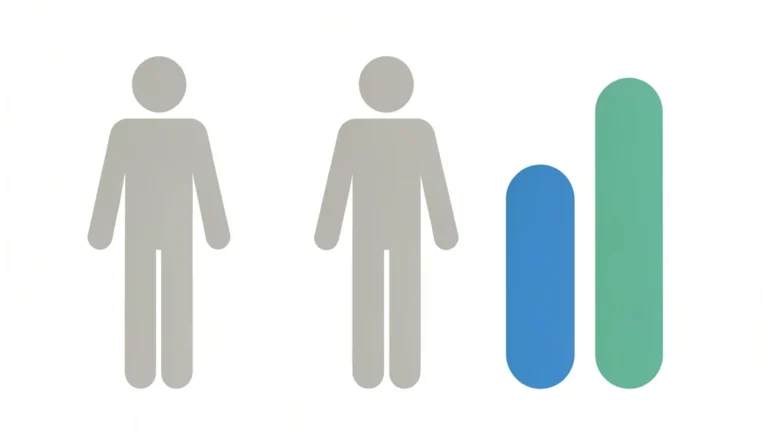
Can two people who are both 5 ft 10 in have different healthy weights? Yes, and body frame size is one reason why. Your frame is the size of your skeleton, the bone structure under your muscle and fat. A larger frame carries more weight in bone alone, so it nudges the healthy weight range upward. A smaller frame nudges it down. That is why ideal weight is best read as a range, not one exact number.
Body frame size is your bone structure: small, medium, or large. It does not set a single ideal weight. Instead it shifts your healthy weight range up for a large frame and down for a small frame, even at the same height. You can estimate your frame from your wrist size or a height-to-wrist ratio. Treat the result as a general guide and get your own range from an Ideal Weight Calculator.
What Body Frame Size Actually Means
Body frame size describes how big your skeleton is. It is your bone width and structure, not your muscle or fat. People are usually sorted into three groups: small, medium, and large frame.
Think of two people who stand the same height. One has narrow wrists, slim ankles, and a delicate build. The other has thick wrists, broad shoulders, and heavier bones. The second person weighs more before you add any muscle or fat at all.
That extra bone is real weight. So a person with a large frame can sit at a higher healthy weight than a small-framed person of the exact same height. Frame size is mostly set by genetics and does not change much as an adult.
How to Estimate Your Body Frame Size
You cannot weigh your bones directly, so we use simple proxies. The wrist is a good stand-in because it has little fat to get in the way. Here are two common methods.
- Wrist circumference method: Wrap a tape around the smallest part of your wrist, just below the wrist bone. Compare the number to a chart for your sex and height.
- Height-to-wrist ratio method: Divide your height by your wrist circumference, using the same units. A thinner wrist for your height means a larger ratio and a smaller frame.
- Elbow breadth method: A clinician measures the width across the two bones of your bent elbow. A wider breadth points to a larger frame. This one usually needs calipers.
The table below shows general wrist guides for adults. These are rough reference points, not strict cutoffs, and they vary by source.
| Method | Small Frame | Medium Frame | Large Frame |
|---|---|---|---|
| Wrist, men over 5 ft 5 in | Under 6.5 in (16.5 cm) | 6.5 to 7.5 in (16.5 to 19 cm) | Over 7.5 in (19 cm) |
| Wrist, women over 5 ft 5 in | Under 6 in (15 cm) | 6 to 6.25 in (15 to 16 cm) | Over 6.25 in (16 cm) |
| Height/wrist ratio, men | Over 10.4 | 10.1 to 10.4 | Under 10.1 |
| Height/wrist ratio, women | Over 11.0 | 10.1 to 11.0 | Under 10.1 |
Why the Same Height Can Mean Different Healthy Weights
Height-based weight charts give one range for everyone at a given height. That is a useful start, but it ignores how people are built. Two bodies of the same height can hold very different amounts of bone.
Bone is dense and heavy. A broad, thick-boned skeleton simply weighs more than a slim one. That difference shows up on the scale before you count muscle or fat.
So a large-framed person often belongs near the top of a healthy range, while a small-framed person often belongs near the bottom. Same height, same chart, but a different healthy target inside that band.
Frame size is only one factor. Muscle, fat, sex, age, and overall health all shape a healthy weight too. Use frame as a nudge within a range, not the whole answer.
How Frame Size Shifts the Ideal Weight Range
A healthy weight for any height is a range, not a single figure. Frame size helps you pick where inside that range you likely fit. A larger frame leans high, a smaller frame leans low.
Picture three people who are all 5 ft 10 in. The overall healthy range runs from roughly 129 to 174 lb (about 59 to 79 kg). Their frames move them to different parts of that band.
The bands overlap, and they all sit inside the same overall healthy range. The point is the trend: bigger frame, higher target. The chart below shows that same upward shift as a simple range for each frame.
A Worked Example, Step by Step
Let us run one person through the math. Meet a man who is 5 ft 10 in tall with a 6.5 in wrist.
- Step 1, convert height: 5 ft 10 in = 70 in.
- Step 2, wrist method: A 6.5 in wrist sits right at the low edge of the medium band for men. By this method he reads as a medium frame.
- Step 3, ratio method: 70 in / 6.5 in = about 10.8. For men, over 10.4 is a small frame, so this reads as small.
- Step 4, read it together: The two methods disagree slightly, so he lands between small and medium.
This is normal and a good lesson. Frame methods are estimates, so you often get a “leans small” or “leans medium” answer. He would aim toward the lower-middle of his height’s healthy range, then confirm the exact numbers with a tool.
Want your own range instead of a guess? Enter your height and frame into our Ideal Weight Calculator to see a healthy weight range built for you, not a one-size-fits-all number.
Where Frame Size Fits in the Bigger Picture
Frame size is one useful clue, but it is not the full story of a healthy body. The scale cannot tell bone, muscle, and fat apart on its own.
If you want to look past total weight, two sibling guides pick up where this one stops. They stay in their own lanes, just as this article stays in frame size.
- To judge fat stored around your middle and its health risk, see Waist Circumference and Health Risk.
- To learn what share of your body is fat by life stage, see Healthy Body Fat Percentage by Age.
Read together, frame size, waist, and body fat give a fuller view than weight alone. Each answers a different question about your body.
Frequently Asked Questions About Body Frame Size
What Is Body Frame Size?
Body frame size is the size of your skeleton, meaning your bone width and structure. It is sorted into small, medium, and large. It does not include your muscle or fat. A larger frame carries more weight in bone, which can raise your healthy weight range compared with a smaller frame at the same height.
How Do I Measure My Frame Size at Home?
The easiest way is the wrist method. Wrap a tape around the smallest part of your wrist, just below the wrist bone, and compare it to a chart for your sex and height. You can also divide your height by your wrist size for a ratio. Both give general guides, not exact labels.
Does Frame Size Change Your Ideal Weight?
It shifts your ideal weight range rather than setting one number. A large frame leans toward the higher end of a healthy range for your height. A small frame leans toward the lower end. Frame size is one factor among several, so use it as a nudge inside a range, not a precise target.
Why Do Two People of the Same Height Weigh Different Healthy Amounts?
Bone is dense and heavy, and people carry different amounts of it. A broad, thick-boned skeleton weighs more than a slim one before any muscle or fat is added. That is why a large-framed person can be healthy at a higher weight than a small-framed person of the exact same height.
What Wrist Size Means a Large Frame?
For men taller than 5 ft 5 in, a wrist over about 7.5 in (19 cm) suggests a large frame. For women taller than 5 ft 5 in, a wrist over about 6.25 in (16 cm) suggests a large frame. These are general guides only and differ between sources, so treat them as rough reference points.
Can My Frame Size Change Over Time?
Your bone structure is mostly set by genetics and stays fairly steady in adulthood. You cannot turn a small frame into a large one through diet or exercise. Your weight, muscle, and fat can change a lot, but the underlying skeleton size does not meaningfully shift once you are grown.
Is Frame Size Enough to Set My Target Weight?
No. Frame size helps you pick where in a healthy range you likely fit, but it is only one piece. Muscle, fat, sex, age, and health all matter too. For a personal range, use an Ideal Weight Calculator, and talk with a healthcare professional before setting any weight goal.
Sources
Authoritative Sources Used in This Article
This article is for general education only, not medical advice. Body composition, healthy ranges, and individual needs vary, so talk with a doctor or a qualified health professional before making changes to your diet, exercise, or health routine. Reviewed for accuracy by Dr. Abdullah Khalil, MBBS. Last updated September 12, 2026.
Author

Shakeel Muzaffar is the Founder and Editor-in-Chief of MultiCalculators.com, bringing over 15 years of experience in digital publishing, product strategy, and online tool development. He leads the platform's editorial vision, ensuring every calculator meets strict standards for accuracy, usability, and real-world value. Shakeel personally oversees content quality, formula verification workflows, and the platform's commitment to publishing tools that are genuinely useful for students, professionals, and everyday users worldwide.