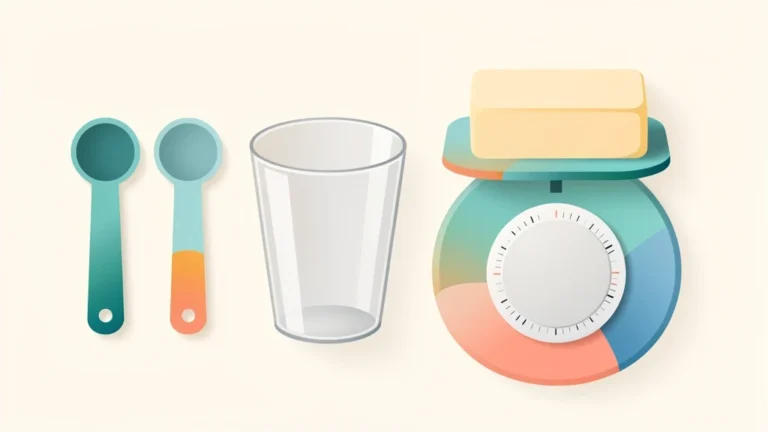
The recipe is written in grams, but your cups are in, well, cups. Now what? Cooking measurement conversions turn one unit into another so any recipe works in your kitchen. This guide keeps the everyday ones close at hand: teaspoons, tablespoons, cups, milliliters, grams, ounces, butter, and oven temperatures. Learn a few key numbers and you can follow almost any recipe with confidence.
The conversions you use most: 1 tablespoon = 3 teaspoons, and 1 cup = 16 tablespoons = 48 teaspoons. For liquids, 1 cup is about 240 milliliters and 1 fluid ounce is about 30 milliliters. For weight, 1 ounce is about 28 grams. One stick of butter equals 8 tablespoons, or 1/2 cup, or about 113 grams. Oven dial: 350 degrees F is about 177 degrees C.
Spoons and Cups
Spoons and cups are the backbone of most recipes. Getting the small units right keeps flavors balanced, especially for salt, baking soda, and spices.
The core rule is simple. One tablespoon holds 3 teaspoons. From there, everything scales up in steady steps.
| Measure | Equals | Also Equals |
|---|---|---|
| 1 tablespoon | 3 teaspoons | – |
| 1/4 cup | 4 tablespoons | 12 teaspoons |
| 1/2 cup | 8 tablespoons | 24 teaspoons |
| 1 cup | 16 tablespoons | 48 teaspoons |
Here is a worked example both ways. A sauce needs 6 teaspoons of soy sauce, so that is 2 tablespoons. Going the other direction, 1/2 cup of oil is 8 tablespoons if you only have a tablespoon on hand.
Two smaller terms show up in older recipes. A “dash” is roughly 1/8 teaspoon, and a “pinch” is about 1/16 teaspoon. Both are approximate, so taste as you go.
These same steps make scaling easy. To double a recipe, double each spoon and cup amount; to halve it, cut each one in two.
Cups to Milliliters and Ounces
Many recipes list liquids in milliliters or fluid ounces. Cups convert cleanly once you know two anchor numbers.
One US cup is about 240 milliliters. One fluid ounce is about 30 milliliters, and a cup holds 8 fluid ounces. Notice that 8 times 30 equals 240, so the numbers line up.
- 1 cup is about 240 ml (8 fluid ounces)
- 1/2 cup is about 120 ml (4 fluid ounces)
- 1 fluid ounce is about 30 ml (2 tablespoons)
One tablespoon is about 15 milliliters, which is a handy anchor for small liquid amounts. So 2 tablespoons make about 30 milliliters, or 1 fluid ounce.
Note that a metric cup is 250 milliliters, slightly larger than the US cup of 240. The gap is small, but it can matter in careful baking.
Fluid ounces measure volume, not weight, so keep them separate from the dry ounces below. For the full gallon, quart, pint, and cup ladder, see our guide on how many cups are in a gallon.
Dry Weights: Grams and Ounces
Weighing dry ingredients is the most accurate way to bake. When a recipe uses grams or ounces, one factor does most of the work.
One ounce is about 28 grams. The precise value is 28.35 grams, but 28 is close enough for the kitchen. To go from ounces to grams, multiply by about 28. To go the other way, divide by 28.
For example, 4 ounces of chocolate is about 113 grams. And 200 grams of flour is about 7 ounces.
A few more everyday weights help too. Half an ounce is about 14 grams, and 16 ounces equals 1 pound, or about 454 grams.
Cups of dry ingredients do not convert to a single gram value. A cup of flour weighs far less than a cup of sugar. So a cup-to-gram number is always approximate and depends on the ingredient. When precision matters, weigh in grams.
Weight and volume belong to different systems. To understand why the two never match one to one, see our metric vs imperial conversion guide.
Butter Conversions
Butter is measured in sticks, tablespoons, cups, and grams, which trips up a lot of cooks. One stick ties all four together.
One stick of butter equals 8 tablespoons. That is the same as 1/2 cup, or about 113 grams. Since a full cup is 16 tablespoons, two sticks make 1 cup.
- 1 stick = 8 tablespoons = 1/2 cup = about 113 grams
- 1/2 stick = 4 tablespoons = 1/4 cup = about 57 grams
- 2 sticks = 16 tablespoons = 1 cup = about 227 grams
Wrapper markings help here. Most US butter wrappers print tablespoon lines, so you can slice off exactly what you need without extra tools.
These amounts are the same for salted and unsalted butter. Softening butter changes its texture, not its weight or volume, so the numbers still hold.
Here is a quick example. A recipe calls for 6 tablespoons of butter, but your butter is in sticks. Since a stick is 8 tablespoons, use three quarters of one stick. Working from grams instead, 170 grams of butter is close to 1 and 1/2 sticks.
Oven Temperatures
Oven dials differ by country. American recipes use degrees Fahrenheit, while many others use degrees Celsius. Converting keeps your bake from burning or staying raw.
The formula is C = (F minus 32) x 5/9. You rarely need to do the math, though, because a few common settings cover most baking.
| Degrees F | Degrees C | Typical Use |
|---|---|---|
| 325 | about 163 | Slow bakes, custards |
| 350 | about 177 | Most cakes and cookies |
| 375 | about 191 | Muffins, some breads |
| 400 | about 204 | Roasting, crisp crusts |
Fan or convection ovens run hotter, so recipes often lower the dial. A common rule is to drop the temperature by about 25 degrees F, or roughly 15 to 20 degrees C.
Need a different temperature? Our Celsius to Fahrenheit converter handles any value in a second.
Tips for Accurate Measuring
Good technique matters as much as the right numbers. These habits keep your results steady from one batch to the next.
- Level dry ingredients by scraping a flat edge across the cup. A heaping cup adds hidden extra.
- Spoon flour into the cup, then level it. Scooping packs it and adds weight.
- Read liquid cups at eye level on a flat surface for a true line.
- Use a kitchen scale for baking. Weight in grams beats volume for accuracy.
- Keep dry and liquid measuring tools separate, since they are designed differently.
- Round gently. Small kitchen rounding, like 28 grams per ounce, is fine for cooking.
When a recipe mixes systems, a converter saves time and prevents mistakes. Keep one open while you cook.
Cooking from a recipe in the other system? Switch grams, ounces, milliliters, and cups in one place with our Metric to Imperial Converter. Type a value, pick your units, and get the answer instantly while you cook.
Frequently Asked Questions About Cooking Conversions
How Many Teaspoons Are in a Tablespoon?
There are 3 teaspoons in 1 tablespoon. This holds for US and metric spoon sets used in most kitchens. So if a recipe calls for 1 tablespoon and you only have a teaspoon, measure 3 level teaspoons. To go the other way, divide teaspoons by 3.
How Many Tablespoons Are in a Cup?
One cup holds 16 tablespoons, which is also 48 teaspoons. A half cup is 8 tablespoons, and a quarter cup is 4 tablespoons. These steps make it easy to measure part of a cup when you do not have the exact tool on hand.
How Many Milliliters Are in a Cup?
One US cup is about 240 milliliters. A half cup is about 120 milliliters. One fluid ounce is about 30 milliliters, and a cup holds 8 fluid ounces, so 8 times 30 equals 240. These are volume measures, used for liquids.
How Many Grams Are in an Ounce?
One ounce is about 28 grams. The exact value is 28.35 grams, but 28 works well for cooking. To convert ounces to grams, multiply by about 28. To convert grams to ounces, divide by 28. This applies to dry weight, not fluid ounces.
How Much Is One Stick of Butter?
One stick of butter equals 8 tablespoons. That is the same as 1/2 cup, or about 113 grams. Two sticks make 1 cup, or about 227 grams. Most US butter wrappers show tablespoon lines, so you can cut the exact amount easily.
What Is 350 Degrees F in Celsius?
350 degrees F is about 177 degrees C. Use the formula C = (F minus 32) x 5/9. Other common settings: 325 F is about 163 C, 375 F is about 191 C, and 400 F is about 204 C. Many ovens round these to the nearest 5.
Can I Convert Cups of Flour to Grams Exactly?
Not exactly, because dry ingredients differ in density. A cup of flour weighs far less than a cup of sugar or a cup of butter. Any cup-to-gram figure is approximate and depends on the ingredient. For precise baking, weigh your ingredients on a kitchen scale in grams.
Sources
Authoritative Sources Used in This Article
This article is for general education only. The conversions here use standard, widely accepted factors; check exact values for scientific, medical, or legal use. Reviewed for accuracy by Prof. Dr. Khalil Mudassar, PhD. Last updated September 12, 2026.
Author

Shakeel Muzaffar is the Founder and Editor-in-Chief of MultiCalculators.com, bringing over 15 years of experience in digital publishing, product strategy, and online tool development. He leads the platform's editorial vision, ensuring every calculator meets strict standards for accuracy, usability, and real-world value. Shakeel personally oversees content quality, formula verification workflows, and the platform's commitment to publishing tools that are genuinely useful for students, professionals, and everyday users worldwide.