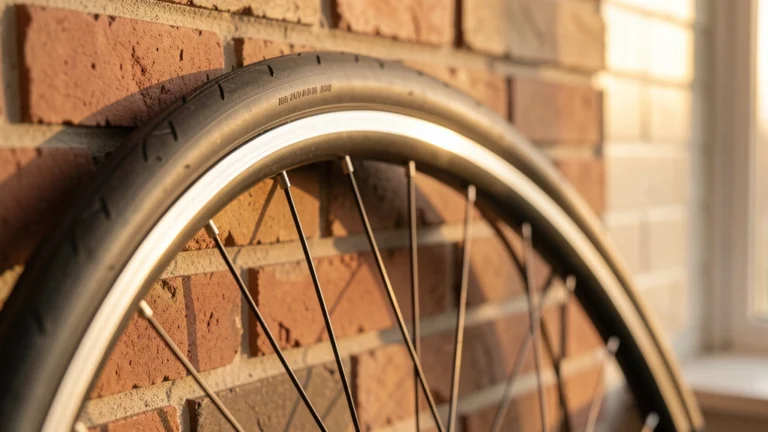
Did you know there are at least six different tire sizes sold as “26 inch”? That is why a new tire can refuse to go on your rim. The fix is one small code on the sidewall, such as 37-622. This guide shows you how to read it, match it to the old inch names, and turn it into a wheel circumference.
- The ISO code 37-622 means a tire about 37 mm wide that fits a 622 mm bead seat.
- The second number, the bead seat diameter, must match your rim exactly.
- 700C, 28 inch and 29 inch tires all share the same 622 mm bead seat.
- Outer diameter is roughly the bead seat plus two tire heights, so 37-622 is about 696 mm.
- Circumference is pi times the outer diameter, about 2,187 mm for a 37-622 tire.
What Do the Two Numbers in 37-622 Tell You?
The first number is the tire’s width in millimeters, and the second is its bead seat diameter in millimeters. So 37-622 is a tire about 37 mm wide that seats on a rim 622 mm across.
This code comes from the ISO 5775 standard, which grew out of a system built by the European Tyre and Rim Technical Organisation. Shops often call it the ETRTO size. Both names point to the same two numbers.
The bead is the stiff edge of the tire that locks into the rim. The bead seat diameter is the size of the ledge where that edge sits. It is the one number that decides whether a tire fits at all.
Which Number Can You Change?
Width is flexible within limits, but the bead seat is not. A 28-622 road tire and a 45-622 gravel tire both mount on a 622 rim. A 37-584 tire never will, since it is 38 mm smaller across the bead.
Why Can Two “26 Inch” Tires Refuse to Swap?
The inch names describe rough outside size, not the bead seat, so one name covers several rims. A “26 inch” label has meant bead seats of 559, 571, 584, 590 and 597 mm over the years.
Modern mountain bikes marked 26 x 2.1 use a 559 mm bead seat. An old three-speed marked 26 x 1 3/8 uses 590 mm. Those two tires differ by 31 mm across the bead, and neither fits the other rim.
Watch the way the width is written, too. One long-standing sizing reference warns that a decimal width and a fraction width never mean the same tire. A 26 x 1.75 tire fits a 559 rim, while a 26 x 1 3/4 tire fits a 571 rim.
The safe habit is simple. Ignore the inch label when you shop, and match the three-digit ISO number printed beside it. Nearly every modern tire carries both markings on the sidewall.
Is a 700C Tire the Same as a 29er?
Yes, for fit: 700C and 29 inch tires both use a 622 mm bead seat. The 29 inch name is a marketing label for wide 622 tires on mountain bikes, so the rims are the same size.
The “700” part comes from the older French system. There, the number was the rough outside diameter in millimeters, and the letter A to D set the width. Today a 700C tire can be narrow or wide, so the name is only a label.
| Common name | Bead seat (mm) | Typical use |
|---|---|---|
| 27 inch (27 x 1 1/4) | 630 | Older road bikes |
| 700C, 28 inch, 29 inch | 622 | Road, hybrid, gravel, 29er mountain |
| 650B, 27.5 inch | 584 | Touring, many mountain bikes |
| 650C | 571 | Triathlon, small road frames |
| 26 x decimal (26 x 2.1) | 559 | Older mountain bikes, cruisers |
| 20 x decimal (20 x 1.75) | 406 | BMX, kids, folding bikes |
Notice the trap in the first two rows. A “27 inch” wheel is 8 mm larger across the bead than a “28 inch” 700C wheel. The larger inch number does not mean the larger wheel.
How Big Is the Whole Wheel With the Tire On?
Add two tire heights to the bead seat diameter. Bike tires stand about as tall as they are wide. So a 37-622 tire is 622 + 2 x 37 = 696 mm across, about 27.4 inches.
Circumference is pi times that diameter. For 696 mm, that works out to about 2,187 mm. Your bike computer uses this number to turn wheel turns into distance, so a wrong entry makes every ride read long or short.
| ISO size | Outer diameter | Circumference | Turns per km |
|---|---|---|---|
| 28-622 | 678 mm | 2,130 mm | 469.5 |
| 37-622 | 696 mm | 2,187 mm | 457.3 |
| 50-584 | 684 mm | 2,149 mm | 465.4 |
| 57-559 | 673 mm | 2,114 mm | 473.0 |
| 40-406 | 486 mm | 1,527 mm | 655.0 |
Treat these as starting points. Very narrow tires run a little taller than their width, and pressure and rider weight squash the tire slightly. For the true figure, mark the tire, roll the bike one full turn with you seated, and measure the distance.
How Do You Enter a Bike Tire in Our Calculator?
Enter the tire width in millimeters, set the aspect ratio to 100, and type the bead seat in inches. Our bike tire size calculator for diameter and circumference then returns results in inches.
The tool uses the car-style inputs of width, aspect ratio and rim size, as explained in our guide on how to read tire size numbers. Sidewall height is width times aspect ratio divided by 100. The tool adds two sidewalls to the rim diameter.
Bike tires do not print an aspect ratio, so 100 stands in for “height equals width.” For a 37-622 tire, enter 37, 100 and 24.49, since 622 divided by 25.4 is 24.49. The tool returns a total diameter of 27.40 inches and a circumference of 86.09 inches.
Watch the Sample Hints in the Boxes
The empty boxes show hints of 700, 28 and 23. Typed in as-is, they give a 196 mm sidewall and a 38.43 inch wheel, which no bike has. The 700 is a size name, not a width, so use 28 for width and 24.49 for the rim instead.
How Wide a Tire Will Your Rim Accept?
A tire fits best when the rim’s inner width is roughly half to two thirds of the tire width. The ISO overview gives about 65 percent for tires under 30 mm and 55 percent for wider ones.
Try the math on two tires. A 25 mm tire suits a rim about 16 mm wide inside. A 37 mm tire suits a rim about 20 mm wide inside. Far outside that range, the tire can squirm in corners or sit too flat.
The frame sets the other limit. A wider tire grows in width and height. Check the gap at the fork crown, chainstays and brakes before you size up. Leave a few millimeters for mud and a slightly wobbly wheel.
Many sidewalls also print a pressure range in kPa, bar or psi. That range belongs to the tire, not the rim size. For how pressure units compare and why cold readings matter, see our guide on recommended tire pressure.
Use the Bike Tire Size Calculator with an aspect ratio of 100 to get total diameter, circumference and sidewall height for any bike tire.
FAQs About Bike Tire Sizes
What Does 700x25C Mean on a Bike Tire?
It means a tire about 25 mm wide for a 700C rim. In ISO terms that is 25-622, since every 700C tire uses a 622 mm bead seat diameter.
Can I Put 29 Inch Tires on 700C Rims?
Yes, as long as the rim and frame have room for the width. Both sizes share the 622 mm bead seat, so the tire will seat on the rim.
Is a 27 Inch Tire the Same as 700C?
No. A 27 inch tire has a 630 mm bead seat, while 700C is 622 mm. The 8 mm gap is enough to stop a 27 inch tire from seating on a 700C rim.
Where Do I Find the ISO Size on My Tire?
Look on the sidewall for two numbers joined by a hyphen, such as 37-622 or 57-559. It usually sits near the inch or French size in smaller print.
Why Does the Calculator Ask for an Aspect Ratio?
The tool uses the car tire method of width, aspect ratio and rim size. Bike tires are roughly as tall as they are wide, so enter 100 for the aspect ratio.
How Do I Measure My Wheel Circumference Exactly?
Mark the tire and the floor, sit on the bike, and roll forward one full wheel turn. The distance between the two floor marks is your true rolling circumference in millimeters.
Are 27.5 Inch and 650B the Same Size?
Yes. Both names refer to the 584 mm bead seat diameter. The 27.5 inch label is usually used for wider mountain bike tires on that rim size.
Sources
References Used in This Article
This article is general cycling equipment education. Always confirm the ISO size printed on your own rim and tire before buying. Reviewed for accuracy by Prof. Dr. Khalil Mudassar, PhD. Last updated September 27, 2026.
Author

Shakeel Muzaffar is the Founder and Editor-in-Chief of MultiCalculators.com, bringing over 15 years of experience in digital publishing, product strategy, and online tool development. He leads the platform's editorial vision, ensuring every calculator meets strict standards for accuracy, usability, and real-world value. Shakeel personally oversees content quality, formula verification workflows, and the platform's commitment to publishing tools that are genuinely useful for students, professionals, and everyday users worldwide.