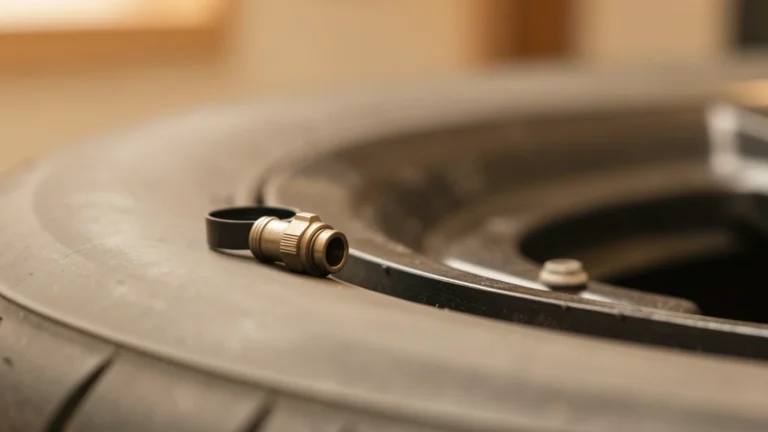
Your car’s recommended tire pressure is not printed on the tire itself. It lives on a small sticker inside the driver’s door jamb, or in your owner’s manual, and it is set by the vehicle maker for how your specific car handles, rides, and saves fuel. The number stamped on the tire sidewall is a different thing entirely: it is the tire’s maximum safe pressure, not the pressure your car actually wants day to day. Mixing these two up is one of the most common tire mistakes drivers make.
Find your car’s recommended tire pressure on the driver’s door jamb sticker or in the owner’s manual, not on the tire sidewall. The sidewall number is the tire’s maximum rating, which is usually higher than what your car actually needs. Correct pressure supports even tread wear, predictable handling, and better fuel efficiency. Always check pressure when tires are cold, ideally before driving or after the car has sat for a few hours. Pressure is commonly shown in PSI in the United States and in bar in much of the rest of the world, so a quick PSI to bar conversion helps when specs or gauges use different units. This article is general education, not a substitute for your vehicle’s specific manual.
Why Correct Tire Pressure Actually Matters
Tire pressure sounds like a small detail, but it affects almost everything about how your car behaves on the road. The right pressure lets your tires meet the pavement the way engineers designed them to.
When pressure is correct, your tires wear evenly across the tread, which means you get more miles from a set before replacing them. Handling stays predictable too, since properly inflated tires respond the way your steering and suspension expect. Fuel efficiency benefits as well, because underinflated tires create more rolling resistance and make the engine work harder.
Safety ties all of this together. Correct pressure helps your car stop, turn, and grip the road the way it was engineered to. That is why checking pressure regularly is one of the simplest habits for keeping a car running well.
Where to Find Your Car’s Real Recommended Pressure
The single most important fact in this article is where the correct number actually lives. It is not on the tire.
Open the driver’s side door and look at the door jamb, the part of the frame you see when the door is open. Most vehicles have a sticker there listing the recommended tire pressure for the front and rear tires, along with other details like tire size. If you cannot find it there, your owner’s manual will list the same numbers, usually in a section about tires or vehicle specifications.
This manufacturer number is calculated for your car’s specific weight, suspension tuning, and intended ride quality. It is the number you should use when adding air, and it is often different between the front and rear tires.
Why the Tire Sidewall Number Confuses So Many Drivers
The tire sidewall has its own pressure number stamped into the rubber, and it is easy to assume that is the target. It usually is not.
That sidewall figure is the maximum pressure the tire itself can safely hold, set by the tire manufacturer for that tire model. It is a safety ceiling for the tire, not a recommendation for your car. The same tire model can be mounted on several different vehicles, each with its own ideal pressure below that ceiling.
Your car’s recommended pressure, set by the vehicle maker, accounts for the car’s weight, how the suspension is tuned, and the ride and handling balance engineers wanted. It is almost always lower than the tire’s maximum rating. Filling tires to the sidewall number instead of the door jamb number can lead to a harsher ride and uneven wear.
PSI and Bar: Understanding the Two Common Units
Tire pressure is measured in different units depending on where you are and what vehicle you drive. In the United States, PSI, or pounds per square inch, is standard. In much of Europe and many other regions, bar is the common unit instead.
Some vehicles imported from other regions, some aftermarket gauges, and some compressors default to bar rather than PSI. If your door jamb sticker uses one unit and your gauge or pump reads the other, you need to convert before you can compare the numbers correctly.
This is exactly the kind of quick, practical conversion our PSI to Bar Converter is built for. Enter the number from either your sticker or your gauge, and it converts instantly between PSI and bar, so you can be confident you are filling to the right target regardless of which unit your equipment uses.
Always Check Pressure When Tires Are Cold
Tire pressure readings change depending on temperature, so widely cited guidance is to check pressure when tires are cold. Cold means the car has not been driven for at least a few hours, or has only gone a short distance at low speed.
Driving heats up the air inside a tire through friction and flexing, which raises the pressure reading. A pressure check right after a highway drive can show a higher number than the tire’s true resting pressure, which can lead you to add less air than the tire actually needs.
A simple routine many drivers follow is checking pressure first thing in the morning, before the car has moved, or at a gas station on the way to somewhere close by. This gives the most accurate baseline reading to compare against the door jamb number.
How Outside Temperature Affects Tire Pressure
Tire pressure does not stay perfectly constant through the seasons. As a general rule widely cited by tire manufacturers, pressure drops roughly one to two PSI for every ten degree Fahrenheit drop in outside temperature.
This means tires that were correctly filled in warm weather can end up underinflated once temperatures fall in autumn or winter, even if no air has leaked out. The reverse also happens: pressure can rise again as temperatures warm up.
Because of this, checking pressure at the start of each season, not just once a year, is a practical habit. It catches the natural swings that temperature alone can cause, separate from any slow leak a tire might have.
General Signs of Under-Inflation and Over-Inflation
Tires that run consistently underinflated tend to show more wear along the outer edges of the tread, since the tire’s center flattens less than it should and the shoulders take on more load. Underinflated tires can also feel softer or less responsive in turns, and they generally increase fuel consumption over time.
Tires that run consistently overinflated tend to show more wear toward the center of the tread, since less of the tire’s surface is meeting the road evenly. Overinflated tires can also feel stiffer, transmitting more bumps from the road into the cabin.
These are general patterns widely described by tire manufacturers, not a precise diagnosis. If you notice uneven wear, it is worth checking pressure right away and having a qualified mechanic take a closer look.
A Simple Routine for Staying on Top of Tire Pressure
Keeping tire pressure correct does not need to be complicated. A short routine, repeated regularly, catches most problems before they become expensive.
Check pressure when tires are cold, at least once a month and before any long road trip. Compare the reading against the door jamb sticker or owner’s manual number, not the tire sidewall. Use the PSI to Bar Converter whenever your gauge or the sticker uses a different unit than the other.
Regular tire checks fit naturally alongside other routine upkeep, like oil changes. Our guide on oil change intervals covers another commonly misunderstood maintenance schedule, and both habits are easiest to keep up when you plan for them ahead of time rather than reacting after something feels wrong.
Not sure whether your gauge and your door jamb sticker agree? Convert instantly between the two most common tire pressure units with our PSI to Bar Converter, and make sure you are always filling to your car’s actual recommended pressure.
FAQs About Recommended Tire Pressure
Where Do I Find My Car’s Recommended Tire Pressure?
Look at the sticker inside the driver’s door jamb, visible when the door is open. It lists the recommended pressure for the front and rear tires. If you cannot find it there, your owner’s manual lists the same numbers, usually in the tires or specifications section.
Is the Number on the Tire Sidewall the Correct Pressure to Use?
No. The number on the tire sidewall is the tire’s maximum safe pressure, set by the tire maker, not the recommended pressure for your specific car. Your car’s recommended pressure, found on the door jamb sticker, is almost always lower than that maximum figure.
Why Does Correct Tire Pressure Matter So Much?
Correct pressure supports even tread wear, predictable handling, and better fuel efficiency, because it lets your tires meet the road the way they were engineered to. It also plays an important role in overall vehicle safety, which is why manufacturers set a specific recommended number for each car.
Why Should I Check Tire Pressure When Tires Are Cold?
Driving heats the air inside a tire, which raises the pressure reading temporarily. Checking when tires are cold, meaning the car has not been driven recently, gives the most accurate baseline reading to compare against your car’s recommended pressure.
Does Outside Temperature Really Change Tire Pressure?
Yes. As a general rule widely cited by tire manufacturers, pressure shifts roughly one to two PSI for every ten degree Fahrenheit change in outside temperature. This is a common reason tires can end up underinflated when the weather turns colder, even without a leak.
What Is the Difference Between PSI and Bar for Tire Pressure?
PSI and bar are two different units for measuring the same kind of pressure. PSI is standard in the United States, while bar is common in much of Europe and elsewhere. If your sticker and your gauge use different units, converting between them ensures you fill to the correct target.
What Are General Signs My Tires Might Be Under or Overinflated?
Underinflated tires often show more wear along the outer tread edges and can feel softer in turns. Overinflated tires often show more wear toward the tread center and can feel stiffer over bumps. These are general patterns, so any uneven wear is worth having a mechanic check.
Sources
Authoritative Sources Used in This Article
This article is for general education only, not mechanical or financial advice. Always follow your vehicle owner’s manual and a qualified mechanic for your specific car. Reviewed for accuracy by Prof. Dr. Khalil Mudassar, PhD. Last updated September 16, 2026.
Author

Shakeel Muzaffar is the Founder and Editor-in-Chief of MultiCalculators.com, bringing over 15 years of experience in digital publishing, product strategy, and online tool development. He leads the platform's editorial vision, ensuring every calculator meets strict standards for accuracy, usability, and real-world value. Shakeel personally oversees content quality, formula verification workflows, and the platform's commitment to publishing tools that are genuinely useful for students, professionals, and everyday users worldwide.