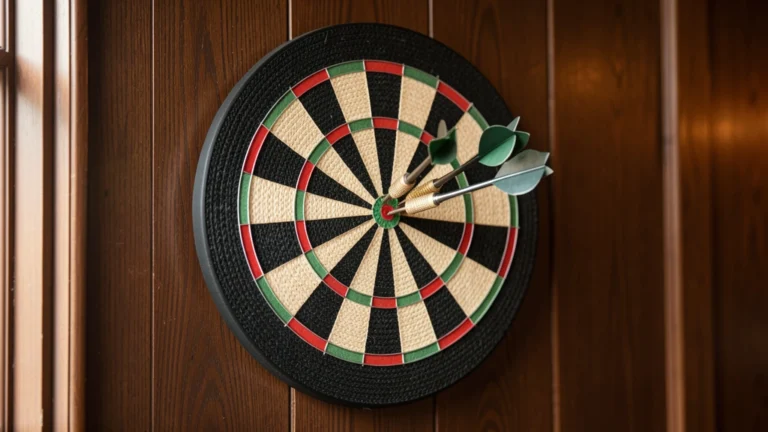
Why can a player on 170 win the leg with three darts, while a player on 169 cannot? The answer comes from one rule: the last dart must land in a double. That rule turns the end of every leg into a small math puzzle. This guide shows which scores you can finish, which you cannot, and how to plan the route.
| Checkout | Up to 3 darts that bring your score to exactly zero |
|---|---|
| Finishing rule | The last dart must hit a double or the 50 bull |
| Highest checkout | 170 (T20, T20, Bull) |
| Bogey numbers | 159, 162, 163, 165, 166, 168, 169 |
| Finishable scores | 162 of the 169 scores from 2 to 170 |
Darts Checkout Chart for Common Scores
The chart below lists common finishes, using standard shorthand. T means treble, D means double, S means single, and Bull is the 50-point center. Each route ends on a double, as the rules require.
| Score left | Route | Darts | Math check |
|---|---|---|---|
| 170 | T20, T20, Bull | 3 | 60 + 60 + 50 |
| 167 | T20, T19, Bull | 3 | 60 + 57 + 50 |
| 160 | T20, T20, D20 | 3 | 60 + 60 + 40 |
| 110 | T20, Bull | 2 | 60 + 50 |
| 100 | T20, D20 | 2 | 60 + 40 |
| 99 | T19, S10, D16 | 3 | 57 + 10 + 32 |
| 60 | S20, D20 | 2 | 20 + 40 |
| 57 | S17, D20 | 2 | 17 + 40 |
| 40 | D20 | 1 | 40 |
| 32 | D16 | 1 | 32 |
Many other routes work for most of these scores. The chart shows one clean option for each, so you can check the arithmetic at a glance. Every even score from 2 to 40, plus 50, can finish with a single dart. That gives 21 one-dart finishes in all.
Five terms show up in almost every checkout conversation. Here is what each one means.
- Checkout
- The darts thrown to reach exactly zero and win the leg. It is also called a finish or an out-shot.
- Double ring
- The thin outer band of the board. A dart there scores twice the segment number.
- Treble ring
- The thin inner band. A dart there scores three times the segment number, so T20 is worth 60.
- Bull
- The small center circle, worth 50. The rules count it as double 25, so it can finish a leg.
- Bust
- A visit that goes past zero, leaves 1, or hits zero without a double. The score resets.
What Counts as a Checkout Under the Double-Out Rule?
A checkout counts only when your darts reach exactly zero and the final dart lands in a double or the bull. The World Darts Federation calls this a double finish, and its rules apply it to every leg.
A standard leg starts at 501 and counts down. Each visit, or throw, is at most three darts, and the points come off your total. This running subtraction feels a lot like working out net score in golf, where one number is taken away from another.
The fewest darts that can win a 501 leg is nine. Two perfect visits of 180 leave 141, and T20, T19, D12 finishes it, since 60 + 57 + 24 equals 141.
How the Bust Rule Works
The federation rules list three ways to bust. You score more points than you have left. You reach zero without a double. Or you leave yourself on exactly 1.
A score of 1 can never be finished, because the smallest double is D1, worth 2 points. After a bust, the whole visit is cancelled, and your score goes back to where it started.
Why Is 170 the Highest Checkout?
170 is the top checkout because the two biggest single darts are T20 at 60 each, and the biggest double is the bull at 50. Add them, and 60 + 60 + 50 equals 170.
The last dart limits everything. D20 is only worth 40, so the bull is the largest possible finishing dart. No other combination of three darts can end on a double and total more.
There is also only one way to throw it. A full search of every three-dart combination finds just one route to 170. Every other big finish below it gives you a few more options.
The next big finishes also end on the bull. 167 is T20, T19, Bull, and 164 is T20, T18, Bull. 161 is T20, T17, Bull, while 160 ends on D20 instead.
Which Scores Are Bogey Numbers?
Bogey numbers are the scores under 171 that no three darts can finish on a double. There are seven: 159, 162, 163, 165, 166, 168 and 169. Our calculator flags each one.
Look at 169 as an example. Two T20s make 120, leaving 49. That is odd, so no double can finish it, and 49 is not 50, so the bull cannot finish it either.
The only finishable scores from 159 to 170 are 160, 161, 164, 167 and 170. Everything else in that band needs one scoring visit first. A player on 169 might throw T19 for 57, leaving 112 for the next visit.
How Do You Plan a Finish From an Odd Score?
Throw a single or treble that leaves an even number, then finish on the matching double. A double always scores an even number, so an odd score can never end on a double alone.
Take 57 as an example. S17 leaves 40, and D20 finishes it. Two darts, one easy even leave, and the leg is over.
Why Some Doubles Leave Better Misses
Our calculator page notes that many players aim at D16 or D20. The math shows why D16 is friendly. Hit S16 by mistake, and you still have 16 left, which is D8.
That halving chain runs 32, 16, 8, 4 and 2, so every miss into the single leaves another double. From 40 the chain breaks sooner, because 40, 20, 10 and then 5 is odd.
Accuracy matters as much as the route. A Stanford statistics paper worked out that a dart landing at a random spot on the board scores about 12.82 on average. Our guide to probability vs odds explains how to read chances like these.
What Board Measurements Does the Rulebook Set?
The WDF rules set the bull center at 1.73 metres above the floor. The throwing line sits 2.37 metres from the board face, measured along the floor.
The board itself is 451 mm across, and the double ring’s outer wire sits 170 mm from the center. The double and treble bands are only 8 mm wide inside the wires on a standard wire board.
The numbers run in a fixed clock order, with 20 at the top. The Stanford paper points out that 20 sits between 5 and 1. That is why a slightly missed T20 can score very little.
These sizes explain why doubles feel so small. A ring only 8 mm deep is a tiny target, yet every leg must end there. To rehearse your usual finishes, the dart checkout route finder gives you scores to rehearse.
Enter any number from 2 to 170 in the Dart Checkout Calculator. It shows a valid route, the double to aim for, and whether the score is a bogey number.
Questions People Ask About Darts Checkouts
What Is a Checkout in Darts?
A checkout is the set of up to three darts that brings your score to exactly zero. The last dart must land in a double or the 50-point bull, or the visit is a bust.
Why Is 170 the Highest Checkout?
Two treble 20s score 120, and the bull is the biggest double at 50. That makes 170 the largest total three darts can reach while ending on a double.
What Are the Bogey Numbers in Darts?
The bogey numbers are 159, 162, 163, 165, 166, 168 and 169. No three darts can finish them on a double, so you must score down to a lower number first.
What Happens When You Bust in Darts?
The whole visit is cancelled, and your score returns to what it was before that visit. You bust by going past zero, leaving 1, or reaching zero without a double.
What Is the Highest Two-Dart Checkout?
The highest two-dart checkout is 110, thrown as treble 20 and then the bull. Seven scores below 110, such as 99 and 109, still need three darts.
Where These Numbers Come From
References Used in This Article
- World Darts Federation, Playing and Tournament Rules, 20th revised edition (double finish, bust rule, board and oche measurements)
- World Darts Federation, Rules and Regulations index
- World Darts Federation, World Cup Format and Playing Rules, rev 28 (501 up, straight start, double or bull to finish)
- Tibshirani, Price and Taylor, A Statistician Plays Darts, Stanford University (board layout and random-throw average)
This article covers standard 501 rules with a straight start and a double finish. Local leagues and house rules can differ. Reviewed for accuracy by Prof. Dr. Khalil Mudassar, PhD. Last updated September 27, 2026.
Author

Shakeel Muzaffar is the Founder and Editor-in-Chief of MultiCalculators.com, bringing over 15 years of experience in digital publishing, product strategy, and online tool development. He leads the platform's editorial vision, ensuring every calculator meets strict standards for accuracy, usability, and real-world value. Shakeel personally oversees content quality, formula verification workflows, and the platform's commitment to publishing tools that are genuinely useful for students, professionals, and everyday users worldwide.