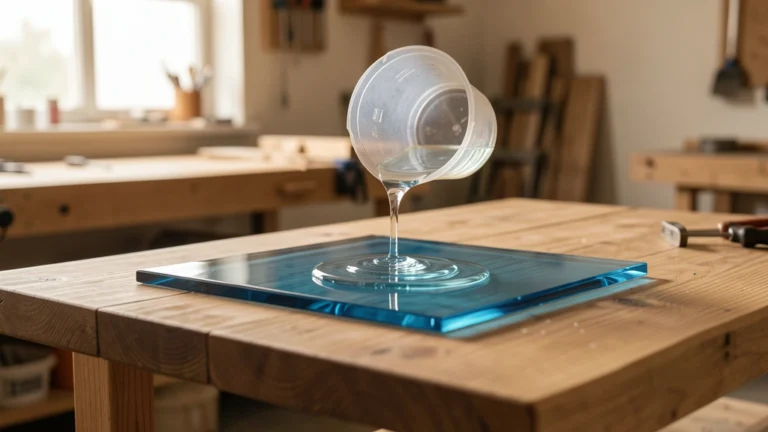
How much epoxy does a 30 by 20 cm tray really need? The answer is 300 mL before waste, and 330 mL with a small margin. The harder part is splitting that total into resin and hardener without a mistake. This guide shows the volume math, the split for each common ratio, and the safety basics.
| Pour volume | Length x width x depth in cm gives mL |
|---|---|
| Example tray | 30 x 20 x 0.5 cm = 300 mL |
| With a 10% margin | 330 mL of mixed epoxy |
| 1:1 split of 330 mL | 165 mL resin + 165 mL hardener |
| 2:1 split of 330 mL | 220 mL resin + 110 mL hardener |
| Rough weight | About 363 g at 1.1 g per mL |
Resin and Hardener Split Table
A mix ratio only changes how the total divides, not the total itself. The table splits the same 330 mL batch at each ratio our calculator offers. The last column shows the resin share as a fraction.
| Ratio (A:B) | Part A resin | Part B hardener | Resin share |
|---|---|---|---|
| 1:1 | 165 mL | 165 mL | 1/2 |
| 2:1 | 220 mL | 110 mL | 2/3 |
| 3:1 | 247.5 mL | 82.5 mL | 3/4 |
| 4:1 | 264 mL | 66 mL | 4/5 |
Notice how fast the hardener shrinks as the ratio climbs. At 4:1, the hardener is only 66 mL, so a 10 mL slip is a big share of it. Higher ratios reward careful measuring.
The same few words show up on every resin label. Here is what each one means in plain terms.
- Part A
- The resin itself, usually the larger bottle in a kit.
- Part B
- The hardener, also called the curing agent, which starts the reaction.
- Mix ratio
- How many parts of resin go with one part of hardener, such as 2:1.
- Pot life
- The working time after mixing, as printed on your product label.
- Exotherm
- The heat the mixture gives off while it cures.
How Much Epoxy Does a Pour Need?
Multiply length by width by depth. Working in centimeters gives the answer straight in milliliters, because NIST lists 1 cubic centimeter as exactly 1 mL.
The tool page uses a clear example. A tray measures 30 by 20 cm, and you pour it 0.5 cm deep. That is 30 x 20 x 0.5, or 300 mL. A 10 percent margin for cup residue brings the batch to 330 mL.
Working in Inches Instead
Inch measurements need one extra step. Multiply the three sides to get cubic inches, then multiply by 16.387 to reach milliliters. A 12 by 12 inch tile coated 0.125 inch deep holds 18 cubic inches, or about 295 mL.
Round and Odd Shapes
A round mould uses pi x radius squared x depth instead. A 10 cm radius poured 2 cm deep needs about 628 mL. Our guide to cylinder, cone and sphere volume covers those formulas in more detail.
Objects set inside the mould take up space too. A piece of wood or a pressed flower means you need a little less resin. The tool page notes that its rectangle math does not subtract those items.
| Project | Size (cm) | Bare volume | With margin |
|---|---|---|---|
| Coaster batch | 10 x 10 x 1 | 100 mL | 110 mL |
| Tabletop seal coat | 60 x 40 x 0.3 | 720 mL | 792 mL |
| River table pour | 100 x 30 x 3 | 9,000 mL | 9,900 mL |
What Does a 2:1 Mix Ratio Actually Mean?
A 2:1 ratio means two equal parts of resin for every one part of hardener. The batch has three parts in total, so resin is two thirds and hardener is one third.
That rule works for any ratio. Add the two numbers, then divide the batch by that sum to find one part. For 330 mL at 2:1, one part is 330 / 3, or 110 mL. Resin takes two parts, so it gets 220 mL.
The same method handles 3:1. The sum is 4, so one part is 82.5 mL. Resin gets three parts, or 247.5 mL, and hardener gets 82.5 mL. Our article on ratios and proportions walks through this parts method in general.
A common slip is to read 2:1 as “half and half plus a bit.” It is not. The hardener in a 2:1 kit is exactly half the resin amount, never a free guess. The tool page warns that guessing the ratio is the top cause of soft or tacky resin.
Marked mixing cups make this easier. Pour part A to the first line, then add part B until the level reaches the total. For 2:1, the first line sits at 220 mL and the second at 330 mL.
Why Does Measuring by Weight Change the Numbers?
Resin and hardener usually have different densities, so equal volumes do not weigh the same. A kit sold as 1:1 by volume is not automatically 1:1 by weight. Always follow the unit on your label.
The math comes from density. Weight equals volume times density for each part. Picture a made-up kit where the resin weighs 1.15 g per mL and the hardener weighs 0.95 g per mL. Mixed 1:1 by volume, the weights come out 115 to 95, or about 100 to 82.6.
So a scale set to “equal grams” would add too much hardener for this kit. The reverse error happens when a by-weight kit is poured by volume. Both mistakes shift the ratio, even though each cup looks correct.
The rough weight still helps with buying. The river table preset needs 9,900 mL with its margin. At 1.1 g per mL, that is about 10.9 kg of mixed epoxy, which tells you which kit size to order.
Plan the pour with the resin and epoxy volume calculator first. Then check whether your label gives the ratio by volume or by weight before you measure.
What Goes Wrong When the Ratio or Batch Is Off?
An off-ratio mix may never fully cure, and a batch that is too large can overheat. The tool page lists both as leading resin mistakes.
Too Much or Too Little Hardener
Mixing 1:1 by mistake in a 2:1 kit shows how big the error gets. The 330 mL batch would get 165 mL of hardener instead of 110 mL. That is 50 percent more hardener than the kit calls for, and the surface can stay soft or sticky.
Heat in a Large Mass
The cure itself gives off heat. The tool page warns that a large, deep mix can overheat, smoke or crack. That is why deep moulds are poured in layers.
A lab incident at the University of Delaware shows the risk. About 1.5 pounds of leftover epoxy reacted out of control inside an oven. The safety office reports temperatures above 900 F, with smoke that forced two buildings to evacuate.
The tool page adds that warmth speeds curing, while cold slows it. Your label’s pot life and layer limit are the numbers to follow for your product.
Is Uncured Epoxy Safe to Touch?
No. Uncured resin and hardener can irritate skin and cause lasting allergies, so avoid bare-skin contact. A dermatology reference notes that fully cured epoxy should be non-irritating and non-sensitizing.
That reference calls uncured resin, hardener and diluent powerful irritants and potent sensitizers. An allergic reaction shows up as red, swollen and itchy skin. It also found measurable uncured chemicals left in some “cured” resin after 1 week.
A construction safety research center adds a key detail. It names amine hardeners as the most common sensitizer in epoxy systems. It also notes that both parts are strong skin irritants on their own.
Sensitization is the reason small habits matter. The same center notes that most people can become allergic with enough repeat exposure. Wear gloves, keep sleeves down, and work with good airflow, as the tool page advises.
Clean up spills before they spread across the bench. Treat drips on a cup rim as live chemicals until the batch has fully cured.
The Resin and Epoxy Volume Calculator takes length, width, depth, ratio and margin. It returns the total, part A, part B and a rough weight in one step.
Questions People Ask About Epoxy Resin
How Do You Calculate How Much Epoxy Resin You Need?
Multiply length by width by depth in centimeters to get milliliters. A 30 by 20 cm tray poured 0.5 cm deep needs 300 mL, or 330 mL with a 10 percent margin.
What Does a 2:1 Epoxy Mix Ratio Mean?
It means two parts resin to one part hardener. Resin is two thirds of the batch and hardener is one third, so 330 mL splits into 220 mL and 110 mL.
Can You Mix a Volume Ratio Epoxy by Weight?
Not with the same numbers. Resin and hardener often have different densities, so a 1:1 volume ratio is not automatically 1:1 by weight. Use the unit printed on your label.
Why Is My Epoxy Still Sticky After Curing Time?
An off-ratio mix is the most common cause. Too much or too little hardener leaves the resin soft or tacky. Cold rooms also slow curing.
Is Epoxy Resin Safe to Touch Before It Cures?
No. Uncured resin and hardener are skin irritants and potent sensitizers that can cause lasting allergies. Wear gloves and work with good airflow until the epoxy fully cures.
Where These Numbers Come From
References Used in This Article
- NIST, SI Units: Volume (1 cubic centimeter equals 1 milliliter)
- DermNet, Epoxy Resin Contact Allergy (irritants, sensitizers, cured resin)
- CPWR Construction Solutions, Skin Contact With Epoxy Resin Systems (amine hardeners)
- University of Delaware Environmental Health and Safety, Epoxy Material Incident
This article covers craft planning math and general safety facts, not product-specific instructions. Always follow your resin label for ratio, pot life and pour depth. Reviewed for accuracy by Prof. Dr. Khalil Mudassar, PhD. Last updated September 27, 2026.
Author

Shakeel Muzaffar is the Founder and Editor-in-Chief of MultiCalculators.com, bringing over 15 years of experience in digital publishing, product strategy, and online tool development. He leads the platform's editorial vision, ensuring every calculator meets strict standards for accuracy, usability, and real-world value. Shakeel personally oversees content quality, formula verification workflows, and the platform's commitment to publishing tools that are genuinely useful for students, professionals, and everyday users worldwide.