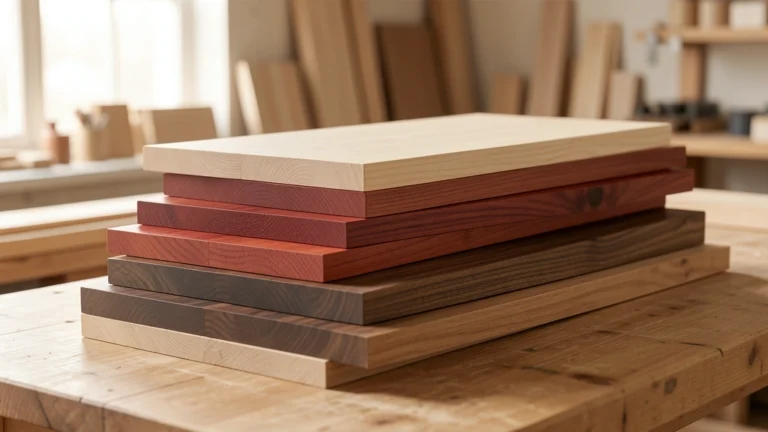
An 8-foot oak slab, 2 inches thick and 12 inches wide, weighs about 59 pounds when dry. Cut the same slab from white pine, and it drops to about 33 pounds. The size never changed, only the species. This guide shows you how to predict the weight of any board before you try to lift it.
| Formula | Weight = volume x density |
|---|---|
| Cubic inches to cubic feet | Divide by 1,728 |
| Dry red oak or sugar maple | About 44 lb per cubic foot |
| Dry eastern white pine | About 24.5 lb per cubic foot |
| Weight per board foot | Density divided by 12 |
| Green versus dry | Green red oak can weigh about 43 percent more |
Dry Weight of Common Woods per Cubic Foot
Each species has its own density, so each one has its own weight per cubic foot. The table uses specific gravity values from the federal Wood Handbook at 12 percent moisture content. That is a typical level for seasoned indoor lumber.
| Species | Specific gravity | lb per cu ft | kg per cu m | 2 x 12 x 96 in slab |
|---|---|---|---|---|
| Eastern white pine | 0.35 | 24.5 | 392 | 32.6 lb |
| Ponderosa pine | 0.40 | 28.0 | 448 | 37.3 lb |
| Yellow-poplar | 0.42 | 29.4 | 470 | 39.2 lb |
| Douglas-fir (coast) | 0.48 | 33.6 | 538 | 44.7 lb |
| Black cherry | 0.50 | 35.0 | 560 | 46.6 lb |
| Black walnut | 0.55 | 38.5 | 616 | 51.3 lb |
| Northern red oak | 0.63 | 44.1 | 706 | 58.7 lb |
| Sugar maple | 0.63 | 44.1 | 706 | 58.7 lb |
| White oak | 0.68 | 47.5 | 762 | 63.4 lb |
The heaviest wood here weighs almost twice as much as the lightest. White oak at 47.5 pounds per cubic foot is about 1.94 times eastern white pine. That gap is why guessing by size alone fails so often.
Five terms explain every number in this guide. Here is what each one means in plain words.
- Density
- Mass divided by volume, given in pounds per cubic foot or kilograms per cubic meter.
- Specific gravity
- Wood density compared with water. The Wood Handbook bases it on oven-dry mass.
- Moisture content
- The mass of water in the wood, shown as a percent of the oven-dry wood mass.
- Green wood
- Freshly sawn wood whose cell walls are fully soaked with water.
- Fiber saturation point
- The moisture level where cell walls are full but cell cavities hold no free water, about 30 percent.
How Do You Work Out the Weight of a Board?
Multiply the board’s volume by the density of its species. Measure length, width and thickness in inches, multiply them, and divide by 1,728 to get cubic feet. Then multiply by pounds per cubic foot.
Take the oak slab used on our calculator page. It is 2 inches thick, 12 inches wide and 96 inches long. That gives 2,304 cubic inches, and 2,304 divided by 1,728 is 1.33 cubic feet.
Our calculator uses 44 pounds per cubic foot for oak and hard maple. So 1.33 cubic feet times 44 gives 58.7 pounds, or about 26.6 kilograms. The same slab in pine, at 28 pounds per cubic foot, weighs about 37.3 pounds.
To switch to metric, multiply pounds by 0.4536. The official factor is 0.4535924 kilograms per pound. For density, one pound per cubic foot equals about 16.02 kilograms per cubic meter. The wood weight calculator by species does both steps and shows board feet alongside.
Why Does Green Wood Weigh So Much More?
Green wood is heavy because it is full of water. The Wood Handbook says green wood can hold from about 30 percent to more than 200 percent moisture, measured against its dry mass.
Water sits in two places inside wood. Bound water soaks the cell walls, and free water fills the hollow cells. The fiber saturation point, about 30 percent, marks where the free water is gone.
Northern red oak shows the effect clearly. Its green heartwood averages 80 percent moisture in the Handbook tables. Using its green specific gravity of 0.56, a green cubic foot weighs about 62.9 pounds. The dry figure is only about 44.
Moisture varies a lot by species and even by board. Western red cedar sapwood averages 249 percent, while white oak heartwood averages 64 percent. Our calculator assumes seasoned wood, so treat its answer as a dry weight.
How Do Board Feet Turn Into Pounds?
Divide the density in pounds per cubic foot by 12. One board foot is 144 cubic inches, which is exactly one twelfth of a cubic foot. So each board foot weighs one twelfth of the cubic-foot figure.
| Species | lb per cu ft | lb per board foot |
|---|---|---|
| Ponderosa pine | 28.0 | 2.33 |
| Yellow-poplar | 29.4 | 2.45 |
| Black cherry | 35.0 | 2.91 |
| Black walnut | 38.5 | 3.21 |
| Red oak | 44.1 | 3.67 |
| White oak | 47.5 | 3.96 |
The oak slab from earlier is 16 board feet. At 3.67 pounds each, that gives the same 58.7 pounds. A 100 board foot stack of dry red oak weighs about 367 pounds, or about 166 kilograms.
One catch matters here. Lumber is often sold by nominal size, while weight depends on the real, planed size. The Handbook notes that nominal 2 to 4 inch softwood is actually 1-1/2 to 3-1/2 inches thick.
So a nominal 2 x 4 that is 8 feet long holds 3.5 board feet of real wood, not 5.33. At 28 pounds per cubic foot, it weighs about 8.2 pounds. Our guide to board feet versus linear feet explains how lumber is measured and priced.
Why Do Boards of the Same Species Weigh Differently?
Density changes within a species because each tree grows differently. The Wood Handbook puts the typical spread at about 10 percent for common domestic species. Two red oak boards of equal size can differ by several pounds.
The ratio of earlywood to latewood matters, and so does heartwood versus sapwood. Minerals and extractives add weight in a few species. A slab of red oak rated at 58.7 pounds could weigh roughly 53 to 65 pounds in practice.
Trade names add more spread. “Pine” covers many trees, from eastern white pine at 24.5 pounds per cubic foot to loblolly pine at about 35.7. Our calculator’s pine setting of 28 matches ponderosa pine.
The extremes are wider still. The Handbook lists oven-dry density from about 10 pounds per cubic foot for balsa to over 65 for some imported woods. Most species fall between 20 and 45. To review the idea behind these numbers, see density explained with examples.
How Can You Estimate Weight When the Species Is Unknown?
Use a range instead of one number. Run the math at both ends of the first table, 24.5 and 47.5 pounds per cubic foot. Those two answers bracket all nine species listed there.
For the oak-sized slab, that range runs from about 32.7 to 63.3 pounds. Plan the lift for the top of the range. Then add weight for any finish or hardware, since our calculator reports bare wood only.
Wet or freshly cut wood needs a bigger margin. The red oak example showed about 43 percent extra from water. Treat the dry figures in these tables as a floor for any board that was cut recently.
The Wood Weight Calculator turns length, width, thickness and species into pounds, kilograms, cubic feet and board feet.
Questions People Ask About Wood Weight
How Much Does a Cubic Foot of Oak Weigh?
Dry northern red oak weighs about 44 pounds per cubic foot at 12 percent moisture. Dry white oak is heavier, at about 47.5 pounds. Green oak weighs far more because of its water.
Is Green Wood Heavier Than Dry Wood?
Yes. Green red oak heartwood averages 80 percent moisture, so a green cubic foot weighs about 62.9 pounds. The same wood dried to 12 percent weighs about 44 pounds.
How Do You Convert Board Feet to Pounds?
Divide the density in pounds per cubic foot by 12, then multiply by the board feet. Dry red oak weighs about 3.67 pounds per board foot, so 100 board feet weighs about 367 pounds.
What Are the Lightest and Heaviest Woods?
Balsa is among the lightest, at about 10 pounds per cubic foot when oven-dry. Some imported woods exceed 65 pounds. Most species fall between 20 and 45 pounds per cubic foot.
Should You Use Nominal or Actual Size for Weight?
Use the actual size. A nominal 2 x 4 is really 1-1/2 by 3-1/2 inches. An 8-foot piece at 28 pounds per cubic foot weighs about 8.2 pounds.
Where These Numbers Come From
References Used in This Article
- USDA Forest Products Laboratory, Wood Handbook Chapter 4: Moisture Relations and Physical Properties of Wood
- USDA Forest Products Laboratory, Wood Handbook Chapter 5: Mechanical Properties of Wood (specific gravity tables)
- USDA Forest Products Laboratory, Wood Handbook Chapter 6: Commercial Lumber, Round Timbers, and Ties
- NIST Guide to the SI, Appendix B.9: Conversion Factors by Kind of Quantity
Weights are estimates for clear, solid wood and vary with moisture and the individual board. Densities are calculated from the cited specific gravity values and rounded. Reviewed for accuracy by Prof. Dr. Khalil Mudassar, PhD. Last updated September 27, 2026.
Author

Shakeel Muzaffar is the Founder and Editor-in-Chief of MultiCalculators.com, bringing over 15 years of experience in digital publishing, product strategy, and online tool development. He leads the platform's editorial vision, ensuring every calculator meets strict standards for accuracy, usability, and real-world value. Shakeel personally oversees content quality, formula verification workflows, and the platform's commitment to publishing tools that are genuinely useful for students, professionals, and everyday users worldwide.