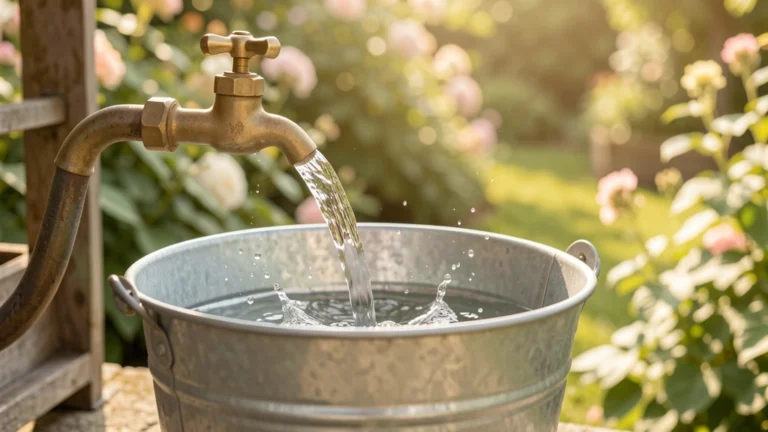
A standard showerhead pours out 2.5 gallons every minute, or about 9.5 liters. Both numbers describe the same stream of water, just in different units. Pumps, faucets, fans and pipes all carry flow ratings like these. This guide shows what each unit means and how to switch between them without mistakes.
| What flow rate means | Volume divided by time |
|---|---|
| 1 US gallon | 3.785411784 liters |
| 10 US gpm | 37.85 L/min |
| 1 CFM | 28.32 L/min, or 1.699 m3/h |
| Fill time | Volume divided by flow rate |
Flow Rate Conversion Chart for Six Common Units
Every flow unit is a volume unit divided by a time unit. That shared shape means one table can link them all. Each row below shows the same one-unit flow in five other units.
| 1 of this | L/min | L/s | m3/h | US gpm | CFM |
|---|---|---|---|---|---|
| L/min | 1 | 0.0167 | 0.06 | 0.2642 | 0.0353 |
| L/s | 60 | 1 | 3.6 | 15.85 | 2.119 |
| m3/h | 16.67 | 0.2778 | 1 | 4.403 | 0.5886 |
| US gpm | 3.785 | 0.0631 | 0.2271 | 1 | 0.1337 |
| CFM | 28.32 | 0.4719 | 1.699 | 7.481 | 1 |
| UK gpm | 4.546 | 0.0758 | 0.2728 | 1.201 | 0.1605 |
Read across a row to convert. For example, 1 CFM equals 7.481 US gallons per minute. To go the other way, read down a column instead, or divide by the factor.
The metric units step by clean factors of 60 and 1,000. The US and UK gallons and the cubic foot bring odd decimals, because they were never built on powers of ten.
What Is a Flow Rate Unit Made Of?
A flow rate unit is a volume unit divided by a time unit. Liters per minute means liters that pass a point each minute. Change either part, and the number changes.
This is why the same flow can look so different on paper. Per second, per minute and per hour differ by factors of 60 and 3,600. A liter and a cubic meter differ by 1,000, because NIST lists 1,000 liters in one cubic meter.
Two rarer units follow the same rule. Liters per hour suits slow drips and dosing pumps, and 1 US gpm equals about 227 L/h. Cubic meters per second suits rivers and large plants, and 1 m3/s equals 1,000 L/s, or about 2,119 CFM.
Flow units also say nothing about speed. A flow of 10 L/min can move slowly through a wide pipe or quickly through a narrow one. Speed in meters per second is a different quantity, and the converter does not handle it.
Five terms cover almost every flow label you will see.
- Volumetric flow rate
- The volume of fluid passing a point per unit of time, such as liters per minute.
- L/min and L/s
- Liters per minute and liters per second. One liter per second equals 60 liters per minute.
- m3/h
- Cubic meters per hour, used for water mains and irrigation. One cubic meter holds 1,000 liters.
- GPM
- Gallons per minute. In the United States this means US gallons of 3.785411784 liters each.
- CFM
- Cubic feet per minute, the usual label for airflow. One cubic foot holds about 28.32 liters.
How Do You Convert GPM to L/min and Back?
Multiply US gallons per minute by 3.785 to get liters per minute. Divide liters per minute by 3.785 to get US gpm. So 10 US gpm equals 37.85 L/min.
The factor comes straight from the gallon. NIST lists one US gallon as 3.785412 liters, rounded from the exact 3.785411784. For a deeper look at the gallon itself, see how liters and gallons compare.
Using the Converter’s Own Example
Our converter page starts with 60 liters per minute. Since a minute has 60 seconds, that flow is exactly 1 liter per second. The same flow is 3.6 cubic meters per hour, or about 15.85 US gallons per minute.
Check the gallon figure by hand: 60 divided by 3.785411784 gives 15.850. The flow rate converter routes every value through liters per second, then divides by the target unit.
Watch the Gallon Size
A UK gallon holds 4.54609 liters, per NIST. That makes one UK gpm about 1.201 US gpm, or 20 percent more flow. A pump rated at 10 UK gpm moves 45.46 L/min, not 37.85.
Why Is CFM the Standard for Airflow?
CFM, or cubic feet per minute, measures the volume of air a fan moves each minute. Our converter page notes that CFM appears on fans and ventilation systems rather than water flows.
One cubic foot is about 28.32 liters, per NIST. That makes 1 CFM equal to 28.32 L/min, 0.4719 L/s, or 1.699 cubic meters per hour. Metric fan labels usually use m3/h, so that last figure matters most.
Try a simple room check. A room that measures 12 by 10 by 8 feet holds 960 cubic feet of air. A fan moving 80 CFM swaps that full volume once every 12 minutes.
This is pure volume and time math. It shows how long one full air change takes, not whether the fan suits the room. Duct length, grilles and pressure all reduce a fan’s real output, and the converter does not model any of them.
Large flows use larger units. The converter page gives a 400 CFM fan as one example of a trade-standard figure. In metric terms, that fan moves about 680 m3/h, or 189 L/s.
How Long Will It Take to Fill a Tank?
Divide the volume by the flow rate, using matching units. Time equals volume divided by flow. A 300-liter tank filled at 37.85 L/min takes about 7.9 minutes.
The trap is mixed units. A hose rated in gpm and a tank rated in liters must meet in one unit first. Convert 10 gpm to 37.85 L/min, then divide 300 by 37.85.
Here are three quick cases, each worked in matching units:
| Container | Flow rate | Fill time |
|---|---|---|
| 55 US gallon drum | 2.5 gpm | 22 minutes |
| 1,000 liter tank | 15 L/min | About 67 minutes |
| 20,000 US gallon pool | 10 gpm | About 33.3 hours |
These times assume the flow stays steady from start to finish. Real supplies can slow as pressure drops, so treat the answer as a best case. Measuring what a well can actually deliver is a separate job, covered in our guide on how to calculate well water flow rate.
What Do Faucet and Shower Flow Ratings Mean?
Faucet and shower ratings state the most water they release per minute. In the United States these ratings use gallons per minute. The EPA lists 2.5 gpm as the standard showerhead flow.
Converted to metric, 2.5 gpm is about 9.46 L/min. Showerheads with the EPA water-saving label must use no more than 2.0 gpm, or about 7.57 L/min.
The gap adds up quickly. A 10-minute shower at 2.5 gpm uses 25 gallons, or 94.6 liters. At 2.0 gpm the same shower uses 20 gallons, which saves 5 gallons, or about 18.9 liters.
Bathroom faucets follow the same pattern. The EPA gives a standard flow of 2.2 gpm, about 8.33 L/min. Labeled faucets use at most 1.5 gpm, about 5.68 L/min, a cut of roughly 32 percent. For public restrooms, the EPA points to 0.5 gpm or less, about 1.89 L/min.
Remember that these are maximums at the fixture. A partly open tap flows less, so the real volume depends on how you use it.
The Flow Rate Converter switches any value between L/s, L/min, L/h, m3/s, m3/h, US and UK gallons per minute, CFM and mL/s.
Questions People Ask About Flow Rate Units
How Many Liters per Minute Is 1 GPM?
One US gallon per minute is about 3.785 liters per minute. One UK gallon per minute is larger, at about 4.546 liters per minute.
How Do You Convert CFM to Cubic Meters per Hour?
Multiply CFM by about 1.699. One cubic foot is 28.32 liters, and an hour has 60 minutes, so 100 CFM equals about 169.9 cubic meters per hour.
Is 60 Liters per Minute the Same as 1 Liter per Second?
Yes. A minute has 60 seconds, so 60 liters per minute equals exactly 1 liter per second. The same flow is 3.6 cubic meters per hour, or about 15.85 US gpm.
What Is the Difference Between Volume Flow and Mass Flow?
Volume flow counts liters or gallons per unit of time. Mass flow counts kilograms or pounds per unit of time, so it also depends on the fluid’s density.
How Do You Work Out How Long a Tank Takes to Fill?
Divide the tank volume by the flow rate in matching units. A 300 liter tank filled at 10 US gpm, or 37.85 liters per minute, takes about 7.9 minutes.
Where These Numbers Come From
References Used in This Article
- NIST SP 811, Appendix B.9: Factors for Units Listed by Kind of Quantity (gallon, cubic foot, gpm and CFM factors)
- NIST Office of Weights and Measures, SI Units: Volume (liter and cubic meter)
- US EPA WaterSense, Showerheads (2.5 gpm standard, 2.0 gpm labeled)
- US EPA WaterSense, Bathroom Faucets (2.2 gpm standard, 1.5 gpm labeled)
This article covers volumetric flow units and simple fill-time math, not pump, pipe or fan sizing. Conversion factors are rounded from the cited references. Reviewed for accuracy by Prof. Dr. Khalil Mudassar, PhD. Last updated September 27, 2026.
Author

Shakeel Muzaffar is the Founder and Editor-in-Chief of MultiCalculators.com, bringing over 15 years of experience in digital publishing, product strategy, and online tool development. He leads the platform's editorial vision, ensuring every calculator meets strict standards for accuracy, usability, and real-world value. Shakeel personally oversees content quality, formula verification workflows, and the platform's commitment to publishing tools that are genuinely useful for students, professionals, and everyday users worldwide.