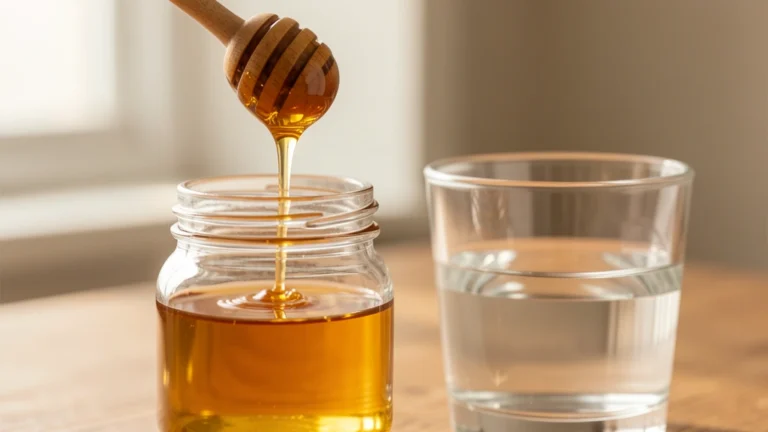
Why does honey crawl off a spoon while water splashes out of the glass? The answer is viscosity, and glycerine at room temperature is about 1,490 times more viscous than water.
This guide explains what viscosity measures and how its units fit together. You will see why datasheets quote two different kinds of viscosity. You will also learn why a warm liquid pours faster than a cold one.
- Dynamic viscosity is a fluid’s resistance to flow, measured in pascal-seconds (Pa s) or centipoise (cP).
- One centipoise equals one millipascal-second, and water at 20 C is about 1.0016 cP.
- Kinematic viscosity equals dynamic viscosity divided by density, measured in m^2/s or centistokes (cSt).
- Most liquids thin out as they warm: water’s viscosity halves between 10 C and 40 C.
Viscosity as a Fluid’s Internal Friction
Viscosity is how strongly a fluid resists flowing. Think of a liquid as thin layers sliding over each other. A thick liquid drags hard on the next layer, while a thin one lets it slip past easily.
HyperPhysics describes the classic test. You pull a flat plate through a liquid at a steady speed. The force you need grows with the plate’s area and with how fast the speed changes across the liquid. The constant linking them is the viscosity.
That is why the SI unit is the pascal-second. A pascal is a unit of stress, one newton per square meter. Our guide to pressure units like psi, bar and Pa explains it in more detail. Multiply that stress by a time, and you get Pa s.
The range is enormous. Air at 20 C sits near 0.018 cP. Water is about 1 cP, heavy oil about 660 cP, and glycerine about 1,490 cP. The chart below uses a log scale, so each gridline is ten times the one before.
How Do Pa s, Poise and Centipoise Relate?
One pascal-second equals 10 poise, and one poise equals 100 centipoise. So one centipoise is exactly 0.001 Pa s, the same as one millipascal-second.
The older poise comes from the centimeter-gram-second system. It survives because the centipoise lands so close to water. At 20 C, water measures 1.0016 cP, so a datasheet in cP reads almost like “times thicker than water.”
Take the tool page’s own example: convert 1 cP to pascal-seconds. The answer is 0.001 Pa s, which is also 1 mPa s. Going the other way, 0.5 Pa s is 500 cP.
| Unit | Equals this many Pa s |
|---|---|
| Pascal-second (Pa s) | 1 |
| Poise (P) | 0.1 |
| Centipoise (cP) | 0.001 |
| Millipascal-second (mPa s) | 0.001 |
| Pound per foot second, lb/(ft s) | 1.488164 |
| Pound-force second per square foot, lbf s/ft^2 | 47.88026 |
The imperial pound-force second per square foot is huge. One of them equals 47.88 Pa s, or 47,880 cP. The pound per foot second is much smaller, at 1.488 Pa s. The two imperial units differ by a factor of about 32.17, so read the label carefully in older engineering texts.
The Viscosity Converter turns any dynamic viscosity into Pa s, mPa s, poise, centipoise, or three imperial units, and shows the conversion rate.
Dynamic vs Kinematic Viscosity: Which One Is on the Datasheet?
Dynamic viscosity measures resistance to shear, while kinematic viscosity is dynamic viscosity divided by density. Check the unit: Pa s or cP means dynamic, and m^2/s, stokes or cSt means kinematic.
Density is the only link between the two numbers. Two liquids with the same dynamic viscosity get different kinematic values when one is denser. Our article on density with everyday examples covers the mass-per-volume side of this formula.
NIST lists the kinematic units. One stokes is 0.0001 m^2/s, and one centistokes is 0.000001 m^2/s, which is 1 mm^2/s.
Converting Water From cP to cSt
- Start with dynamic viscosity. Water at 20 C is 1.0016 cP, which is 0.0010016 Pa s.
- Find the density. The same water has a density of 0.9982 g/cm^3, or 998.2 kg/m^3.
- Divide in SI units. 0.0010016 divided by 998.2 gives 0.0000010034 m^2/s.
- Convert to centistokes. Divide by 0.000001 to get 1.0034 cSt, matching the HyperPhysics table.
- Use the shortcut next time. cP divided by density in g/cm^3 gives cSt directly.
Try the shortcut on a made-up oil of 90 cP with a density of 0.9 g/cm^3. It comes out to 100 cSt. Water barely changes because its density is so close to 1 g/cm^3.
Our calculator handles dynamic units only. It does not divide by density, so do that step by hand for any cSt figure.
Why Does Temperature Change Viscosity So Much?
Warm liquid molecules move faster and hold each other less tightly, so the liquid flows more easily. For water, the effect is large while the density barely moves.
The HyperPhysics water table, built on 2008 international reference data, shows the pattern. Water is 1.3059 cP at 10 C and 0.6527 cP at 40 C, so it halves over those 30 degrees. At 80 C it drops to 0.354 cP, about 35 percent of its 20 C value.
Even a small change matters. From 20 C to 25 C, water falls from 1.0016 cP to 0.89 cP, a drop of about 11 percent. A lab that reports a result at the wrong temperature can be off by more than a tenth.
This is why every viscosity number needs a temperature beside it. A figure of “1 cP” means little without “at 20 C.”
A Brief Word on Motor Oil Grades
Motor oil labels such as 5W-30 name a viscosity grade, and each engine calls for a specific one. FuelEconomy.gov reports that 10W-30 in an engine designed for 5W-30 can lower gas mileage by 1 to 2 percent. Using the grade your owner’s manual lists avoids that loss.
Unit Slips That Skew Viscosity Numbers
A single unit slip can shift a viscosity result by a factor of 10, 100 or 1,000. The table pairs each trap with a safer habit.
| Mistake | Better approach |
|---|---|
| Treating cP and cSt as the same unit | Check the letters. cP is dynamic, cSt is kinematic, and they match only for fluids near 1 g/cm^3. |
| Using 0.01 instead of 0.001 for a centipoise | Remember that 1 poise is 0.1 Pa s, so 1 cP is 0.001 Pa s. The wrong factor gives a tenfold error. |
| Dividing by density in mixed units | Put Pa s over kg/m^3 for m^2/s, or cP over g/cm^3 for cSt. Never mix the two pairs. |
| Quoting a viscosity with no temperature | Always state it. Water is 1.3059 cP at 10 C but 0.6527 cP at 40 C. |
| Assuming water is exactly 1 cP | Use 1.0016 cP at 20 C, and 0.89 cP at 25 C, from the reference table. |
Blood is a good reminder of the temperature rule. HyperPhysics lists whole blood at about 4 cP, but that figure is measured at body temperature, 37 C, not at 20 C.
Try it with a value from your own datasheet. Enter it in the viscosity unit converter to see the same number in Pa s, poise and centipoise.
Viscosity: Frequently Asked Questions
What Is the Viscosity of Water?
Water at 20 C has a dynamic viscosity of about 1.0016 cP, which is 0.0010016 Pa s. Its kinematic viscosity at the same temperature is about 1.0034 cSt.
What Is the Difference Between Dynamic and Kinematic Viscosity?
Dynamic viscosity measures resistance to shear, in Pa s or cP. Kinematic viscosity is dynamic viscosity divided by density, in m^2/s or cSt.
Is a Centipoise the Same as a Millipascal-Second?
Yes. One centipoise equals exactly one millipascal-second, which is 0.001 Pa s. The two names are used interchangeably on datasheets.
How Do You Convert Centipoise to Centistokes?
Divide the centipoise value by the density in g/cm^3. For example, an oil of 90 cP with a density of 0.9 g/cm^3 has a kinematic viscosity of 100 cSt.
Why Does Viscosity Drop When a Liquid Heats Up?
Warmer molecules move faster and cling to each other less, so the layers slide more easily. Water falls from 1.3059 cP at 10 C to 0.6527 cP at 40 C.
How Many Centipoise Are in One Poise?
One poise equals 100 centipoise. It also equals 0.1 Pa s, so 10 poise make one pascal-second.
Do Gases Have Viscosity Too?
Yes, but it is small. HyperPhysics lists air at 0.00018 poise at 20 C, which is 0.018 cP, less than one fiftieth of water.
Which Viscosity Do Motor Oil Grades Describe?
Labels such as 5W-30 name a viscosity grade for engine oil. FuelEconomy.gov notes that using 10W-30 instead of a specified 5W-30 can cut gas mileage by 1 to 2 percent.
Sources and Further Reading
References Used in This Article
- HyperPhysics (Georgia State University), Viscosity of Liquids and Gases, with the Viscosity of Water table
- HyperPhysics (Georgia State University), Laminar Flow and Viscosity
- NIST Guide to the SI (SP 811), Appendix B.9: Factors for Units Listed by Kind of Quantity
- FuelEconomy.gov (US DOE and EPA), Keeping Your Vehicle in Shape
This article explains viscosity and its units for learning and everyday engineering work. Real fluids vary with temperature, pressure and composition, so check a datasheet for critical jobs. Reviewed for accuracy by Prof. Dr. Khalil Mudassar, PhD. Last updated September 27, 2026.
Author

Shakeel Muzaffar is the Founder and Editor-in-Chief of MultiCalculators.com, bringing over 15 years of experience in digital publishing, product strategy, and online tool development. He leads the platform's editorial vision, ensuring every calculator meets strict standards for accuracy, usability, and real-world value. Shakeel personally oversees content quality, formula verification workflows, and the platform's commitment to publishing tools that are genuinely useful for students, professionals, and everyday users worldwide.