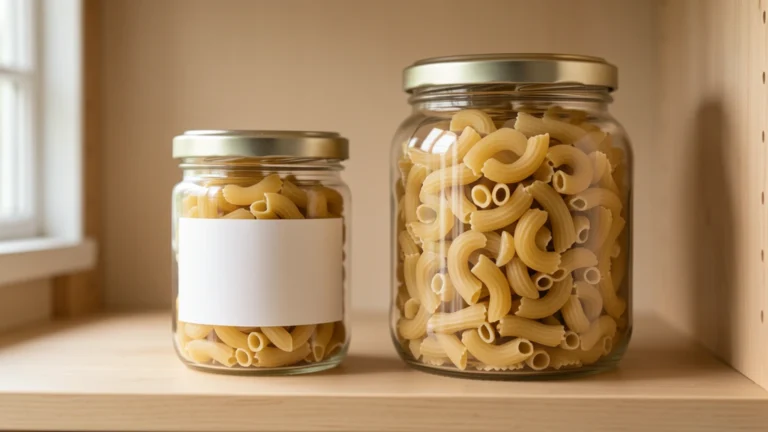
Is the giant jar really the better deal? A 24-ounce jar costs $4.80, and the 64-ounce jar next to it costs $11.20. Only the unit price tells you which one gives more for each dollar.
This guide shows how to find a unit price and how to compare packages in the same unit. It also covers the size tricks on the shelf. Finally, it shows when a bulk discount disappears because of waste, spoilage, or storage.
- Unit price equals the package price divided by the quantity inside, such as dollars per ounce.
- Compare two packages only after both prices use the same unit of measure.
- The 64-ounce jar above costs $0.175 per ounce, which is 12.5% cheaper than $0.200.
- Bulk only saves when you use it all before it spoils and the storage costs little.
How Unit Price Turns Any Package Into a Fair Comparison
A unit price is the cost of one unit of measure, such as one ounce, one pound, or one sheet. NIST describes unit pricing as the pricing of goods based on cost per unit of measure. The formula is short: unit price = price / quantity.
Take the two jars from the top of this page. The small jar costs $4.80 for 24 ounces, so it costs $0.200 per ounce. The big jar costs $11.20 for 64 ounces, so it costs $0.175 per ounce.
The big jar saves 2.5 cents on every ounce. Divide that gap by $0.200, and you get a discount of 12.5% per ounce. The sticker price alone hides this, because $11.20 looks much larger than $4.80.
NIST gives a shelf example of its own. A 32-ounce ketchup bottle at $4.99 works out to about $0.16 per ounce. A 14-ounce bottle at $3.19 works out to about $0.23 per ounce. The bigger bottle wins by about 32% per ounce.
Keep three decimal places when prices are close. Rounding both jars to the nearest cent per ounce would show $0.20 and $0.18, which hides the real gap.
How Do You Compare Unit Prices in the Store?
Put both packages in the same unit, divide each price by its quantity, and compare the results. The steps below work for food, soap, paper goods, and anything else sold by size or count.
- Read the net contents. Find the quantity printed on the package, not a banner such as “family size.” The FTC notes that federal packaging law requires the net contents on the label.
- Pick one unit. Choose ounces, pounds, liters, or count. A 32-ounce bottle and a 32-count box both say “32,” yet they measure different things.
- Convert when the units differ. One pound equals 16 ounces, so a 2-pound bag holds 32 ounces. Metric labels need a conversion from grams to ounces first.
- Divide price by quantity. A 2-pound bag at $5.00 costs $0.156 per ounce. A 20-ounce box at $3.50 costs $0.175 per ounce.
- Compare and check the gap. Subtract the two unit prices and divide by the higher one. Here the bag is about 11% cheaper per ounce.
Grams and ounces show up side by side on many imported goods. Our guide to converting ounces to grams covers that step in detail. Do the conversion once and write both prices in the same unit.
Count-based items need care too. Compare paper towels per roll only when the rolls hold the same number of sheets. Otherwise, compare the price per sheet or per square foot printed on the pack.
The Bulk Buying Savings Calculator works out the cost per unit for both sizes. It then subtracts storage cost to show your net savings.
When Does Buying in Bulk Actually Save Money?
Bulk saves money when its unit price is lower and you use every unit before it spoils. It also needs storage that costs little or nothing. Miss any one of those three, and the savings shrink fast.
Our calculator page uses paper towels as its main example. A 6-roll pack costs $8.99, or $1.498 per roll. A 30-roll pack costs $29.99, or $0.999 per roll. That is a saving of $0.499 per roll.
Across 30 rolls, the gross saving comes to $14.97. Now add usage and storage. At 4 rolls a month, the big pack lasts 7.5 months. At $2 a month for storage space, that costs $15.00, so the net result is -$0.03.
Faster use changes the answer. At 6 rolls a month, the pack lasts 5 months and storage costs $10.00. The net saving rises to $4.97, which is a real gain.
The calculator also finds a break-even point. Divide the bulk price by the regular unit price: $29.99 / $1.498 gives about 20 rolls. The bulk pack must deliver at least 20 rolls of value before it beats the small pack.
Waste Raises the Real Unit Price
Food you throw away still counts in the price. Say you toss 16 ounces of the 64-ounce jar. You paid $11.20 for 48 ounces eaten, which is $0.233 per ounce. That is more than the small jar’s $0.200 per ounce.
To stay ahead, you must eat at least 56 of the 64 ounces. That is 87.5% of the jar. The EPA advises that buying large quantities only saves money when you use all the food before it spoils.
Waste is common, too. USDA’s Economic Research Service estimated that 31% of the available US food supply went uneaten at the retail and consumer levels in 2010.
The same cost-per-use idea applies outside the grocery store. Our guide on cost per visit for a gym membership uses the same division on a monthly fee.
Package-Size Traps and Smarter Habits
Stores and brands change sizes, labels, and pack counts often. Each trap below has a simple fix that relies on the unit price, not the package.
| Mistake | Better approach |
|---|---|
| Assuming the largest package is always cheapest | Divide price by quantity for every size. Some bulk packs cost the same per unit or more. |
| Comparing ounces on one item with pounds on another | Convert first. A 2-pound bag is 32 ounces, so divide its price by 32. |
| Trusting “family size” or “value pack” banners | Read the net contents line, which federal law requires on the label. |
| Ignoring a smaller package at the same price | Recheck the unit price each time. A shrink from 1.5 to 1.44 quarts raises the price per quart by about 4.2%. |
| Counting rolls or pods without checking their size | Compare per sheet, per load, or per ounce when the units differ in size. |
| Counting the whole bulk pack as used | Divide the price by the amount you actually use, not the amount you bought. |
The fourth row describes what NIST calls shrinkflation. A product keeps its price, but the net contents go down. NIST cites ice cream sold in 1.44-quart containers, where 1.5 quarts was common a few years earlier.
Sale tags add one more twist. Compare the sale price of the small pack with the regular price of the big pack. The small pack on sale sometimes wins on unit price.
Why Are Unit Price Labels Not the Same Everywhere?
US unit price labels vary because each state sets its own rules. NIST writes a model regulation, but it applies only when stores choose to show unit prices.
NIST reports that 19 states and 2 territories have unit pricing laws or regulations. Eleven of those places make unit pricing mandatory. The list includes Connecticut, Maryland, Massachusetts, New York, and Oregon.
Labels can also use different units for similar items. One shelf tag may show price per ounce while the next shows price per pound or per count. Always check the unit printed beside the number before you compare two tags.
The FTC enforces the federal packaging law behind net contents. That law aims to prevent deception and to make value comparisons easier. The net contents line is what you divide by when you work out a unit price yourself.
Try it with your own shopping list. Enter a regular pack, a bulk pack, and your monthly use in the bulk savings calculator to see the net result before you buy.
Unit Prices: Frequently Asked Questions
How Do You Calculate a Unit Price?
Divide the total price by the quantity in the package. A 24-ounce jar at $4.80 costs $4.80 / 24, which is $0.200 per ounce.
Is Buying in Bulk Always Cheaper?
No. Some bulk packs cost the same per unit as smaller ones. Bulk also loses its edge when food spoils or storage space costs money each month.
How Do You Compare Unit Prices in Different Units?
Convert both packages to one unit first. One pound is 16 ounces, so a 2-pound bag at $5.00 costs $0.156 per ounce.
What Is the Percent Savings Between Two Unit Prices?
Subtract the lower unit price from the higher one, then divide by the higher one. From $0.200 to $0.175 per ounce is a 12.5% saving.
How Much Waste Cancels a Bulk Discount?
Divide the bulk price by the small pack’s unit price to find the break-even amount. For a $11.20 jar against $0.200 per ounce, you must use at least 56 of 64 ounces.
Are Stores Required to Show Unit Prices?
It depends on the state. NIST reports that 19 states and 2 territories have unit pricing rules, and 11 of those places make them mandatory.
What Is Shrinkflation?
NIST describes shrinkflation as a product sold at the same price while its net contents go down. The unit price rises even though the tag does not change.
Should Storage Cost Count in a Bulk Comparison?
Yes, when the space has a real cost. In our paper towel example, $15.00 of storage cancels a $14.97 gross saving at 4 rolls a month.
Sources and Further Reading
References Used in This Article
- NIST, Uniform Unit Pricing: Tools for Consumers to Fight Shrinkflation
- NIST, Best Practices for Uniform Unit Pricing: An Update to NIST SP 1181 and NIST Handbook 130 Regulations
- Federal Trade Commission, Fair Packaging and Labeling Act
- USDA Economic Research Service, One-Third of Calories in the U.S. Food Supply Go Uneaten
- US EPA, Preventing Wasted Food at Home
This article explains unit price math for everyday shopping and budgeting. Store labels and state rules vary, so check the tag in your own store. Reviewed for accuracy by Prof. Dr. Khalil Mudassar, PhD. Last updated September 27, 2026.
Author

Shakeel Muzaffar is the Founder and Editor-in-Chief of MultiCalculators.com, bringing over 15 years of experience in digital publishing, product strategy, and online tool development. He leads the platform's editorial vision, ensuring every calculator meets strict standards for accuracy, usability, and real-world value. Shakeel personally oversees content quality, formula verification workflows, and the platform's commitment to publishing tools that are genuinely useful for students, professionals, and everyday users worldwide.