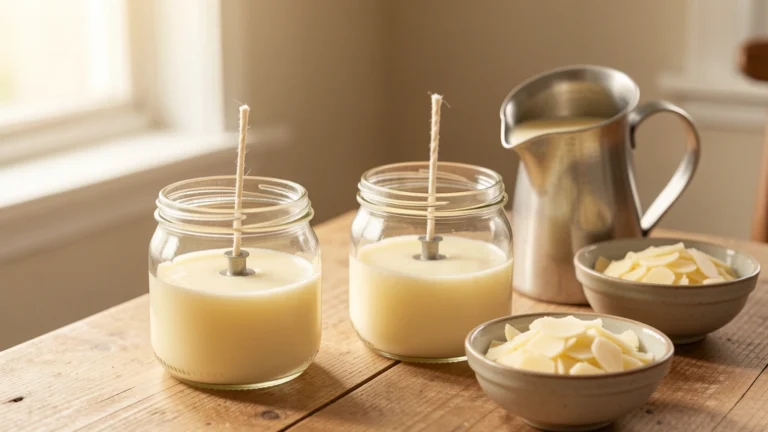
An 8 ounce jar sounds like it needs 8 ounces of wax, but it takes only about 6.8. That gap trips up almost every first batch. Jars are sold by the fluid ounces they hold, while wax is sold and weighed by the ounce on a scale. Those are two different kinds of ounce, and one simple factor links them.
Multiply the jar size in fluid ounces by 0.85 to get the wax weight in ounces, so an 8 fl oz jar takes about 6.8 oz. Multiply by the number of jars for the batch total. Then weigh out fragrance oil as a percent of that wax weight, usually 6 to 10 percent.
What Does a Jar’s Size Tell You About Wax?
A jar’s size tells you its volume in fluid ounces, not the weight of wax it holds. Wax weighs less than water, and you leave room at the top. So the wax weight always comes out lower than the number on the jar.
A fluid ounce measures space. A weight ounce measures mass on a scale. Both share the name “ounce,” which is why the mix-up is so common.
Water gives a handy reference point. One US fluid ounce of water weighs about 1.04 ounces. Solid paraffin has a density of around 900 kg per cubic meter, about 90 percent of water’s. So one fluid ounce of solid paraffin weighs only about 0.94 ounces.
This link between space and weight is density at work. Our guide on how density connects mass and volume covers the idea in more depth. For candles, you only need one takeaway: weigh the wax, and never pour it by volume.
Turning Fluid Ounces Into Wax Weight
Our calculator uses one short rule: wax weight in ounces equals the jar’s fluid ounces times 0.85. It treats 0.85 as an average for common waxes such as soy and paraffin. The full method takes four steps:
- Wax per candle = jar size (fl oz) x 0.85.
- Total wax = wax per candle x number of candles.
- Fragrance oil = total wax x fragrance load.
- Total wax in pounds = total ounces / 16.
Why 0.85 and not 0.94? The physics above covers a completely full jar. Nobody fills a candle to the very rim, though. Dividing 0.85 by 0.94 shows the factor fills about 90 percent of the jar with solid paraffin, which leaves a clean band of space at the top.
| Jar size | Wax per candle | Oil at 6% | Oil at 8% | Oil at 10% |
|---|---|---|---|---|
| 4 fl oz | 3.4 oz | 0.20 oz | 0.27 oz | 0.34 oz |
| 8 fl oz | 6.8 oz | 0.41 oz | 0.54 oz | 0.68 oz |
| 12 fl oz | 10.2 oz | 0.61 oz | 0.82 oz | 1.02 oz |
| 16 fl oz | 13.6 oz | 0.82 oz | 1.09 oz | 1.36 oz |
Working in metric? The same rule becomes grams of wax = jar volume in mL x 0.815. A 100 mL jar takes about 81.5 grams of wax.
Pouring Six 8 Oz Jars, Start to Finish
Here is the example our calculator uses. You are pouring six candles in 8 fl oz jars at an 8 percent fragrance load. Work through it one step at a time.
Step 1: Wax per Jar
Multiply 8 by 0.85 to get 6.8 ounces of wax per jar. That is about 193 grams, so a kitchen scale in grams works just as well.
Step 2: Wax for the Batch
Multiply 6.8 by 6 jars to get 40.8 ounces. Divide by 16 to get 2.55 pounds of wax for the whole batch.
Step 3: Fragrance Oil
Multiply 40.8 by 0.08 to get 3.264 ounces, which rounds to 3.3 ounces of oil. A 3 pound bag of wax and a 4 ounce bottle of oil cover this batch with a small margin.
The Candle Wax Calculator takes your jar size, candle count, and fragrance load. It returns the total wax, the oil, the wax per candle, and the total in pounds.
How Much Fragrance Oil Goes Into the Wax?
Most container candles use 6 to 10 percent fragrance oil, measured against the wax weight. Our calculator treats 8 percent as the standard load and caps it at 12 percent. Always check the maximum load printed on your wax.
The load is a percent of wax weight, not of jar volume. One pound of wax, which is 16 ounces, takes about 1.3 ounces of oil at 8 percent. That same pound takes about 1.6 ounces at 10 percent.
| Load | Scent strength | Oil per pound of wax | Good for |
|---|---|---|---|
| 6% | Light | 0.96 oz | Small rooms, soft scents |
| 8% | Standard | 1.28 oz | Most container candles |
| 10% | Strong | 1.60 oz | Large rooms, bold scents |
More oil does not always mean more scent. Past the wax’s limit, the extra oil pools on the surface instead of binding into the wax. It can also make the candle smoke or sweat.
Two other batch presets show how loads scale. Twelve 4 fl oz tins at 10 percent need 40.8 ounces of wax and 4.08 ounces of oil. Two 16 fl oz vessels at 6 percent need 27.2 ounces of wax and about 1.6 ounces of oil.
Where Candle Wax Math Goes Wrong
Most wasted wax traces back to one of five slips. Each one takes a few seconds to avoid.
- Measuring wax in a measuring cup. Loose flakes and pellets leave air gaps, so a cup of them holds less wax than it seems. Put every batch on a scale.
- Using the jar number as the wax weight. Buying 8 ounces of wax per 8 ounce jar overbuys by about 18 percent. The right figure is 6.8 ounces.
- Taking the oil percent from the total. The load applies to the wax weight alone. Keep 40.8 ounces of wax as your base, then add 3.3 ounces of oil to it.
- Filling to the rim. A candle poured to the top looks messy and leaves no space around the flame. Stop a little below the rim.
- Ignoring the wax type. Soy, paraffin, coconut, and beeswax differ slightly in density. Use your supplier’s exact figure when one is printed on the bag.
How Do You Size an Unlabeled or Odd Jar?
Fill the jar with water to your planned fill line and weigh the water in grams. Each gram of water equals one milliliter, so multiply that number by 0.815 to get grams of wax.
Say a thrifted jar holds 300 grams of water at the fill line. That is 300 mL, or about 10.1 fluid ounces. Multiply 300 by 0.815 to get about 245 grams of wax, or about 8.6 ounces. Dry the jar fully before you pour, since water and hot wax do not mix.
For a straight-sided glass, you can measure instead of weighing. A jar 3 inches wide filled 3.5 inches deep holds about 24.7 cubic inches. That is about 13.7 fluid ounces, so it takes about 11.7 ounces of wax. Our guide to cylinder, cone, and sphere volume formulas covers rounded and tapered shapes.
Safety belongs in the plan too. The National Fire Protection Association advises keeping burning candles at least 12 inches from anything that can burn. They also advise blowing out every candle before you leave a room or go to sleep.
Once you know each jar’s size, enter it in our wax and fragrance oil calculator to size the whole batch.
Common Questions About Candle Wax
How Much Wax Do I Need for an 8 Oz Jar?
An 8 fl oz jar takes about 6.8 ounces of wax by weight. Multiply the jar size by 0.85 to get the figure, then weigh the wax on a scale.
Why Is the Wax Weight Less Than the Jar Size?
Wax is lighter than water, and you leave space below the rim. One fluid ounce of solid paraffin weighs about 0.94 ounces, and the 0.85 factor also allows for that top gap.
How Many Candles Does a Pound of Wax Make?
A pound is 16 ounces of wax. That fills about two 8 fl oz jars at 6.8 ounces each, or four 4 fl oz tins at 3.4 ounces each.
How Much Fragrance Oil Do I Add per Pound of Wax?
At an 8 percent load, one pound of wax takes about 1.3 ounces of oil. At 6 percent it takes about 1 ounce, and at 10 percent about 1.6 ounces.
Can I Measure Candle Wax in Cups Instead of Weighing It?
No. Flakes and pellets hold air, so a cup of solid wax holds less wax than it seems. Wax is sold and used by weight, so a kitchen scale gives the only reliable amount.
Does Soy Wax Need a Different Amount Than Paraffin?
Only slightly. Common waxes differ a little in density, and the 0.85 factor is an average for soy and paraffin. Use your supplier’s exact figure when the bag lists one.
References
References Used in This Article
This article covers wax and fragrance amounts for container candles, using our calculator’s 0.85 volume-to-weight factor. Your wax label’s density and maximum fragrance load take priority. Reviewed for accuracy by Prof. Dr. Khalil Mudassar, PhD. Last updated September 27, 2026.
Author

Shakeel Muzaffar is the Founder and Editor-in-Chief of MultiCalculators.com, bringing over 15 years of experience in digital publishing, product strategy, and online tool development. He leads the platform's editorial vision, ensuring every calculator meets strict standards for accuracy, usability, and real-world value. Shakeel personally oversees content quality, formula verification workflows, and the platform's commitment to publishing tools that are genuinely useful for students, professionals, and everyday users worldwide.