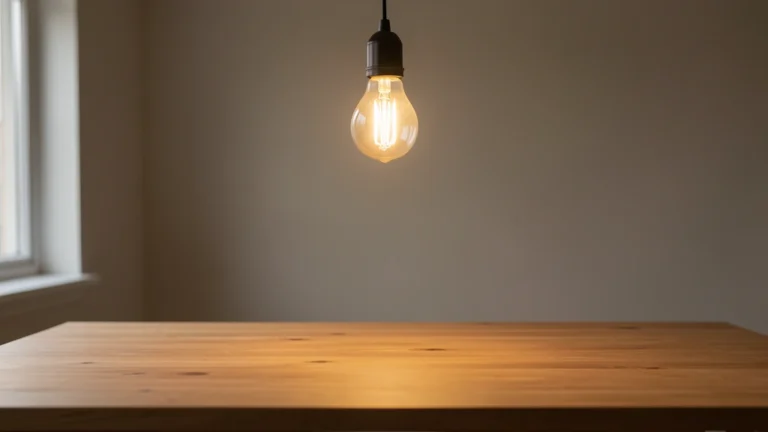
An old 60-watt bulb gives off about 800 lumens. Hang that bulb bare, 2 meters above a table, and the table gets only about 16 lux. So why do the two numbers differ so much?
The answer is that lumens and lux measure two different things. This guide shows what each unit counts and how to turn lumens into lux. It also covers the foot-candle and why light fades so fast as you move away from a lamp.
- Lumens measure the total light a source gives off, while lux measures the light landing on each square meter.
- Lux equals lumens divided by area in square meters, so 1,000 lumens spread evenly over 10 square meters gives 100 lux.
- One foot-candle is one lumen per square foot, which NIST lists as 10.76391 lux.
- From a small bare bulb, doubling the distance cuts the lux to one quarter, because light spreads over a bigger sphere.
Lumens Count the Light, Lux Counts Where It Lands
Lumens describe a light source. They tell you how much visible light a bulb, lamp, or flashlight sends out in total. The number stays the same whether the bulb hangs in a closet or in a huge hall.
Lux describes a surface. It tells you how much of that light arrives on each square meter of a desk, floor, or wall. NIST defines the lux as one lumen per square meter, so the two units are linked by area.
A garden hose makes a handy picture. Lumens are the total water flowing out of the nozzle each second. Lux is how wet one patch of lawn gets. Spray the same flow over a wider area, and each patch gets less.
This is why a bulb box shows lumens, while a lighting code lists lux or foot-candles. The box describes the product. The code describes the result you need on a work surface.
How Do You Turn Lumens Into Lux?
Divide the lumens that reach a surface by that surface’s area in square meters. The formula is lux = lumens / area, and it assumes the light spreads evenly.
- Find the lumens. Read the lumen rating on the package or datasheet. For this example, use a fixture rated at 1,000 lumens.
- Measure the lit area. Multiply length by width in meters. A 2 m by 5 m floor is 10 square meters.
- Divide lumens by area. 1,000 lumens divided by 10 square meters gives 100 lux.
- Convert to foot-candles when needed. Divide lux by 10.764. So 100 lux is about 9.29 foot-candles.
- Check the result against your target. Compare the number with the level a code or task requires, using the same unit.
The same math works in feet. Spread 1,000 lumens over 100 square feet, and you get 10 foot-candles. That equals about 107.6 lux.
Keep one limit in mind. Real rooms never deliver every lumen to the floor. Some light hits the walls and ceiling, and dark surfaces soak it up. The simple formula gives an upper limit for an even spread, not a meter reading.
The Illuminance Converter turns lux into foot-candles, kilolux, phots, milliphots, and nox, and it shows each value in lux as well.
Why Is a Foot-Candle About 10.76 Lux?
A foot-candle is one lumen per square foot, and a square foot is much smaller than a square meter. One square meter holds about 10.76 square feet, so one foot-candle equals 10.76391 lux.
Think of the same single lumen squeezed onto a smaller patch. Less area means more light per unit of area. That is why the foot-candle is the bigger unit, even though both units start from one lumen.
Our converter’s own example turns 500 lux into foot-candles. Divide 500 by 10.76391, and you get about 46.45 foot-candles. The tool page describes 500 lux as a typical office light level.
Foot-candles still show up in United States rules. The OSHA construction standard sets minimum light levels in foot-candles. The table below lists those minimums with their lux values.
| Area or operation | Foot-candles | About lux |
|---|---|---|
| Concrete placement, excavation, and waste areas | 3 | 32.3 |
| General construction area lighting | 5 | 53.8 |
| Indoor warehouses, corridors, and exitways | 5 | 53.8 |
| General construction plant and shops | 10 | 107.6 |
| First aid stations, infirmaries, and offices | 30 | 322.9 |
These are legal minimums while work is going on, not comfort targets. They also apply only to the construction settings the standard names.
Why Does Light Fade So Fast With Distance?
Light from a small source spreads over a growing sphere, and the sphere’s area rises with the square of the distance. So twice the distance means one quarter of the lux.
HyperPhysics explains that a point source spreading equally in all directions obeys the inverse square law. The strength at any distance equals the source strength divided by the area of the sphere. For light, that gives lux = lumens / (4 x pi x distance squared).
Take the bare 800-lumen bulb from the opening. At 1 meter, the sphere’s area is 12.57 square meters, so the lux is about 63.7. At 2 meters, the area grows four times, and the lux falls to about 15.9.
This model ignores light bouncing off walls, so real rooms read a little higher. Reflectors and lenses also break the rule, because they aim the light instead of spreading it evenly.
Lumens per Watt and Other Mix-Ups
Watts measure the electric power a bulb draws, not its light. The FTC notes that a traditional 60-watt incandescent bulb gives about 800 lumens. An LED bulb can give the same 800 lumens on about 9 watts.
Dividing lumens by watts gives efficacy. The incandescent bulb makes about 13.3 lumens per watt, and the LED makes about 88.9. For the electric side, see our guide on how to calculate power in watts.
Those watts turn into energy use over time, which your bill counts in kilowatt-hours. Our guide on what a kWh is covers that step. The table below pairs common light-unit errors with a better habit.
| Mistake | Better approach |
|---|---|
| Treating lux and lumens as the same unit | Lumens describe the source. Lux describes one surface. Divide lumens by area to link them. |
| Judging brightness by watts | Compare lumens on the package. An 800-lumen LED and a 60-watt incandescent give about the same light. |
| Reading foot-candles as lux | Multiply foot-candles by 10.764 for lux. A 30 fc minimum is about 323 lux, not 30. |
| Using square feet in the lux formula | Lux needs square meters. Lumens over square feet gives foot-candles instead. |
| Expecting even light at every distance | From a small bare source, twice the distance gives one quarter of the lux. |
Try it with your own numbers. Enter a lux or foot-candle reading in the illuminance converter to see it in every other unit.
Lux and Lumens: Frequently Asked Questions
Is Lux the Same as Lumens?
No. Lumens measure the total light a source gives off. Lux measures how much of that light lands on each square meter of a surface.
How Many Lux Is One Foot-Candle?
One foot-candle is 10.76391 lux, the factor NIST lists. It is one lumen per square foot, and a square foot is smaller than a square meter.
How Do You Convert Lumens to Lux?
Divide the lumens by the lit area in square meters. For example, 1,000 lumens spread evenly over 10 square meters gives 100 lux.
How Many Lumens Does a 60-Watt Bulb Give?
The FTC says a traditional 60-watt incandescent bulb gives about 800 lumens. An LED bulb can give the same 800 lumens on about 9 watts.
Why Does Doubling the Distance Cut Lux to a Quarter?
Light from a small source spreads over a sphere whose area grows with the distance squared. At twice the distance, the same lumens cover four times the area.
How Much Light Does OSHA Require in Construction Offices?
OSHA rule 29 CFR 1926.56 sets at least 30 foot-candles for construction offices, first aid stations, and infirmaries. That is about 323 lux.
Can a Light Meter Measure Lumens?
No. A light meter reads the light landing on its sensor, which is lux or foot-candles. Total lumens describe the whole source, so one reading cannot give them.
Is 500 Lux Bright Enough for an Office?
Our converter’s page describes 500 lux, about 46.45 foot-candles, as a typical office level. OSHA’s construction office minimum is lower, at 30 foot-candles.
Sources and Further Reading
References Used in This Article
- NIST Guide to the SI (SP 811), Chapter 4: SI Derived Units, Including the Lumen and Lux
- NIST Guide to the SI (SP 811), Appendix B.9: Conversion Factors for Light
- HyperPhysics (Georgia State University), Inverse Square Law
- eCFR, 29 CFR 1926.56 Illumination (OSHA Construction Standard)
- Federal Trade Commission, Shopping for Light Bulbs
This article explains light units for learning and everyday planning. It is not a lighting design or safety compliance service. Reviewed for accuracy by Prof. Dr. Khalil Mudassar, PhD. Last updated September 27, 2026.
Author

Shakeel Muzaffar is the Founder and Editor-in-Chief of MultiCalculators.com, bringing over 15 years of experience in digital publishing, product strategy, and online tool development. He leads the platform's editorial vision, ensuring every calculator meets strict standards for accuracy, usability, and real-world value. Shakeel personally oversees content quality, formula verification workflows, and the platform's commitment to publishing tools that are genuinely useful for students, professionals, and everyday users worldwide.