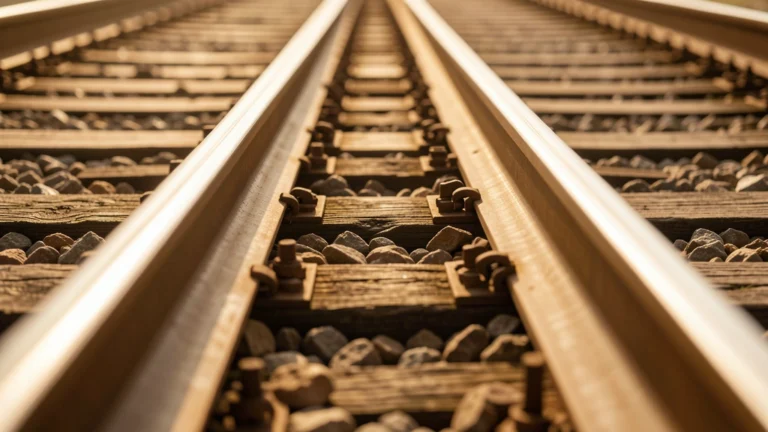
Why does a 10 meter steel rail grow almost 5 millimeters on a hot afternoon? The answer is thermal expansion, the steady growth of a material as its temperature rises. The change looks tiny, yet it bends tracks, cracks roads and pushes pipes out of line. One short formula predicts it, and this guide shows you how to use it.
- Most materials grow when heated and shrink when cooled, because their atoms push farther apart.
- Linear expansion uses dL = alpha x L x dT, where alpha is the material’s coefficient.
- Steel grows about 12 millionths of its length per degree Celsius; aluminum grows about twice as much.
- Area grows by about 2 alpha and volume by about 3 alpha, so beta is close to 3 alpha.
- Rails, bridges and pipes need gaps or joints, or the blocked growth turns into large stress.
Why Does a Solid Get Bigger When It Warms Up?
A solid grows when heated because its atoms vibrate harder and push their neighbors slightly farther away. Each tiny gap widens a little, and millions of gaps add up to a visible change in size.
Heat is the energy that drives this. Adding energy raises the temperature, and the temperature decides how hard the atoms shake. Our guide to BTUs for heating and cooling covers how that energy is measured.
The push is lopsided, which is the key detail. Atoms resist being squeezed together more than they resist being pulled apart. So a stronger vibration moves them outward more than inward, and the average spacing grows.
For most solids there is no favorite direction. Length, width and height all grow by the same fraction, so the shape stays the same while the size changes. Cooling reverses the whole process, and the object shrinks back.
What Does the Formula dL = alpha x L x dT Tell You?
The formula says the change in length equals the coefficient, times the starting length, times the temperature change. Double any one of those three inputs and the growth doubles too.
Each term has a clear job. L is the original length, and dT is the final temperature minus the starting one. Alpha is the coefficient of linear expansion, the fraction a material grows for each degree.
The Celsius degree and the kelvin are the same size, so alpha has the same value per C or per K. A Fahrenheit degree is smaller, so a per-F value is 5/9 of the per-C value. Steel at 12 x 10^-6 per C becomes about 6.7 x 10^-6 per F.
Two Examples From the Tool Page
A 1 meter steel rod warms from 20 C to 50 C, a rise of 30 degrees. With alpha at 12 x 10^-6, the rod grows 0.00036 m, or 0.36 mm. A 6 meter copper pipe runs from 20 C to 90 C, a 70 degree rise. At 17 x 10^-6, it grows 7.14 mm and ends at 6.00714 m.
To run your own numbers in length, volume or density form, open the Thermal Expansion Calculator and enter the coefficient and both temperatures.
Which Materials Grow the Most When Heated?
Among common solids, aluminum and lead grow the most, while Pyrex glass, quartz and Invar grow the least. Steel, iron and concrete sit in the middle at about 12 x 10^-6 per degree.
| Material | OpenStax table | HyperPhysics table |
|---|---|---|
| Aluminum | 25 | 24 |
| Copper | 17 | 17 |
| Steel | 12 | 13 |
| Concrete, brick | 12 | not listed |
| Ordinary glass | 9 | 9 |
| Pyrex glass | 3 | 4 |
| Invar (nickel-iron) | 0.9 | not listed |
Notice that two respected tables disagree by one or two units. Real coefficients shift with the exact alloy and the temperature range. Use a supplier’s figure for design work, and treat textbook values as good estimates.
The spread matters in practice. Heat a 10 m bar by 40 C, and steel grows 4.8 mm while aluminum grows about 10 mm. Invar grows only 0.36 mm, which is why it suits precise instruments.
How Do Area and Volume Change Compared With Length?
Area grows by about 2 alpha per degree, and volume grows by about 3 alpha per degree. The volume coefficient is called beta, so for solids beta is close to 3 alpha.
The reason is simple. A plate grows in two directions at once, and a block grows in three. Each direction adds its own share, so the fractions stack up.
Take a 1 square meter steel plate heated by 40 C. Its area grows by 2 x 12 x 10^-6 x 40, which is 9.6 square centimeters. A 1 cubic meter steel block heated the same amount gains about 1.4 liters of volume, using beta of 35 x 10^-6.
Holes grow too, which surprises many people. The ring of metal around a hole expands outward, so the hole gets larger, not smaller. Machinists use this to fit a heated ring over a cold shaft.
Liquids Use Beta Only
A liquid takes the shape of its container, so only the volume coefficient makes sense. Liquids also expand far more than solids. Gasoline has a beta of 950 x 10^-6, about 27 times steel’s 35 x 10^-6.
OpenStax works a clear case. A full 60 liter steel tank warms from 15 C to 35 C, and about 1.10 liters of gasoline spill out. Water is the odd one: it is densest at 4 C and expands as it cools toward 0 C.
Why Do Rails, Bridges and Pipes Need Room to Move?
Long structures need gaps or joints because small growth per meter adds up over hundreds of meters. Without room to move, the metal bends, buckles or pushes its supports out of place.
Length is the multiplier here. One meter of steel heated by 40 C grows under half a millimeter. A 100 m run of steel rail heated by the same 40 C grows 48 mm, which is almost 2 inches.
Bridges show the scale best. OpenStax treats the Golden Gate Bridge’s 1,275 m main span as all steel. Across a swing from -15 C to 40 C, the span changes length by about 0.84 m. Many expansion joints share that motion, so each joint moves only a little.
Pipes face the same issue indoors. A 30 m copper hot water line heated from 10 C to 60 C grows 25.5 mm. Designers add loops, bends or sliding joints so the pipe can flex instead of pulling on its fittings.
Power lines follow the same rule. They sag more in summer and pull tighter in winter, so crews hang them with enough slack for the cold months.
What Happens When Expansion Is Blocked?
Blocked expansion turns into thermal stress, a squeezing force inside the material. The stress can be large enough to crack concrete, burst a sealed tank or buckle a track on a hot day.
OpenStax gives a road example. Concrete slabs laid tight at 5 C warm to 38 C with no gap between them. The stress reaches about 7.9 x 10^6 pascals, or roughly 1,150 psi. Our guide to pressure units like psi, bar and Pa explains that conversion.
That stress sits below concrete’s crushing strength, so the slabs survive. The edges still face shear stress, and some corners chip off. This is why roads and sidewalks carry deliberate gaps.
Engineers also match materials on purpose. Steel and concrete share nearly the same coefficient, about 12 x 10^-6. So steel rebar and the concrete around it grow together and do not tear apart.
Mismatched materials can be useful too. A bimetallic strip bonds two metals that expand at different rates, so it curls as it heats. Older thermostats used that curl to switch the heat on and off.
The Thermal Expansion Calculator works out the length, volume or density change from a coefficient and two temperatures.
FAQs About Thermal Expansion
What Is Thermal Expansion in Simple Terms?
Thermal expansion is the growth of a material as it gets warmer. Heat makes atoms vibrate harder and sit slightly farther apart, so length, area and volume all increase. Cooling reverses the change.
What Is the Formula for Linear Thermal Expansion?
The formula is dL = alpha x L x dT. Multiply the coefficient of linear expansion by the starting length and the temperature change. A 10 m steel rail heated by 40 C grows 4.8 mm.
Is the Volume Coefficient Always Three Times the Linear One?
For most solids, beta is very close to 3 alpha, because the material grows in three directions. Steel lists alpha at 12 x 10^-6 and beta at 35 x 10^-6. Liquids have only a beta value.
Does Aluminum Expand More Than Steel?
Yes, about twice as much. Tables list aluminum at 24 to 25 x 10^-6 per C and steel at 12 to 13 x 10^-6. A 10 m bar heated by 40 C grows about 10 mm in aluminum and 4.8 mm in steel.
Can I Use Fahrenheit in the Expansion Formula?
Yes, as long as the coefficient matches the unit. A per-F coefficient is 5/9 of the per-C value. Steel at 12 x 10^-6 per C is about 6.7 x 10^-6 per F.
Why Do Hot Water Pipes Need Expansion Loops?
Long pipes grow a lot in total. A 30 m copper line heated from 10 C to 60 C grows 25.5 mm. Loops, bends and sliding joints let the pipe flex instead of straining its fittings.
Does Anything Shrink When It Gets Warmer?
Water does over a narrow range. It is densest at 4 C, so between 0 C and 4 C it shrinks as it warms. Above 4 C, water expands like most other liquids.
Sources
References Used in This Article
This article is general physics education, not structural or plumbing design advice. Use a supplier’s coefficient and a qualified engineer for real projects. Reviewed for accuracy by Prof. Dr. Khalil Mudassar, PhD. Last updated September 27, 2026.
Author

Shakeel Muzaffar is the Founder and Editor-in-Chief of MultiCalculators.com, bringing over 15 years of experience in digital publishing, product strategy, and online tool development. He leads the platform's editorial vision, ensuring every calculator meets strict standards for accuracy, usability, and real-world value. Shakeel personally oversees content quality, formula verification workflows, and the platform's commitment to publishing tools that are genuinely useful for students, professionals, and everyday users worldwide.