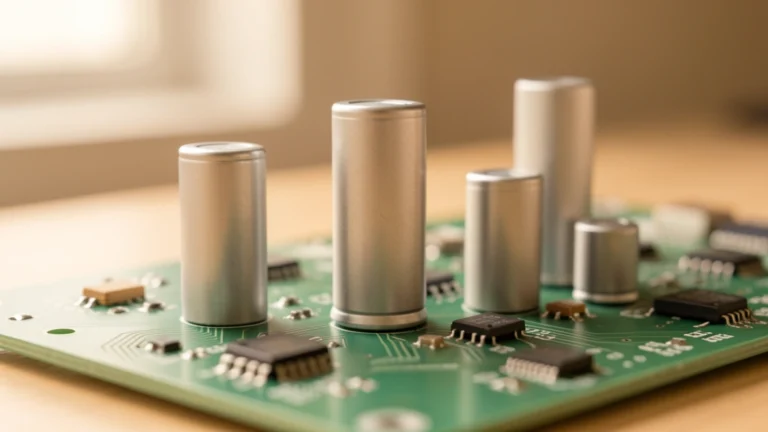
How can a part smaller than a grain of rice hold a charge, while a single farad would need plates wider than a city? The answer sits in one short formula, C = Q / V. Capacitance tells you how much charge a part stores for each volt you push across it. This guide shows what the number means, how to size it, and why big capacitors deserve respect.
- Capacitance is stored charge divided by voltage: C = Q / V, measured in farads.
- One farad holds one coulomb at one volt, so real parts use pF, nF, and uF.
- Stored energy is E = 1/2 C V squared, so doubling the voltage gives four times the energy.
- For flat plates, C = e0 x er x A / d: bigger plates and thinner gaps raise it.
- Parallel capacitors add directly, while series capacitors combine as reciprocals.
What Does a Farad Really Measure?
A farad measures how many coulombs of charge a part stores for each volt across it. The formula is C = Q / V. One farad means one coulomb of charge at one volt.
Picture two metal plates facing each other with a thin insulator between them. A battery pulls electrons off one plate and pushes them onto the other. The plates end up with equal and opposite charges, and their attraction is described by Coulomb’s law and the force between charges.
One farad turns out to be a huge amount. OpenStax notes that typical parts range from picofarads to millifarads. Here are the prefixes you will see on real parts:
| Unit | Value in farads | Typical use |
|---|---|---|
| Picofarad (pF) | 0.000000000001 F | Radio tuning, small air gaps |
| Nanofarad (nF) | 0.000000001 F | Timing and signal filters |
| Microfarad (uF) | 0.000001 F | Power supply smoothing |
| Millifarad (mF) | 0.001 F | Large storage banks |
Keep one conversion handy: 1 uF equals 1,000 nF, which equals 1,000,000 pF. Most unit mistakes come from a slipped factor of 1,000.
How Much Charge and Energy Sits in a Charged Capacitor?
Charge is capacitance times voltage, Q = C x V. Energy is half the capacitance times the voltage squared, E = 1/2 x C x V squared. Both results use farads, volts, coulombs, and joules.
Try a 100 uF capacitor on a 12 V supply. The charge is 0.0001 x 12, which is 0.0012 C, or 1.2 mC. The energy is 0.5 x 0.0001 x 144, which gives 0.0072 J, or 7.2 mJ.
The tool page uses a 470 uF filter capacitor at 12 V as its example. The charge comes to 5.64 mC, and the stored energy comes to 33.84 mJ. You can check both numbers in the capacitance, charge, and energy calculator by choosing each mode in turn.
Why is there a one-half in the energy formula? The voltage starts at zero and climbs as charge builds up. Early charge moves across a small voltage, so the average cost is half the final voltage.
The squared term matters most in practice. Raise that 100 uF part from 12 V to 24 V, and the energy jumps from 7.2 mJ to 28.8 mJ. The voltage doubled, but the energy grew four times.
Why Do Plate Size, Gap, and Insulator Set the Value?
For two flat plates, capacitance equals e0 times er times plate area, divided by the gap. Bigger plates raise it, a thinner gap raises it, and a better insulator raises it.
Here, e0 is the permittivity of free space. NIST lists it as about 8.854 x 10^-12 farads per meter. The letter er stands for relative permittivity, which is 1 for a vacuum and close to 1 for air.
The tool page example uses two 10 cm by 10 cm plates, 1 mm apart in air. The area is 0.01 square meters, so C = 8.854 x 10^-12 x 0.01 / 0.001. That comes to 88.54 pF.
Now change one thing at a time. Halve the gap to 0.5 mm, and the value doubles to 177.08 pF. Fill the gap with paper, where er is about 3.7, and it rises to about 327.6 pF.
This formula also explains why one farad is so large. With a 1 mm air gap, a 1 F capacitor needs about 113 million square meters of plate. That is roughly 113 square kilometers, bigger than many cities.
What Changes When You Wire Capacitors Together?
Capacitors in parallel simply add their values. Capacitors in series combine as reciprocals, so the total is always smaller than the smallest part. This is the reverse of how resistors behave.
Take a 10 uF and a 20 uF capacitor. Side by side in parallel, they act like one 30 uF part. Each one sees the full supply voltage, and the plate areas effectively add up.
In series, use 1 / C = 1 / 10 + 1 / 20. The result is about 6.67 uF. OpenStax explains that every capacitor in a series string carries the same charge, because charge cannot leak out of the wire between them.
Why would anyone lose capacitance on purpose? Series strings split the voltage across the parts. Two identical 100 uF capacitors in series give 50 uF, but each part only holds about half the supply voltage.
Where Do Capacitors Earn Their Keep in Real Devices?
Capacitors smooth power supplies, filter signals, set timing, and release stored energy in quick bursts. OpenStax lists uses ranging from radio filtering to energy storage in heart defibrillators.
A camera flash shows the burst idea well. The tool page describes a 330 uF capacitor charged to 300 V. It holds 0.099 C of charge and about 14.85 J of energy, dumped into the flash tube at once.
Put those joules in household terms, and they look tiny. One kilowatt-hour equals 3.6 million joules, as our guide to what a kWh measures on your electric bill explains. Our 7.2 mJ example would need 500 million full charges to reach a single kWh.
So capacitors are poor at storing lots of energy but great at delivering it fast. Batteries do the reverse, holding far more energy but releasing it more slowly. Circuits often pair both for that reason.
Why Can a Capacitor Still Shock You After Power Is Off?
A capacitor keeps its charge after the power source is disconnected. Nothing drains it until a path connects the two plates. Large, high-voltage capacitors can therefore hold a dangerous charge in a switched-off device.
Workplace rules take this seriously. The federal electrical safety rule for power line work, 29 CFR 1910.269, requires workers to disconnect capacitors and short circuit them before work begins. It also requires a wait of at least 5 minutes after disconnection before applying that short circuit.
At home, the lesson is simple. Leave old microwaves, flash units, and power supplies closed, even when unplugged. Large capacitors inside them may still be charged, and qualified technicians use proper tools to discharge them.
The energy formula explains the risk. Energy grows with the square of voltage, so a 300 V part stores 625 times the energy of the same part at 12 V. High voltage turns a small capacitor into a serious hazard.
The Capacitance Calculator finds capacitance from plate size and gap, charge from C and V, or stored energy, with units from pF to F.
FAQs About Capacitance
What Is Capacitance in Simple Terms?
Capacitance is how much electric charge a part stores for each volt across it. The formula is C = Q / V, and the unit is the farad.
How Many Picofarads Are in a Microfarad?
One microfarad equals 1,000 nanofarads, which equals 1,000,000 picofarads. A 0.1 uF part is therefore 100 nF or 100,000 pF.
How Do You Find the Energy Stored in a Capacitor?
Use E = 1/2 x C x V squared, with C in farads and V in volts. A 100 uF capacitor at 12 V stores 0.0072 J, or 7.2 mJ.
Is Capacitance the Same as Charge?
No. Capacitance is a property of the part, while charge is what it holds right now. Charge equals capacitance times voltage, so the same part holds more charge at a higher voltage.
Do Capacitors Add Up in Series or in Parallel?
They add directly in parallel, so 10 uF and 20 uF give 30 uF. In series they combine as reciprocals, giving about 6.67 uF for the same pair.
Why Does a Thinner Gap Increase Capacitance?
The gap d sits in the bottom of C = e0 x er x A / d. Halving the gap doubles the capacitance, as long as the insulator can handle the stronger electric field.
Is It Safe to Touch an Unplugged Capacitor?
Not always. A capacitor can hold its charge after power is removed. Large or high-voltage parts can deliver a dangerous shock, so leave discharging to qualified people with proper tools.
Sources
References Used in This Article
- OpenStax, University Physics Volume 2, 8.1 Capacitors and Capacitance
- OpenStax, University Physics Volume 2, 8.2 Capacitors in Series and in Parallel
- HyperPhysics (Georgia State University), Parallel Plate Capacitor
- NIST, CODATA Value: Vacuum Electric Permittivity
- eCFR, 29 CFR 1910.269, Electric Power Generation, Transmission, and Distribution
This article is general physics and electronics education, not electrical safety training. Leave work on high-voltage equipment to qualified technicians. Reviewed for accuracy by Prof. Dr. Khalil Mudassar, PhD. Last updated September 27, 2026.
Author

Shakeel Muzaffar is the Founder and Editor-in-Chief of MultiCalculators.com, bringing over 15 years of experience in digital publishing, product strategy, and online tool development. He leads the platform's editorial vision, ensuring every calculator meets strict standards for accuracy, usability, and real-world value. Shakeel personally oversees content quality, formula verification workflows, and the platform's commitment to publishing tools that are genuinely useful for students, professionals, and everyday users worldwide.