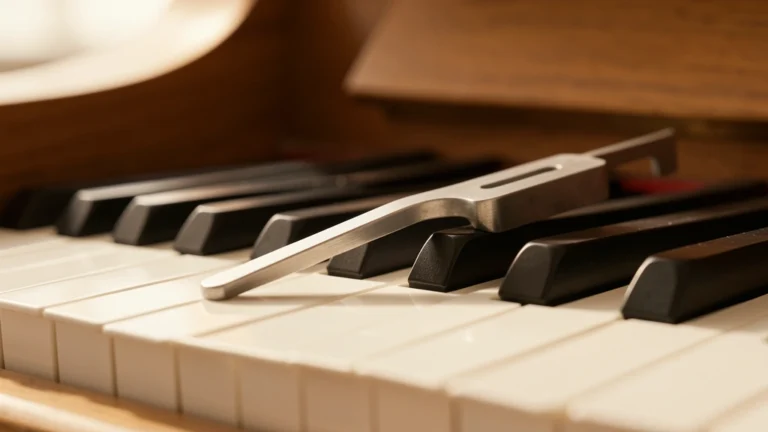
Why does almost every tuner on the planet start from the number 440? That number is the frequency of the A above middle C, and it anchors the pitch of every other note. Once you know it, one short formula gives you any note on the keyboard.
This guide explains what a note frequency is and why A440 became the standard. It also shows how equal temperament and MIDI numbers turn a note name into hertz, and how long each sound wave is in the air.
- A4, the A above middle C, is tuned to 440 Hz under the ISO 16 standard pitch.
- Equal temperament gives any note as f = 440 x 2^((n – 69) / 12), where n is the MIDI number.
- Every octave doubles the frequency, so A5 is 880 Hz and A3 is 220 Hz.
- Wavelength equals the speed of sound divided by frequency, about 0.78 m for A440 at 20 C.
What a Note Frequency Means
A note frequency is how many times a sound wave repeats each second. We measure it in hertz, written Hz, where 1 Hz means one cycle per second. A string playing A4 vibrates back and forth 440 times every second.
Frequency sets pitch. A higher frequency sounds higher, and a lower frequency sounds lower. Loudness is a separate property that depends on the size of the wave, which our guide to decibels and sound levels covers in detail.
The most useful fact in music is that octaves double. An octave is a ratio of 2 to 1, so going up one octave multiplies the frequency by two. A3 is 220 Hz, A4 is 440 Hz, and A5 is 880 Hz.
This doubling explains why the same note name repeats across the keyboard. The ear hears a 2 to 1 ratio as the same note in a higher register. A standard 88-key piano runs from A0 at 27.5 Hz up to C8 at about 4,186 Hz.
Why Is A440 the Standard Tuning Pitch?
A440 is the standard because international and national bodies agreed on it during the 20th century. The International Organization for Standardization first adopted it in 1955 and formalised it as ISO 16 in 1975.
Before that, pitch varied from city to city. France set A at 435 Hz in the 1860s, and British piano tuners used 439 Hz from 1899. In 1936 the American Standards Association recommended 440 Hz, and a 1939 meeting in London backed the same value.
A shared reference solves a practical problem. A piano, an oboe and a synthesizer built in different countries can play together without retuning. The US time station WWV has broadcast a 440 Hz tone once each hour since August 1936 for this reason.
Other Reference Pitches Still in Use
The standard is common, but it is not universal. Many orchestras in continental Europe tune A4 between 440 and 444 Hz. Period-instrument groups often use a baroque pitch of 415 Hz, which sits about one semitone below A440.
Some musicians also tune A4 to 432 Hz. That reference is about 32 cents lower than A440, while A442 is about 7.85 cents higher. Our guide to cents and musical intervals shows how those small gaps are measured.
The Note Frequency Calculator returns the frequency, MIDI number, wavelength and period for any note and any A4 reference.
How the Equal Temperament Formula Works
Modern instruments use equal temperament, which splits each octave into 12 equal semitones. Each semitone multiplies the frequency by the twelfth root of 2, which is about 1.0595. Twelve of those steps multiply to exactly 2, which is one full octave.
MIDI numbers make the formula easy to use. Every key gets a whole number, and A4 is number 69. Each semitone up adds 1, so middle C, nine semitones below A4, is number 60.
The full rule is f = 440 x 2^((n – 69) / 12), where n is the MIDI number. Follow these steps to find middle C.
- Name the note and octave. Middle C is written C4 in scientific pitch notation.
- Find its MIDI number. C4 is MIDI 60, and the reference A4 is MIDI 69.
- Count the semitone distance. Subtract 69 from 60 to get -9 semitones.
- Raise 2 to that distance over 12. Two to the power of -9/12 is about 0.5946.
- Multiply by the reference. 440 times 0.5946 gives about 261.63 Hz for middle C.
The same steps give every other note. E4 is MIDI 64, so it lands at about 329.63 Hz. The low E string on a guitar, E2, is MIDI 40 and sits near 82.41 Hz.
Notice that semitones are not equal in hertz. C4 to C sharp 4 is a gap of about 15.56 Hz. A5 to A sharp 5 is about 52.33 Hz, even though both steps sound the same size.
How Long Is the Sound Wave of a Note?
A note’s wavelength equals the speed of sound divided by its frequency. In air at about 20 C, sound travels near 343 m/s. So A440 has a wavelength of about 0.78 m, and middle C is about 1.31 m long.
Low notes make long waves, and high notes make short ones. The guitar’s low E at 82.41 Hz stretches about 4.16 m. The lowest piano key, A0 at 27.5 Hz, produces a wave of about 12.47 m.
Temperature changes the answer, but not the pitch. Sound moves at about 331.5 m/s near 0 C, so A440 then measures about 0.75 m. The frequency stays at 440 Hz, and only the length of the wave changes.
Wavelength matters in real rooms. Bass waves several metres long bend around furniture and build up in corners. Treble waves only a few centimetres long behave more like beams and are easier to block.
The period is the time for one cycle, found as 1 divided by the frequency. A440 repeats every 2.27 milliseconds, while middle C repeats every 3.82 milliseconds.
Octave Labels, Reference Drift and Other Pitfalls
Most note frequency errors come from labels, not from the math. The formula is exact, so a wrong answer almost always traces back to a wrong input. The table lists the usual traps and how to avoid each one.
| Mistake | Better approach |
|---|---|
| Calling middle C “C3” or “C5” because one program does | Check the software’s convention. Scientific pitch notation names middle C as C4, which is MIDI 60. |
| Mixing a chart made for A442 with a tuner set to A440 | Confirm the A4 reference first. Every note shifts by the same ratio when the reference moves. |
| Adding a fixed number of hertz for each semitone | Multiply by about 1.0595 per semitone instead. The hertz gap grows as notes get higher. |
| Treating C sharp and D flat as different pitches | In equal temperament they are the same key and the same frequency, about 277.18 Hz in octave 4. |
| Assuming wavelength is fixed for a note | Wavelength depends on the speed of sound, which rises with air temperature. |
A reverse check catches most slips. A measured 300 Hz tone works out to MIDI 62.37, so it sits between D4 at 293.66 Hz and D sharp 4 at 311.13 Hz. That result tells you the tone is slightly sharp of D4.
Try it yourself with the note frequency calculator for any octave and reference pitch, then compare the result with a tuner.
Note Frequencies: Frequently Asked Questions
What Is the Frequency of Middle C?
Middle C, written C4, is about 261.63 Hz when A4 is tuned to 440 Hz. It is MIDI note 60, nine semitones below A4.
Why Is A4 Set to 440 Hz?
A440 gives musicians and instrument makers one shared reference. It was recommended in the United States in 1936, agreed in London in 1939, and formalised as ISO 16 in 1975.
How Do You Calculate the Frequency of Any Note?
Use f = 440 x 2^((n – 69) / 12), where n is the MIDI number of the note. For E4, MIDI 64, the result is about 329.63 Hz.
How Much Does the Frequency Change per Octave?
Each octave doubles the frequency. A3 is 220 Hz, A4 is 440 Hz, and A5 is 880 Hz. Going down one octave halves it.
What Is the Difference Between A440 and A442?
A442 raises the reference by 2 Hz, which is about 7.85 cents sharper. Every other note rises by the same ratio, so middle C moves from 261.63 Hz to about 262.81 Hz.
What Is the Wavelength of A440?
About 0.78 m in air at 20 C, using a speed of sound of 343 m/s. In colder air near 0 C, it shrinks to about 0.75 m.
What MIDI Number Is A4?
A4 is MIDI note 69. Each semitone up adds 1 and each semitone down subtracts 1, so middle C is 60 and A5 is 81.
Are C Sharp and D Flat the Same Frequency?
Yes, in equal temperament they share one key and one frequency. C sharp 4 and D flat 4 are both about 277.18 Hz with A4 at 440 Hz.
Sources and Further Reading
References Used in This Article
- NIST, WWV and WWVH Digital Time Code and Broadcast Format (hourly 440 Hz tone)
- NIST, History of Radio Station WWV (440 Hz tone added in 1936)
- UNSW Physics, Note Names, MIDI Numbers and Frequencies
- HyperPhysics (Georgia State University), Speed of Sound in Air
- A440 (Pitch Standard): history, ISO 16 and other reference pitches
This article covers equal temperament with A4 as the reference and does not model just or meantone tunings or instrument overtones. Reviewed for accuracy by Prof. Dr. Khalil Mudassar, PhD. Last updated September 27, 2026.
Author

Shakeel Muzaffar is the Founder and Editor-in-Chief of MultiCalculators.com, bringing over 15 years of experience in digital publishing, product strategy, and online tool development. He leads the platform's editorial vision, ensuring every calculator meets strict standards for accuracy, usability, and real-world value. Shakeel personally oversees content quality, formula verification workflows, and the platform's commitment to publishing tools that are genuinely useful for students, professionals, and everyday users worldwide.



1 thought on “Note Frequencies and A440 Explained”