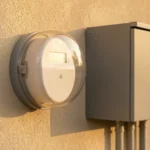
Subtract the start meter reading from the end reading to get the kWh you used, then divide by the days between them. From 45,210 to 46,110 over 30 days is 900 kWh, or 30.0 kWh a day and about 10,950 kWh a year. The average U.S. home bought 10,791 kWh in 2022, about 899 kWh a month.
Bars drawn to scale from 0.
Calculations run in your browser. Inputs are not sent to our servers; anything you Save stays in this browser only.
Saved results (0)
How to Use the Home Energy Usage Calculator
- Pick how you want to calculate: two meter readings, a set of monthly bills, or a year of every fuel your home burns.
- For meter readings, type the start and end numbers and the days between them. Your bill lists all three.
- For monthly bills, type the kWh from each bill. Add gas therms if you have them. Leave missing months blank.
- For all fuels, type a year of kWh, therms and gallons of propane or heating oil.
- Add your home size and electricity price if you want kWh per square foot and cost. Then read the results, the chart and the working.
This tool looks at the whole home. It totals what your meters and bills show, not what each appliance uses.
Home Energy Use Formulas
A meter counts up, so the energy used is the change in the reading. Dividing by the days gives a daily rate that you can compare across bills of any length.
With fewer than 12 bills, the yearly figure is the monthly average x 12. That is only an estimate, since the missing months may be warmer or colder.
Here k is kWh, t is therms, and g is gallons. One MMBtu is one million Btu.
How to Read Your Electric Meter
Your meter shows a running total of kWh since it was installed. You only need two readings and the number of days between them.
Digital and Smart Meters
Most homes now have a digital display. The EIA reports that about 73% of U.S. residential meters were smart (AMI) meters in 2022. Write down the kWh number, and skip any screen that shows kW, volts or a test pattern. Many utilities also post daily readings online.
Dial Meters
Older meters have four or five small dials. Read them from left to right. When a pointer sits between two numbers, write the lower one. Neighboring dials turn in opposite directions, so check each one.
Note the Billing Days
Your bill prints the read dates and the number of days in the cycle. Use that day count, not 30, when you work out kWh per day.
Why Monthly Use Goes Up and Down
Days in the Billing Cycle
Bills are not all the same length. A 33-day bill holds 10% more days than a 30-day bill, even if your habits did not change. That is why this calculator gives kWh per day and a 30-day projection.
Weather
Heating and cooling are the biggest swing. The EIA found that space heating and air conditioning made up 52% of household energy use in 2020, and both are mostly seasonal. A home with electric heat peaks in winter. A home with central air peaks in summer.
Other Causes
Guests, holidays, a new appliance, or an estimated reading can also move one month. An estimated bill is corrected on the next actual read, so two odd months in a row often cancel out.
Convert Every Fuel to One Unit
Electricity comes in kWh, gas in therms, and propane or oil in gallons. To add them up, turn each into Btu using the EIA heat contents below.
| Fuel | Unit | Btu | kWh equivalent |
|---|---|---|---|
| Electricity | 1 kWh | 3,412 | 1.000 |
| Natural gas | 1 therm | 100,000 | 29.31 |
| Natural gas | 1 cubic foot | 1,036 | 0.304 |
| Propane | 1 gallon | 91,452 | 26.80 |
| Heating oil | 1 gallon | 138,500 | 40.59 |
For example, 700 therms x 100,000 Btu = 70 MMBtu. Divided by 3,412 Btu per kWh, that is 20,516 kWh. This is a heat-content total. It does not account for how well a furnace or heat pump turns that fuel into warmth.
How Your Home Compares
The calculator compares your yearly electricity with the EIA figure for an average U.S. residential customer: 10,791 kWh in 2022, about 899 kWh a month.
- By state: Louisiana was highest at 14,774 kWh per customer, and Hawaii was lowest at 6,178 kWh.
- Purchases, not use: the EIA figure counts power bought from the utility. Homes with net-metered solar panels may use more than they buy.
- Your mix matters: a home that heats with electricity will run well above a home that heats with gas, oil or propane.
For a fair check on your own home, compare kWh per day or kWh per square foot from one year to the next.
Worked Example
- The last bill read 45,210 kWh. This bill reads 46,110 kWh, 30 days later.
- Energy used: 46,110 - 45,210 = 900 kWh.
- Per day: 900 / 30 = 30.0 kWh. Per year: 30.0 x 365 = 10,950 kWh.
- At $0.17 per kWh, the bill is 900 x 0.17 = $153.00, or about $1,861.50 a year.
- In a 1,800 sq ft home, that is 10,950 / 1,800 = 6.08 kWh per sq ft per year.
- Compared with the 2022 U.S. average: 10,950 / 10,791 = 101%.
- The home also burned 700 therms of gas: 70 MMBtu, or 20,516 kWh. Total energy: 107.36 MMBtu.
One bill can run high or low with the weather, so a full year of bills gives a better yearly number.
How We Calculate
Frequently Asked Questions
How do I work out my home's electricity use from meter readings?
Subtract the start reading from the end reading, then divide by the days between them. From 45,210 to 46,110 over 30 days is 900 kWh, or 30.0 kWh a day. Multiply the daily figure by 365 for a yearly projection: 10,950 kWh. Use the dates and days printed on your bill.
How much electricity does the average U.S. home use?
The U.S. Energy Information Administration says the average residential customer bought 10,791 kWh in 2022, about 899 kWh a month. Louisiana was highest at 14,774 kWh and Hawaii lowest at 6,178 kWh. These are purchases from the utility, so homes with solar panels can use more than they buy.
Why is my electric use higher in some months?
Two things drive most of it. Billing periods run from about 27 to 35 days, so a longer cycle holds more days of use. Weather matters more: the EIA says space heating and air conditioning made up 52% of household energy use in 2020, and both are seasonal. Compare kWh per day, not kWh per bill.
How do I convert therms of natural gas to kWh?
One therm is 100,000 Btu and one kWh is 3,412 Btu, so 1 therm = 100,000 / 3,412 = 29.31 kWh. For example, 700 therms = 70 MMBtu = 20,516 kWh. If your bill shows CCF, multiply by 1.036 first to get therms.
How do I add up electricity, gas, propane and oil use?
Turn each fuel into Btu, add them, then show the total in MMBtu or kWh. Use 3,412 Btu per kWh, 100,000 per therm, 91,452 per gallon of propane and 138,500 per gallon of heating oil. For example, 800 gallons of propane is 73.16 MMBtu, or 21,442 kWh.
How do I find kWh per square foot?
Divide yearly kWh by the heated floor area. A home that uses 10,950 kWh a year in 1,800 sq ft uses 6.08 kWh per sq ft. There is no single good number, since climate, heating fuel and home type change it a lot. It is most useful for tracking your own home from year to year.
What if my end reading is lower than my start reading?
An end reading lower than the start (end < start) usually means a misread digit or readings typed in the wrong order. On an older meter it can also mean the dials rolled past all 9s. For a 5-digit meter, add 100,000 to the end reading. For example, 99,850 to 00,150 is 100,150 - 99,850 = 300 kWh.
Sources
- U.S. Energy Information Administration: How much electricity does an American home use? (2022 average residential customer: 10,791 kWh a year, about 899 kWh a month; Louisiana 14,774 kWh, Hawaii 6,178 kWh; figures are purchases, not total use).
- U.S. Energy Information Administration: British thermal units (Btu) (heat contents: 1 kWh = 3,412 Btu, 1 therm = 100,000 Btu, 1 cubic foot of gas = 1,036 Btu, propane 91,452 Btu per gallon, heating oil 138,500 Btu per gallon).
- U.S. Energy Information Administration: Use of energy explained, energy use in homes (space heating and air conditioning were 52% of household energy use in 2020; mostly seasonal and vary by location and home size).
- U.S. Energy Information Administration: How many smart meters are installed in the United States? (about 73% of residential electric meters were smart AMI meters in 2022).
Related Guides
Related Calculators
Planning more home projects?
Explore all construction calculatorsThis calculator totals whole-home energy use for planning. It is not an energy audit or a billing statement. Your utility's meter and bill are the final record. Spotted an error? Let us know.
Author

Shakeel Muzaffar is the Founder and Editor-in-Chief of MultiCalculators.com, bringing over 15 years of experience in digital publishing, product strategy, and online tool development. He leads the platform's editorial vision, ensuring every calculator meets strict standards for accuracy, usability, and real-world value. Shakeel personally oversees content quality, formula verification workflows, and the platform's commitment to publishing tools that are genuinely useful for students, professionals, and everyday users worldwide.