Does your well really deliver 7 gallons per minute, or just your pressure tank? A five-gallon bucket and a stopwatch give you the first number in under two minutes. The harder question is what that number means for showers, laundry, and a dry August. This guide shows how to measure flow, how to estimate true well yield, and what a home actually needs.
- Flow rate in GPM equals gallons collected divided by seconds, times 60.
- A 5-gallon bucket that fills in 40 seconds means 7.5 GPM at that tap.
- Tap flow is not well yield; yield is the rate the well refills over hours.
- Penn State Extension suggests at least 6 GPM for most single-family homes.
- Low-yield wells work with storage tanks and by spreading out heavy water use.
How Do You Do a Bucket Test for Well Flow Rate?
Time how long a bucket of known size takes to fill, then divide gallons by seconds and multiply by 60. The result is gallons per minute, or GPM. A 5-gallon bucket that fills in 40 seconds shows 7.5 GPM.
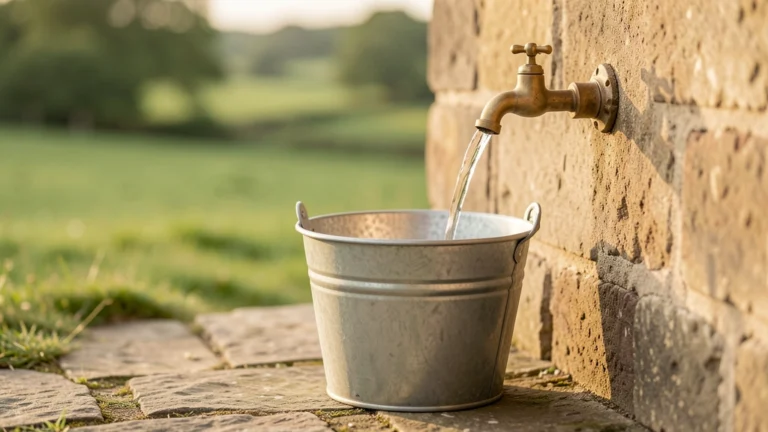
Use the spigot closest to the pressure tank, and open it all the way. Close every other faucet in the house first. Run the water until the pump switches on, then start timing on a fresh, empty bucket.
Repeat the fill three times and average the results. A slower fill of 75 seconds means 4.0 GPM, which is a very different story. Your stopwatch matters more than your bucket, so start and stop it at the same moments.
Some buckets are marked only in liters. A 20-liter pail holds about 5.28 gallons, and our guide to converting liters to gallons shows the math. Filling that pail in 40 seconds works out to about 7.9 GPM.
Is Tap Flow the Same as Well Yield?
No. Tap flow shows what your pump and pipes deliver right now, while well yield is the rate the well refills over hours. A strong tap reading can hide a weak well.
Think of three separate numbers. Tap flow is your bucket result. Pump capacity is what the pump is rated to move. Sustained yield is what the aquifer feeds into the borehole, hour after hour.
Penn State Extension defines well yield as the maximum GPM a well can be pumped without dropping the water below the pump intake. That limit comes from the ground, not the plumbing.
The pressure tank adds another twist. Penn State notes that only about 20 percent of a pressure tank holds usable water. A 42-gallon tank gives about 8 gallons before the pump restarts, so a quick first fill mostly measures the tank.
Math makes the gap clear. A tap reading of 7.5 GPM equals 10,800 gallons a day, yet few wells refill that fast. Only a longer test reveals what the well truly supplies.
How Do You Measure Well Yield With a Recovery Test?
Pump the water level down, then time how many feet it rises and multiply by the casing gallons per foot. Divide those gallons by the minutes to get recovery in GPM.
Casing gallons per foot comes from the cylinder formula: pi times radius squared in feet, times 7.48 gallons per cubic foot. A 6-inch casing holds 1.469 gallons per foot. The CT Department of Public Health rounds this to 1.5 gallons.
| Casing diameter | Gallons per foot | Per 100 feet of water |
|---|---|---|
| 4 inches | 0.653 | 65.3 |
| 5 inches | 1.020 | 102.0 |
| 6 inches | 1.469 | 146.9 |
| 8 inches | 2.611 | 261.1 |
Here is a worked example. In a 6-inch well, the water rises 24 feet in 10 minutes. That is 24 times 1.469, or about 35.3 gallons, which means roughly 3.5 GPM of recovery.
The Pump-Down Method
A pump test gives a second estimate. Pump 10 GPM for 30 minutes, or 300 gallons, while the level drops 120 feet. Storage supplied 176.3 gallons, so the well added 123.7 gallons, or about 4.1 GPM. The well flow rate calculator runs both methods from your readings.
How Much Water Does a Household Need From a Well?
Plan on 50 to 100 gallons per person per day, per Penn State Extension, and size the system for peak hours. Penn State suggests a minimum flow of 6 GPM for most single-family homes.
The CT Department of Public Health uses 75 gallons per person per day for well design. A four-person home therefore averages about 300 gallons a day.
Daily totals are only half the picture. Penn State recommends a system that can supply the whole day’s use within a 2-hour peak period. For 300 gallons, that means 2.5 GPM for two straight hours.
The 6 GPM benchmark covers this with room to spare. It delivers 360 gallons each hour, enough for most home peak demands. Penn State’s table raises the minimum for bigger homes, up to 18 GPM for six bedrooms and three baths.
Weather shifts these numbers too. Penn State notes that well storage drops in dry periods, with the lowest groundwater levels usually in fall. Tracking rainfall totals helps explain a slow season.
What Can You Do With a Low-Yield Well?
Add storage, spread out heavy water use, or both. Penn State Extension notes that a 1 GPM well still produces 1,440 gallons a day. The problem is timing, not total supply.
Stagger the big users first. Penn State suggests spreading laundry across the week and moving some showers to the evening. Those changes cost nothing and cut the morning rush.
An intermediate storage tank fixes the timing for good. The well pump slowly fills a nonpressurized tank, and a second pump feeds the house. Penn State’s rule of thumb is 100 gallons of storage per person, so a family of five needs 500 gallons.
The borehole itself also stores water. A 6-inch well with 150 feet of standing water holds about 220 gallons. Penn State warns this storage shrinks during droughts, when water levels fall.
Avoid one tempting shortcut. The CT Department of Public Health warns against trucking water into a dry well. Much of it drains out into the empty cracks of the aquifer.
When Should You Call a Licensed Well Contractor?
Call a licensed contractor for any test that opens the well, pulls the pump, or measures water levels inside the casing. Bucket tests at a spigot are safe to do yourself.
The CT Department of Public Health suggests having a licensed plumber or well driller fit a small water meter on the discharge line. The well then runs until the flow holds steady. That stabilized reading is a solid yield check for an older home.
Test length matters for low producers. Connecticut requires a yield test of at least four hours for new private wells. Its program office recommends at least 18 hours for wells under 1.0 GPM.
Test water quality as a separate job. A flow test says nothing about safety. The EPA recommends testing private wells every year for total coliform bacteria, nitrates, total dissolved solids, and pH.
The Well Flow Rate Calculator turns bucket times into GPM, recovery readings into yield, and household size into a storage check.
FAQs About Well Flow Rate
What Is a Good Flow Rate for a Well?
Penn State Extension suggests a minimum of 6 GPM for most single-family homes. That delivers 360 gallons each hour, enough for most household peak demands. Larger homes with more bathrooms need higher flow rates.
How Do I Calculate GPM With a Bucket?
Divide the gallons collected by the seconds it took, then multiply by 60. A 5-gallon bucket that fills in 40 seconds gives 7.5 GPM. Filling it in 75 seconds gives 4.0 GPM.
Is the Flow at My Faucet the Same as My Well Yield?
No. Faucet flow shows what the pump and pressure tank deliver in the moment. Well yield is the rate the aquifer refills the borehole over hours, which a recovery or pump test measures.
How Many Gallons Are in a Foot of Well Casing?
Multiply pi by the radius squared in feet, then by 7.48. A 4-inch casing holds 0.653 gallons per foot, a 6-inch holds 1.469, and an 8-inch holds 2.611.
Can a 1 GPM Well Supply a House?
Often yes, with storage. Penn State Extension notes a 1 GPM well yields 1,440 gallons a day. It cannot keep up with a 2-hour morning rush alone, so a storage tank fills the gap.
How Big Should a Storage Tank Be for a Low-Yield Well?
Penn State Extension suggests 100 gallons of storage for each person in the home. A family of five would need 500 gallons, in one tank or several.
Does a Flow Test Tell Me if My Well Water Is Safe?
No. Flow and quality are separate checks. The EPA recommends testing private wells every year for total coliform bacteria, nitrates, total dissolved solids, and pH.
Sources
References Used in This Article
This article is general homeowner education, not engineering, plumbing, or health advice. Rules for well testing vary by state and town, so check with your local health department. Reviewed for accuracy by Prof. Dr. Khalil Mudassar, PhD. Last updated September 27, 2026.
Author

Shakeel Muzaffar is the Founder and Editor-in-Chief of MultiCalculators.com, bringing over 15 years of experience in digital publishing, product strategy, and online tool development. He leads the platform's editorial vision, ensuring every calculator meets strict standards for accuracy, usability, and real-world value. Shakeel personally oversees content quality, formula verification workflows, and the platform's commitment to publishing tools that are genuinely useful for students, professionals, and everyday users worldwide.