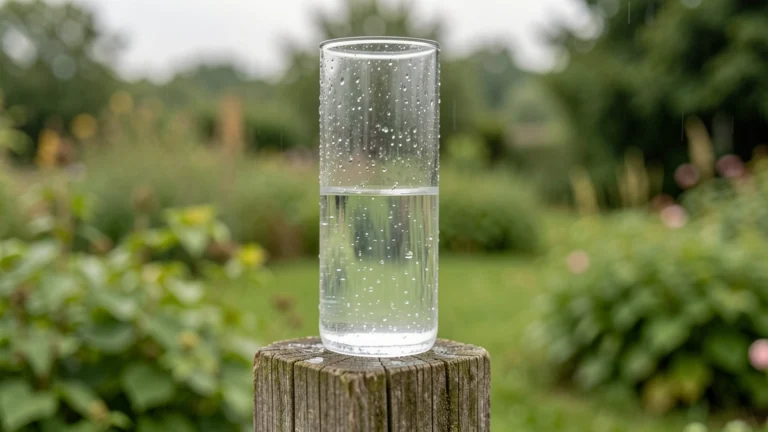
Measuring rain is one of the oldest and simplest kinds of weather record. All it takes is a straight-sided container and a ruler. Yet a few small habits separate a useful rainfall total from a misleading one. This guide walks through how to measure rain, add up daily and monthly totals, convert between inches and millimeters, and turn a total into the gallons of water it represents.
- Rainfall is measured as a depth, in inches or millimeters, using a rain gauge.
- The daily total is simply the depth in the gauge when you empty it once a day.
- Add daily totals to get weekly, monthly, or yearly rainfall.
- Convert units with 1 inch = 25.4 millimeters.
- To turn a total into water volume, multiply depth by area, which a calculator can do for you.
What a Rainfall Total Actually Measures
Rainfall is measured as a depth, not a volume. A total of one inch means the rain would sit one inch deep on a flat, level surface if none drained away or evaporated. The same one inch falls on a teacup and a football field alike.
This is why rainfall is reported in inches or millimeters. It describes how much rain fell per unit of ground, which lets you compare a storm in one place with a storm anywhere else, whatever the area.
How to Measure Rainfall
A rain gauge is any container with straight, vertical sides so the depth it collects matches the depth that fell. A simple graduated cylinder works, and official gauges add a funnel that pours into a narrow inner tube to make small amounts easier to read.
Place the gauge in the open, away from trees, walls, and roof overhangs that could block or add rain. Mount it level, with the opening about a foot above the ground to avoid splash-in. After rain, read the water level at eye height against the scale.
Adding Up Daily and Monthly Totals
To keep a running record, empty the gauge at the same time each day and write down the depth. That reading is your daily total. Longer totals are just sums of the days.
| Period | How to calculate it |
|---|---|
| Daily total | The depth in the gauge at your daily reading time |
| Weekly total | Add the 7 daily totals together |
| Monthly total | Add every daily total in the month |
| Yearly total | Add the 12 monthly totals together |
Record a zero on dry days so your totals stay honest. Reading at a fixed daily time, such as 8am, keeps each day’s total comparable and matches how official networks report rain.
Converting Between Inches and Millimeters
Rainfall is reported in inches in the United States and in millimeters almost everywhere else. Converting between them uses one fixed factor.
| Inches | Millimeters |
|---|---|
| 0.1 in | 2.54 mm |
| 0.5 in | 12.7 mm |
| 1 in | 25.4 mm |
| 2 in | 50.8 mm |
The rule is simple: multiply inches by 25.4 to get millimeters, or divide millimeters by 25.4 to get inches.
Turning a Rainfall Total Into Water Volume
A depth becomes a volume once you spread it over an area. This is the practical step for rain barrels, gardens, and roof runoff. Multiply the rainfall depth by the collection area, and the result is a volume of water.
In imperial units, one inch of rain over one square foot equals about 0.623 gallons. So one inch on a 1,500 square foot roof is roughly 934 gallons before any losses. In metric it is cleaner still: one millimeter over one square meter is exactly one liter.
Rather than doing this by hand, the Rainfall to Water Volume Calculator converts any depth and area into gallons and liters, and applies a runoff efficiency for real systems.
Common Mistakes
Using a Tapered Container
A bowl or bucket that widens toward the top collects rain over a bigger mouth than its base, so the depth inside does not match the true rainfall. Use straight, vertical sides.
Poor Placement
A gauge under a tree or beside a wall catches too little or too much. Place it in the open, clear of anything that blocks or funnels rain.
Letting Water Evaporate
Reading the gauge days later loses water to evaporation and understates the total. Read and empty it daily, especially in warm weather.
The Rainfall to Water Volume Calculator turns a depth and area into gallons and liters in seconds.
FAQs About Rainfall Totals
How Do You Calculate Total Rainfall?
Measure the depth of rain in a straight-sided gauge, which is the total for that period. Add daily depths to get weekly, monthly, or yearly totals. Record zero on dry days.
How Is Rainfall Measured?
With a rain gauge, a container with straight vertical sides placed in the open. The depth of water it collects equals the depth of rain that fell, read against a scale in inches or millimeters.
What Does One Inch of Rain Mean?
It means the rain would lie one inch deep on a flat surface if none drained or evaporated. The same one inch falls everywhere in the area, whatever the size of the surface.
How Do You Convert Rainfall From Inches to Millimeters?
Multiply the inches by 25.4 to get millimeters. So one inch is 25.4 millimeters, and half an inch is 12.7 millimeters. To go the other way, divide millimeters by 25.4.
How Much Water Is One Inch of Rain?
About 0.623 gallons per square foot. On a 1,500 square foot roof, one inch of rain is roughly 934 gallons before losses, or about one liter per square meter per millimeter in metric.
Can I Make My Own Rain Gauge?
Yes. Any straight-sided container and a ruler will work. Place it in the open, read the water depth after rain, and empty it. A funnel into a narrow tube improves accuracy for small amounts.
What Time Should I Read My Rain Gauge?
Pick a fixed time each day and stick to it, such as early morning. A consistent reading time keeps daily totals comparable and matches how official weather networks record rainfall.
Sources
References Used in This Article
This article is general practical education. Reviewed for accuracy by Prof. Dr. Khalil Mudassar, PhD. Last updated September 25, 2026.
Author

Shakeel Muzaffar is the Founder and Editor-in-Chief of MultiCalculators.com, bringing over 15 years of experience in digital publishing, product strategy, and online tool development. He leads the platform's editorial vision, ensuring every calculator meets strict standards for accuracy, usability, and real-world value. Shakeel personally oversees content quality, formula verification workflows, and the platform's commitment to publishing tools that are genuinely useful for students, professionals, and everyday users worldwide.