Two bakers use the same flour, the same starter, and the same oven, yet one loaf comes out tight and dense while the other is airy and open. The difference is often a single number: hydration. It is the quiet lever behind every sourdough, written in a shorthand called baker’s percentage. Once you can read that number, you can predict what a dough will do before you ever touch it.
- Hydration is the weight of water as a percentage of the flour weight.
- In baker’s percentage, flour is always 100 percent, and everything else compares to it.
- A 70 percent hydration dough has 700 grams of water per 1000 grams of flour.
- Higher hydration gives a wetter dough, an opener crumb, and a harder handle.
- Most sourdough sits between 65 and 80 percent, tuned to the bread you want.
What Baker’s Percentage Actually Means
Baker’s percentage looks strange at first, because the numbers can add up past 100. That is by design. Flour is the anchor, always set to 100 percent. Every other ingredient is measured against the flour, not against the whole recipe.
So water at 70 percent means the water weighs 70 percent of what the flour weighs. Salt at 2 percent means the salt is 2 percent of the flour weight. This lets you scale a recipe up or down freely, and compare any two recipes at a glance, because the ratios stay fixed no matter the batch size.
How to Read a Hydration Number
Hydration is simply the water percentage. Take the water weight, divide by the flour weight, and multiply by 100. If a recipe uses 700 grams of water and 1000 grams of flour, that is 70 percent hydration.
One detail trips people up: the starter counts. A ripe starter is roughly half flour and half water, so its water adds to your total. Serious bakers fold the starter’s flour and water into the sums, which is fiddly by hand. The Sourdough Hydration Calculator handles that for you and returns the exact water and flour weights for any target.
What Hydration Does to the Bread
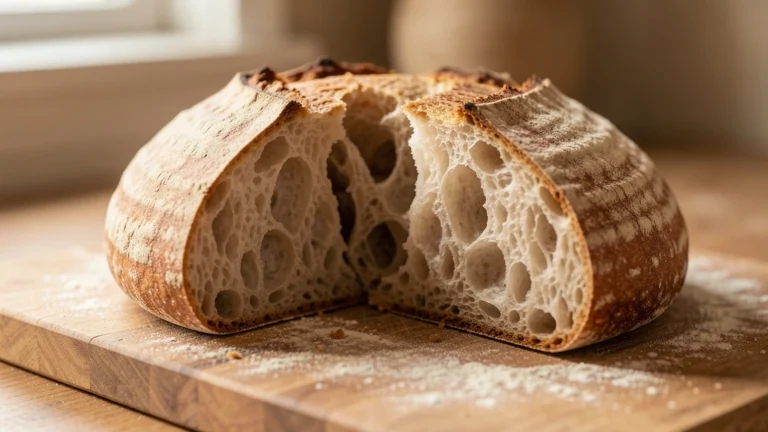
Water is what lets the crumb open up. More water means a slacker, stickier dough, and steam trapped in a wetter dough blows larger holes during the bake. That is the prized open crumb of a good ciabatta or a rustic country loaf.
But wetter dough is harder to handle. It spreads, it sticks, and it demands better shaping technique. Drier dough is firm, easy to knead, and holds a tidy shape, at the cost of a tighter, more uniform crumb. Neither is better. They suit different breads.
Hydration Ranges to Aim For
There is no single right number, only a right number for the bread you want. Use these ranges as a starting point, then adjust to your flour and your hands.
| Bread | Hydration | Character |
|---|---|---|
| Bagels, pretzels | 50 to 57% | Stiff, chewy, dense |
| Sandwich loaf | 60 to 68% | Even, soft crumb |
| Country sourdough | 68 to 78% | Open, rustic |
| Ciabatta, focaccia | 80 to 90% | Very open, wet |
The Sourdough Hydration Calculator takes your target hydration and starter, then gives you the precise amounts to weigh out.
FAQs About Sourdough Hydration
What Is Sourdough Hydration?
Hydration is the weight of water as a percentage of the flour weight. A dough with 700 grams of water and 1000 grams of flour is 70 percent hydration. It controls how wet the dough is and how open the crumb turns out.
What Does Baker’s Percentage Mean?
It is a way of writing a recipe where flour is always 100 percent and every other ingredient is a percentage of the flour weight. It makes recipes easy to scale and compare, which is why the numbers can add up past 100.
What Is a Good Hydration for Beginners?
Around 65 to 70 percent. That dough is wet enough for a nice crumb but firm enough to shape without frustration. You can raise the hydration as your handling improves.
Does Higher Hydration Make Better Bread?
Not better, just different. Higher hydration gives a more open, airy crumb but is harder to handle. Lower hydration gives a tighter crumb that is easier to shape. The right level depends on the bread you want.
Does the Starter Count Toward Hydration?
Yes. A starter is roughly half flour and half water, so its water and flour add to the totals. Accurate hydration math includes the starter, which is why a calculator helps.
How Do I Calculate Hydration Percentage?
Divide the total water weight by the total flour weight, then multiply by 100. Include the flour and water from your starter for an accurate figure.
Sources
References Used in This Article
This article is general baking education. Reviewed for accuracy by Prof. Dr. Khalil Mudassar, PhD. Last updated September 26, 2026.
Author

Shakeel Muzaffar is the Founder and Editor-in-Chief of MultiCalculators.com, bringing over 15 years of experience in digital publishing, product strategy, and online tool development. He leads the platform's editorial vision, ensuring every calculator meets strict standards for accuracy, usability, and real-world value. Shakeel personally oversees content quality, formula verification workflows, and the platform's commitment to publishing tools that are genuinely useful for students, professionals, and everyday users worldwide.