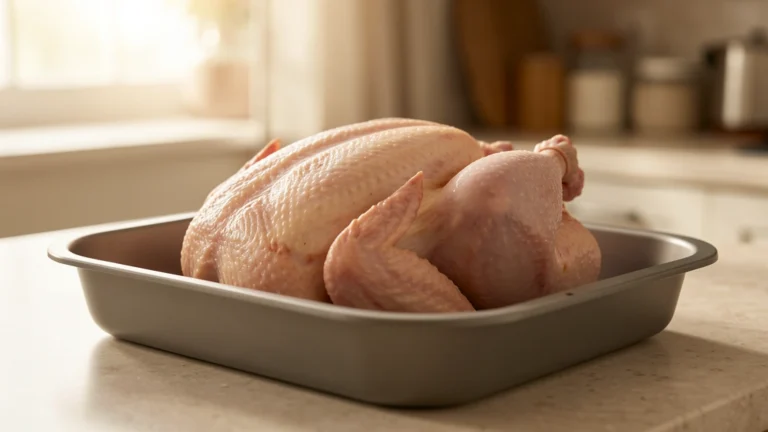
A whole turkey does not cook on a fixed clock. Roasting time scales with weight, oven temperature, and whether the bird holds stuffing. The only number that truly confirms a turkey is done is internal temperature, not a timer or a clock on the wall. This guide covers a general time-per-pound guideline for an unstuffed turkey at 325F, a reference table across common holiday weights, resting time, and thawing time, so the whole roasting plan fits together before the oven even turns on.
A whole turkey is safe to eat once its internal temperature reaches 165F (74C) in the thickest part of the thigh, without touching bone, per USDA guidance. As a general starting point, an unstuffed turkey roasts at roughly 13 to 15 minutes per pound at 325F. A 16-pound turkey lands in a range of about 3 hours 28 minutes to 4 hours. Always confirm doneness with a food thermometer rather than time alone, then rest the bird 20 to 30 minutes before carving.
What Is the Safe Internal Temperature for a Turkey?
A whole turkey is safe once it reaches 165F (74C) at its thickest part, according to USDA guidance for whole poultry. That spot is deep in the thigh, away from the bone, since bone conducts heat differently than meat and can give a false high reading.
This single number applies to the whole bird, including breast meat, thigh meat, and any stuffing packed inside the cavity. A thermometer reading below 165F anywhere in the thigh means the turkey needs more time in the oven, regardless of how the skin looks.
The sibling article on meat cooking times and temperatures covers the full picture of thermometer placement, carryover cooking, and why internal temperature beats color or time as a doneness test across all types of meat. This guide focuses specifically on turkey and does not repeat that explanation in depth.
Treat every number in this article as general reference guidance, not a personalized food-safety guarantee. Oven accuracy, bird shape, and starting temperature all shift the real result, so a thermometer reading always has the final say.
How Long Does a Turkey Take to Cook Per Pound?
An unstuffed turkey roasted at 325F commonly takes about 13 to 15 minutes per pound as a general starting-point range. This figure comes from widely published roasting guidelines and works as a planning estimate, not a guarantee tied to any specific oven or bird.
Multiply the bird’s weight by the low and high ends of that range to estimate a time window. A 14-pound turkey, for example, lands between 182 minutes (14 x 13) and 210 minutes (14 x 15), or roughly 3 hours 2 minutes to 3 hours 30 minutes.
Oven calibration varies more than most people expect, and a dial that reads 325F does not always match the oven’s real internal temperature. Treat the per-pound range as a starting point for checking the bird, not the moment to pull it out automatically.
A larger turkey needs proportionally less time per pound than a small one, because a bigger bird holds heat differently and its surface-to-mass ratio shrinks. That is one reason the reference table below does not scale in a perfectly straight line from the smallest weight to the largest.
How Long Does an Unstuffed Turkey Take by Weight?
The table below applies the 13-to-15-minute-per-pound guideline to four common holiday turkey weights. Every figure is a general starting-point range, always confirm doneness with a food thermometer reading 165F in the thigh.
| Weight | Minutes (13-15/lb) | Estimated Time Range |
|---|---|---|
| 12 lb | 156-180 min | About 2h 36m to 3h |
| 16 lb | 208-240 min | About 3h 28m to 4h |
| 20 lb | 260-300 min | About 4h 20m to 5h |
| 24 lb | 312-360 min | About 5h 12m to 6h |
A 16-pound turkey, the most common size for a mid-sized holiday gathering, needs roughly 3 hours 28 minutes at the low end and 4 hours at the high end. Start checking internal temperature around the low end of the range rather than waiting for the high end to arrive.
These ranges assume a fully thawed bird roasted at a steady 325F with the oven door staying shut most of the time. Opening the oven repeatedly lets heat escape and commonly pushes the real cooking time toward or past the high end of the range.
Does a Stuffed Turkey Need More Time?
A stuffed turkey generally needs more roasting time than an unstuffed bird of the same weight. Stuffing packed inside the cavity slows how quickly heat reaches the center of the bird, and the stuffing itself also needs to reach 165F for safety.
Exact extra minutes vary by how densely the stuffing is packed and the stuffing’s starting temperature, so this article does not state a fixed added-time figure as guaranteed fact. Treat a stuffed bird as running noticeably longer than the unstuffed ranges in the table above, and plan extra buffer time into a holiday schedule.
A food thermometer matters even more with a stuffed turkey, since both the thigh meat and the center of the stuffing need to reach a safe temperature before the bird comes out. Many cooks find it simpler to roast stuffing separately in its own dish, which shortens turkey time and removes one more spot that needs checking.
Loosely packed stuffing heats faster than densely packed stuffing, since air pockets let heat move through more evenly. Cold stuffing spooned in straight from the refrigerator also adds extra minutes compared with stuffing mixed at room temperature, another reason a fixed added-time number does not fit every kitchen.
A turkey roasted with stuffing inside also holds heat differently once it comes out of the oven, so checking the stuffing’s own temperature separately from the thigh remains a good habit through the entire cooking and resting process.
How Long Should a Turkey Rest After Roasting?
A turkey should rest about 20 to 30 minutes after coming out of the oven, tented loosely with foil. Resting lets juices redistribute through the meat instead of running out onto the carving board the moment a knife goes in.
Internal temperature keeps climbing a few degrees during this rest period, a normal effect known as carryover cooking. A turkey pulled right at 165F commonly reads a few degrees higher by the time resting finishes, which adds a small safety margin on top of the minimum.
Skipping the rest period does not make dinner unsafe on its own, since the bird already reached 165F before leaving the oven. Carving too soon mainly costs moisture and texture rather than safety, so the short wait pays off in a juicier plate.
How Long Does It Take to Thaw a Frozen Turkey?
A frozen turkey thawed in the refrigerator commonly needs about 24 hours for every 4 to 5 pounds of weight, as a general planning guideline. This is the safest thawing method, since it keeps the bird at a consistently cold temperature the whole time.
A 12-pound turkey needs roughly 2.5 to 3 days in the refrigerator. A 16-pound bird needs about 3 to 4 days, a 20-pound bird needs about 4 to 5 days, and a 24-pound bird needs about 5 to 6 days.
Counting backward from a planned dinner time avoids the last-minute scramble that a still-frozen turkey creates. A 20-pound turkey for a dinner on a Thursday, for instance, needs to move from freezer to refrigerator by the previous Saturday or Sunday to finish thawing safely.
A refrigerator-thawed turkey stays safe for an extra day or two once fully thawed, which gives a small buffer if the roasting schedule shifts. A cold-water thaw works faster, commonly about 30 minutes per pound with the water changed every 30 minutes, but it needs closer attention than the refrigerator method and the turkey must go straight into the oven once thawed.
Refreezing a thawed raw turkey is generally discouraged once it has fully thawed in the refrigerator, since repeated temperature swings affect texture and quality. Planning the thaw window a few days ahead of the holiday removes this problem entirely.
How Do You Scale the Rest of Your Menu Once the Turkey Time Is Set?
Once a turkey’s roasting window and rest time are locked in, the rest of a holiday menu still needs to scale to the actual guest count. No dedicated turkey-timer tool exists here, but the Recipe Scaler & Pantry Tracker at least helps scale every side dish, sauce, and dessert to match how many people the turkey itself is feeding.
Enter a recipe’s original serving count and a target headcount into the tool, and every ingredient amount adjusts together. That keeps side dishes proportional to the turkey size, instead of guessing quantities separately for each recipe on the table.
For a deeper look at scaling ingredients correctly, including which ones do not scale in a straight line, see the sibling guide on how to scale a recipe up or down.
Once the turkey’s timing is set, scale the rest of the holiday menu to match your guest count with the Recipe Scaler & Pantry Tracker.
FAQs About Turkey Cooking Time by Weight
Is a Turkey Done When Its Pop-Up Timer Pops Up?
A pop-up timer is not the same as a food thermometer and should not be the only doneness check. These built-in timers can trigger early or late depending on placement and manufacturing, so a real thermometer reading 165F in the thigh remains the reliable test.
Does a Stuffed Turkey Cook Faster or Slower Than an Unstuffed One?
A stuffed turkey cooks slower than an unstuffed bird of the same weight. Stuffing packed into the cavity slows how quickly heat reaches the center, and the stuffing itself also needs to reach 165F before the bird is safe to serve.
What If My Turkey’s Weight Falls Between Two Rows in the Table?
Multiply the actual weight by 13 and by 15 minutes to get a custom range. An 18-pound turkey, for example, falls between 234 minutes (18 x 13) and 270 minutes (18 x 15), or roughly 3 hours 54 minutes to 4 hours 30 minutes.
What Mistake Do People Make When Checking Turkey Temperature?
The most common mistake is touching the thermometer tip to bone, which gives a falsely high reading. Insert the thermometer into the thickest part of the thigh, angled away from the bone, for an accurate result.
How Can the Recipe Scaler Help With Holiday Turkey Planning?
The Recipe Scaler & Pantry Tracker adjusts every side dish and dessert to match your guest count once the turkey size is set. Enter a recipe’s original servings and your target headcount, and every ingredient amount scales together automatically.
Does a Higher Oven Temperature Shorten the Time-Per-Pound Guideline?
A hotter oven generally shortens total roasting time, but 325F is the common reference point for the 13-to-15-minute-per-pound guideline used throughout this article. A different oven temperature changes the per-pound math, so always confirm doneness with a thermometer rather than the clock alone.
How Long Does a 20-Pound Turkey Take to Roast and Rest?
A 20-pound unstuffed turkey roasted at 325F takes about 4 hours 20 minutes to 5 hours (20 x 13 to 20 x 15 minutes), plus a 20-to-30-minute rest before carving. Confirm doneness at 165F in the thigh before pulling it from the oven.
Sources
Reference Sources Used in This Article
This article is general cooking education, not food-safety or professional culinary advice. Always use a food thermometer and follow your local health authority’s guidance for safe minimum cooking temperatures. Reviewed for accuracy by Prof. Dr. Khalil Mudassar, PhD. Last updated September 23, 2026.
Author

Shakeel Muzaffar is the Founder and Editor-in-Chief of MultiCalculators.com, bringing over 15 years of experience in digital publishing, product strategy, and online tool development. He leads the platform's editorial vision, ensuring every calculator meets strict standards for accuracy, usability, and real-world value. Shakeel personally oversees content quality, formula verification workflows, and the platform's commitment to publishing tools that are genuinely useful for students, professionals, and everyday users worldwide.